This story is from my new book “30 Philosophers: A New Look at Timeless Ideas.”
In the Roman Empire, there lived an extraordinary ruler who embodied the very concept of the philosopher-king as envisioned by Plato, in his seminal work, “The Republic.” This is that story.
Marcus Aurelius was born on April 26, 121 CE, in Rome. His father, Marcus Annius Verus, and his mother, Domitia Lucilla, were both from prominent and noble lineages. Tragedy struck early in the life of Marcus Aurelius when his biological father passed away in 124 CE, leaving him fatherless at the young age of three. As he grew up, fortune favored the young Marcus. The Roman Emperor Hadrian took notice of his potential and arranged for him to be adopted by his paternal relative, Lucius Aelius, who was then designated as Hadrian’s successor. Marcus was likely around 14 or 15 years old when he was adopted and put inline to potentially become emperor.
A few years later in early 138 CE, his adopted father Lucius Aelius died unexpectedly. The aged Hadrian knew he needed to stabilize the line of succession. He adopted Antoninus Pius as his son making him his new successor, under the condition that he adopt Marcus Aurelius and Lucius Verus (Aelius’s son). This arrangement ensured a stable line of succession.
Hadrian’s arrangement for Marcus to be adopted a second time made it clear to history that Hadrian wanted him to be among those considered to become emperor. This second adoption secured his place in the line of imperial succession. Marcus was about 17 years old at this time. His new-to-him adopted sister Faustina the Younger was around 11 years old. Hadrian passed away a few months later, and Antoninus Pius ascended to the throne.
Seven years later, in 145 CE, Marcus and his adopted sister Faustina get married; Marcus is about 24, Faustina about 18. Later, in 161 CE, their father Antoninus Pius died, Marcus Aurelius ascended to the throne as the new Roman Emperor. Demonstrating his commitment to fairness and shared responsibility, he named his adoptive brother, the biological son of his first adopted father, Lucius Verus, as his co-emperor. This arrangement continued for about eight years until Lucius Verus’ death from a sudden illness, possibly food poisoning or the plague, after which Marcus Aurelius ruled the empire alone, but legend says his wife Faustina played a significant role in courtly life. She was well-respected, and their marriage was marked by mutual respect and loyalty.
The empire he governed was immense, spanning much of the known world. Yet, even amid the enormity of his responsibilities, he never lost sight of his humanity. He knew he was but one person, no different from the multitude of individuals who called the Roman Empire their home.
As a leader, he endeavored to embody the qualities of the philosopher-king. He was constantly aware of the impact of his decisions on the lives of others. In doing so, he earned not only the admiration of his people but also the reverence of history. In about 170 CE, he wrote in Greek in Book 10, Section 16, about his own character:
“Waste no more time arguing about what a good man should be. Be one.”
Throughout his life, he sought refuge in the sanctuary of his thoughts, contemplating the interconnectedness of all and the importance of reason for a purposeful existence.
By this time, the codex—a precursor to the modern book—had begun to replace the scroll as the primary form of recording text. Scrolls, like “giant snakes of text,” were cumbersome to read and transport. The codex, on the other hand, was more reader-friendly and portable, thanks to its stackable “book” format. The wealthy frequently possessed private libraries of books. Marcus’ emperor library was vast and included texts on philosophy, rhetoric, history, and poetry. Literacy rates were still low, so the possession of even a small family library was a sign of status and education.
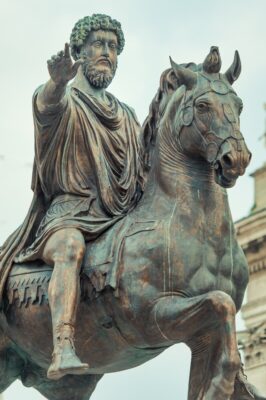
As a Roman, Latin was Marcus’s native language, but he was also fluent in Greek—the mark of the well-educated. The language of philosophy and high culture during this era was Greek.
In his tranquil moments, Marcus Aurelius found solace in the introspective act of writing. He penned his personal reflections in notebooks. These notes were a collection of insights he would revisit and contemplate. It was not until centuries later, in the 16th century, that these scattered writings were gathered, organized, and published as the “Meditations” we know today. This profound work has endured the test of time and is read widely today.
Power often breeds corruption, but Marcus Aurelius emerged as a beacon of hope, a ruler who remained humble and resolute. Although Plato’s vision of philosopher-kings remains a compelling idea, history has shown that it is an elusive and challenging endeavor, making Marcus a truly exceptional figure.
The Personal Philosophy of Marcus Aurelius
Your worldview is comprised of your personal language, religion, and philosophy. Like everyone, Marcus Aurelius had a worldview too, including his own flavor of Stoicism. While he adhered to the traditional principles, his version incorporated some elements that set it apart. These twists on Stoicism are why he is my favorite philosopher.

The Last Years and Death of a Philosopher King
To tell the story of Marcus Aurelius’s last years, let’s start with the challenges he faced on the Roman frontier. The empire was engaged in the Marcomannic Wars near modern-day Germany, and he spent much of his time on campaign, dealing firsthand with battles. Amid these wars, the empire grappled with the devastating Antonine Plague. The name “Antonine” is derived from Aurelius’ family name.
But it wasn’t just external threats that Marcus had to manage. In 175 CE, the respected general Avidius Cassius declared himself emperor. This internal revolt was short-lived as Cassius was soon assassinated by his own troops, who then sent his severed head to Marcus. Exhibiting his Stoic principles, Marcus expressed regret at the death, wishing he could have pardoned him.
Away from the battlefield and politics, Marcus’s family life was complex. He and his wife, Faustina the Younger, had at least 13 children[1]. Tragically, most died young, but several would play significant roles in the Roman Empire’s future. Of the couple’s seven sons, only their son Commodus, whom Marcus named as co-emperor in 177 CE, would survive to succeed him.
Marcus Aurelius fell ill and succumbed to illness at the age of 58. He passed away on March 17, 180 CE, while on campaign in the area of modern-day Vienna, Austria. Upon death, his soul, according to Stoic beliefs, returned to the cosmic Logos. Stoics had a wide range of afterlife beliefs. Some thought souls returned entirely to a universal spirit known as Logos; others believed in a short-lived afterlife before the soul disappeared.
I’m sure some stoics believed all souls go to Hades, but based on his writing, not Marcus Aurelius. He saw death as a natural and inevitable process and did not believe in an afterlife or in any kind of individual existence for the soul after death. To him, death wasn’t something to fear or mourn—it was just a natural step in life’s journey.