The long fight against unchecked power.
Across cultures and centuries, the same warning reappears: concentrate power in one person, or even one group, and you plant the seeds of corruption and collapse. This living essay stitches together short passages from my book 30 Philosophers with commentary to sketch a simple truth with deep roots: free people do not want kings.
As America debates power without accountability, and citizens take to the streets to oppose creeping strongman politics, history offers clarity. We’ve seen this pattern before. Protests in favor of checking leaders emerges repeatedly across civilizations. We’ve learned, and relearned, why unchecked power is dangerous.
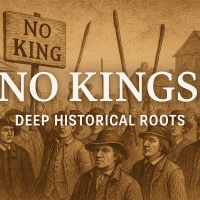
The Long Evolution of Power with Accountability
From ancient China to Enlightenment Europe, humanity has wrestled with the same problem: how to hold power accountable without losing stability. Our story begins in 500 BCE China, where Confucius and his disciples insisted that a ruler’s mandate was conditional: a bad king forfeits their right to rule.
It travels through Plato’s search for the impossible philosopher-king and Marcus Aurelius’s lonely attempt to live up to that ideal. It crosses the Atlantic to 1644, when Roger Williams planted the first true hedge between church and state. Then to Locke’s argument that even kings must answer to parliaments; to Voltaire’s defense of a free press; and finally to Montesquieu’s elegant architecture of checks and balances.
At every step, one truth emerges: civilization advances when power is divided, questioned, and made answerable.
500 BCE: No Sacred Mandate
Even when dressed in sacred language, rightful rule was never supposed to be limitless. The Mandate could be revoked. That’s the seed of no kings: legitimacy depends on just conduct, not personal loyalty or myth.
From Chapter 5 on Confucianism…
“In this time, the idea of the Mandate of Heaven ruled. It asserted that rulers held their positions with divine approval. This divine favor, however, was contingent on the ruler’s ability to govern. Should they falter, they would lose it, opening the door for another to seize power to restore balance.
This idea is not unique to ancient China; throughout world history, similar concepts have been invoked to legitimize the rule of kings and emperors. In medieval Europe, for example, the ‘Divine Right of Kings’ asserted that monarchs are chosen by God and not subject to earthly authority.”
Protest that is peaceful, persistent, and informed is how a free people signals that the mandate is being tested. In our moment, when some flirt with the comforts of a crowned strongman (whether they call it that or not), this older wisdom is a flashing caution light: power without checks drifts toward tyranny, often slowly, like the proverbial boiling frog, until it’s suddenly too late.
350 BCE: The Unreachable Ideal — The Philosopher King
(Plato’s Dream and Marcus Aurelius’s Lonely Reality)
If Confucius taught that a ruler’s mandate depends on virtue, Plato went one step further — he imagined a ruler made entirely of it.
In The Republic, Plato described the Philosopher King, an ideal leader guided not by ambition or wealth, but by wisdom and reason. He believed society could only flourish when governed by those who loved truth more than power.
From Chapter 8 on Plato
“Plato envisioned a world where the philosopher—one trained to see the Form of the Good—would rise above personal interest and rule for the benefit of all.
He argued that only those who understand justice itself are fit to administer it.”
It was a beautiful dream — and an impossible one. Plato’s republic demanded leaders untouched by ego, greed, or the need for praise. He sought perfection in a species built for imperfection.
Across history, rulers have borrowed his title but not his discipline. Kings crowned themselves with the illusion of wisdom; priests claimed divine insight; politicians posed as philosophers. Yet only once, perhaps, did the idea come close to life — in Marcus Aurelius, the Roman emperor who ruled two millennia ago with a Stoic heart and a philosopher’s restraint.
From Chapter 13 on Marcus Aurelius…
“Marcus Aurelius stands nearly alone in history—a man who held absolute power yet sought to master himself first. His writings in Meditations reveal a ruler fighting to live by reason, duty, and compassion.”
Even so, Aurelius’s story exposes the flaw in Plato’s dream: virtue cannot be institutionalized in one man. The moment power gathers in a single hand, even the philosopher risks becoming the tyrant he fears.
From this failure came the slow awakening that no ruler, no matter how wise, should rule unchecked. The age of the philosopher king gave way, at last, to the age of shared power—the long, unfinished journey from wisdom above all to liberty for all.
1644: Separation of Church and State
When the Puritan colonies in New England demanded unity of belief, Roger Williams offered something more radical: unity through freedom. His 1644 work, The Bloody Tenet of Persecution, challenged both crown and clergy alike.
From Chapter 23 on Roger Williams…
“More than a historical or religious treatise, The Bloody Tenet is a seminal work. It launched a full-throttle assault on the prevailing norms of religious and political intolerance that plagued both Old and New England.
Williams passionately argued for the separation of church and state, insisting that governments had no role in regulating thought or belief. One of Williams’ most evocative lines was the call for separation:
‘…a hedge or wall of separation between the Garden of the Church and the Wilderness of the world.’
This wasn’t merely a theological claim; it was a philosophical argument for individual liberty and freedom of conscience.”
Williams took aim not only at kings, but at the tyranny of conformity itself. His idea of a “wall of separation” was not a defense of faithlessness, but of freedom — the right to stand apart, to think freely without threat of punishment or exile.
Later in the chapter, in what he called the Two Tables, Williams divided human obligation into two realms: one spiritual, one civil.
“The first group is about one’s relationship with God — how to worship. The second is about how we should treat each other.
In a groundbreaking reinterpretation, Williams argued that the state should confine its jurisdiction to the second table. People have rights independent of both church and state. You have a right to your personal beliefs, and that personal right is more foundational than either institution.”
This was a revolution of conscience, an early blueprint for the American idea that no one, not even a government or majority, may rule your mind.
Williams didn’t just reject kings; he rejected mental monarchs. He saw that tyranny could wear many faces — a crown, a pulpit, or even a crowd. The hedge he described wasn’t just for churches; it was for the mind itself.
Tyranny is Short-Sighted Self-Interest
Williams recognized a recurring truth about power: tyranny only works for one group at a time. When church and state merge, it feels righteous only while your side holds the scepter. But history guarantees the wheel turns. The persecutor of one century becomes the persecuted in the next.
Also from chapter 23…
“It’s understandable that each Church wants to govern themselves. It’s when any one Church gains political power that difficulties begin… Those in power believed the state knew best for all, especially when it came to matters of religion. And essentially, if your personal beliefs aligned with the state-sanctioned religion, the merging of church and state appeared not only logical but beneficial.”
Williams saw the pattern clearly. Each faith, once ascendant, used power to protect its own truth—until another faith rose to do the same. Tyranny only works for one group at a time. What feels righteous today becomes oppressive tomorrow.
“As the tides of religious dominance shifted over time, those who once advocated for a state religion found themselves objecting when their beliefs fell out of favor. Williams was simply saying we need a rule to guide this ebb and flow, because the Church is not particularly well-suited for the role of ethical enforcement. Instead, he believed that ethical standards are best determined and upheld by the collective conscience of the people.”
That was his quiet revolution: he broke the cycle of moral opportunism. Williams argued that freedom of conscience is the only stable foundation for peace because it protects everyone, including those in power today who will, inevitably, be out of power tomorrow.
1689: Natural Rights Before Kings!
Within a few decades, a dangerous idea was spreading through Europe: that rights were not granted by rulers but born within us. This is the time of John Locke and the birth of modern freedom.
From Chapter 24 on John Locke…
“Locke, and others, will pick up the mantle for individual rights, and over the next century it will develop into a force powerful enough to take down kings.
This was nothing short of a revolutionary moment in the history of political philosophy.
Liberalism emphasizes personal freedom for all, individual rights, equality before the law, and limited government intervention.”
In a world still under monarchies, these words were dynamite. Locke’s belief that every human being was entitled to life, liberty, and property threatened to topple the very structure of divine rule. He wasn’t just theorizing; he was defying the throne.
Locke understood the danger.
“At times, the precarious political landscape under a King made his hairs stand in fear. He knew his subversive ideas made him vulnerable… While his advocating for individual liberties was one thing, his questioning of the divine right of kings could cost him his head.”
So he fled England for the Netherlands — a thinker in exile, defending reason from the reach of royal power. Yet even abroad, he kept writing, but anonymously. In 1689, his Two Treatises of Government appeared anonymously — a bold rebuttal to the idea that kings ruled by divine command.
“The first refutes the divine right of kings, and the second outlines natural rights… inherent rights that all people have simply by being human. They are not externally granted.”
Locke argued that because humans are born as blank slates, an idea he called tabula rasa, all begin equal in moral potential. From that foundation, he built the revolutionary claim that no one is born to rule, and no one is born to serve.
His natural rights included life, liberty, and property and it became the moral DNA of democracy. Every revolution since, from America to modern protest movements, carries traces of that code.
Locke’s core insight was disarmingly simple:
because we can think and reason, we can govern ourselves.
Because we can govern ourselves, no king can govern us by right.
And so, the cry of No Kings! took on new meaning. It became not just a political protest, but a declaration of nature. A statement about what it means to be human.
1718: The Rise of Free Speech
Voltaire and the voice of the Fourth Estate that would rise.
By the early 1700s, a new kind of revolution was brewing — not on battlefields, but in print shops and salons. With every pamphlet, essay, and satirical verse, ordinary citizens found a new weapon against kings: truth itself.
From Chapter 26 on Voltaire…
“The Fourth Estate extends the idea of three estates, which harkens back to ancient times, serving as a framework for societal division…
In Voltaire’s time, there were the Three Estates of the Realm that defined society: the clergy (First Estate), the nobility (Second Estate), and the commoners (Third Estate).
Voltaire, by using his sharp wit, audacious critiques, and widespread influence, broke down the walls of information controlled by these estates. His writings empowered the common populace to question authority, establishing the idea that a free press could check the balance of power.”
Voltaire’s pen did what swords could not — it pierced the illusion that kings and clergy alone held truth. His mockery of hypocrisy and tyranny transformed laughter into a democratic act. Every printed word became a spark, igniting the minds of those long kept in the dark.
Thus was born the Fourth Estate, the free press, a power outside of government that serves as both mirror and check.
The same spirit animates today’s journalists, whistleblowers, and truth-tellers who dare to publish what power prefers to hide.
The “NO KINGS” movement in every era depends on their courage, for speech without fear is freedom in its purest form.
1748: The Three Branches of Government
If Voltaire gave voice to liberty, Montesquieu gave it structure. In The Spirit of the Laws (1748), he mapped the architecture of freedom — a system where power restrains power.
From Chapter 24 on Montesquieu…
“Montesquieu argued that for the preservation of individual liberty and the prevention of tyranny, political power must be distributed among different branches of government: executive, legislative, and judicial.
This framework was grounded in the idea that human nature is easily corruptible and that concentrating power is dangerous. It embodies the philosophical idea of checks and balances, ensuring that no single authority goes unchecked.”
Williams had separated church from state.
Locke had separated the ruler from divine right.
And now Montesquieu separated government from itself.
He completed a trilogy of accountability — a triangle of restraint that became the backbone of the American Constitution three decades later.
Each branch would check the others, ensuring that the will of one group, or of one man, could never become absolute.
“The lesson taught endures: power must always be checked.”
That idea is not abstract. It’s alive every time citizens demand transparency, journalists question leaders, courts assert independence, or legislatures push back against executive overreach.
In essence, No Kings became the civic formula for enduring liberty.
The Long Road to No Kings
From Confucius to Montesquieu, one idea threads through the centuries:
unchecked power is the root of oppression.
Every great leap toward human freedom began with that recognition. The arch of liberty is clear, from the separation of church and state, to natural rights, free speech, and checks and balances.
Each reform chipped away at the throne, whether it stood in a palace, a pulpit, or the public square.
Today, as protesters take to the street and chant, they echo millennia of hard-won wisdom. Their cry is not just against one man or one movement, it’s a reaffirmation of a timeless truth:
Freedom endures only when power is divided, questioned, and answerable to the people.
So let the chant rise again, from parchment to protest sign, from philosopher to citizen:
NO KINGS! NO THRONES! NO CROWNS!
It is up to each of us to guard the endless pursuit of liberty.
It is up to us to defend freedom of conscience.
And it is up to us to summon the will and courage to keep freedom alive.