
Phil • Cr. Think • Science • Hist •
TST PRACTICE

The Philosophy Website

FAQ

What is the “Parable of the Ship?”

☐ Read
☑ Read
You’ve read this 0 times.
You’ve listened to this 0 times.
Wed 24 Dec 2025
Published 9 months ago.
Updated 4 days ago.
Related FAQs
What is Ontology and why is it important?
Can our perception of size and scale be trusted?
What is the TST Ethical Roadmap?
Debating History: Should We Say “Dark Ages” or “Middle Ages?”
Was Trump the worst president in history?
Do cats see humans as another cat?
Share :
Email
Print

What is the “Parable of the Ship?”

Buckle up! We’re about to embark on a fascinating journey through history. Roger Williams wrote his Parable of the Ship in 1655 to promote his groundbreaking idea for the separation of church and state.

Here it is in a nutshell…

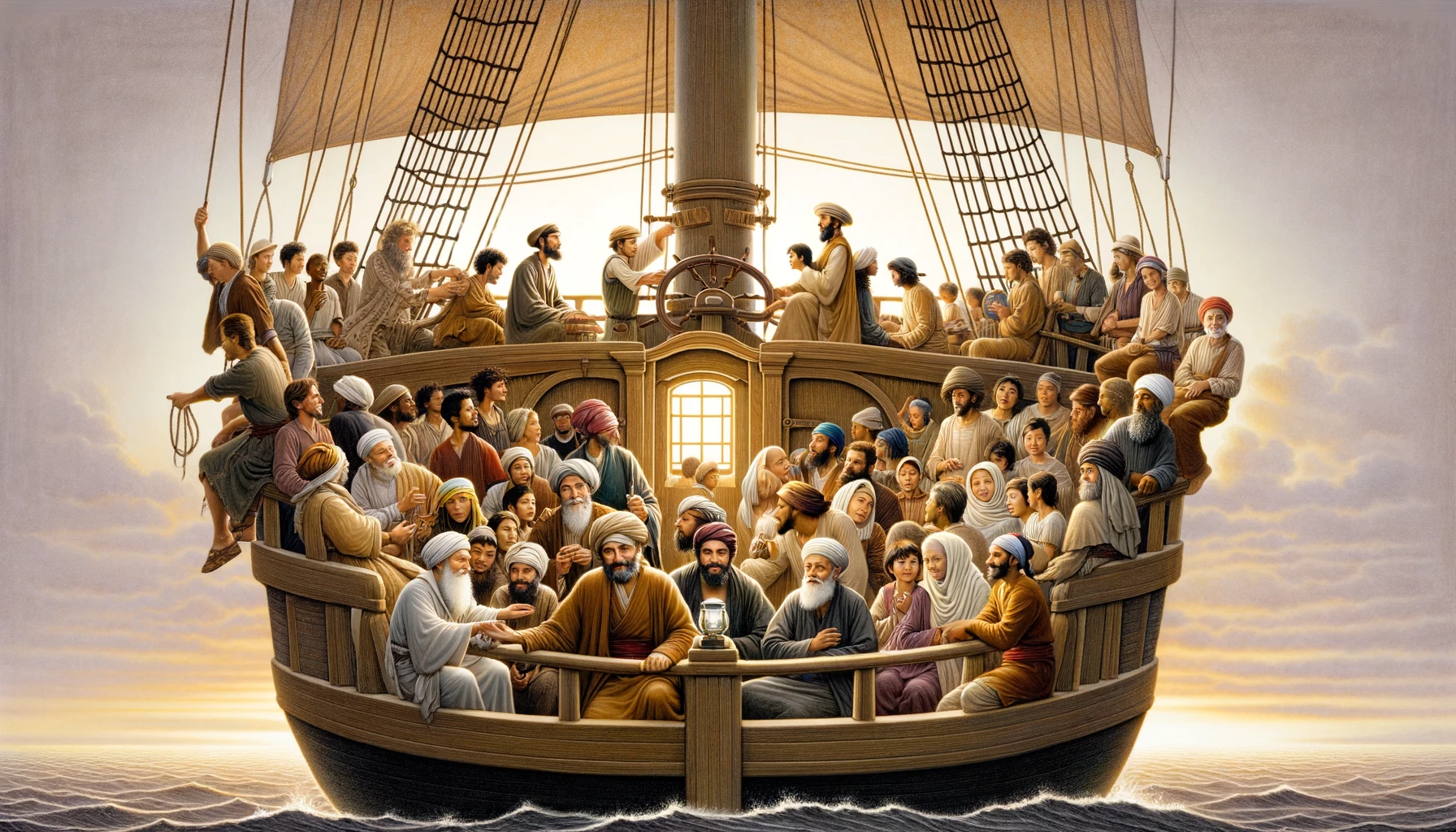
Imagine a rickety old ship, creaking its way across the ocean. Crammed on board are folks from all walks of life – Protestants saying grace, Catholics muttering Hail Marys, and a rabbi studying scripture by the light of a flickering lantern. This diverse crew is like a miniature society, and Williams, a sharp thinker aboard this metaphorical vessel, used it to sell his idea.

Back then, folks believed the captain, think government, should also be their religious leader. They figured everyone on board should sing the same hymns and follow the same religious practices. 

His Parable argued that forcing everyone to follow one religion was a recipe for mutiny. He proposed a system where the captain (the government) focuses on keeping the ship afloat – making sure everyone has enough food, the sails are in good order, and nobody goes overboard. As for religion? That’s a personal choice, like choosing your favorite sea shanty to sing while you swab the deck.

Fast-forward to the 18th century, the Founding Fathers included his idea as the very First Amendment. So, the next time you hear about the First Amendment, remember Roger Williams and his Parable of the Ship. It’s a reminder that a smooth-sailing society is one where everyone has the freedom to choose their own religious course, or no religious course, so long as they contribute to the common good and don’t rock the boat too much!
— map / TST —

TST Tracker
✓ Reading recorded.
Deep-Dive Article: Parable of the Ship by Roger Williams, 1655
Williams imagined society as a ship carrying people of many faiths. The captain can require behavior necessary to keep the ship safe and functioning, but should not dictate what passengers believe or how they worship. That distinction is the seed of modern pluralism: different worldviews, one shared civic space.
Michael Alan Prestwood
Author & Natural Philosopher
Prestwood writes on science-first philosophy, with particular attention to the convergence of disciplines. Drawing on his TST Framework, his work emphasizes rational inquiry grounded in empirical observation while engaging questions at the edges of established knowledge. With TouchstoneTruth positioned as a living touchstone, this work aims to contribute reliable, evolving analysis in an emerging AI era where the credibility of information is increasingly contested.
The Prestwood Column
Menu
September 2026
Column Research….
1. Timeline Story
Hume’s Is–Ought Problem
2. Linked Quote
“I meet with no proposition that is not connected with an ought, or an ought not.”
3. Science FAQ »
Can science prove flourishing should be our goal?
4. Philosophy FAQ »
What is the difference between a normative aim and a normative directive?
5. Critical Thinking FAQ »
Is flourishing for all just utilitarianism?
6. History FAQ!
What is the history of the idea of flourishing in philosophy?
Bonus Deep-Dive Article
TST Normative Ethics: Flourishing as a Philosophical Goal

Comments

Join the Conversation! Currently logged out.
NEW BOOK! NOW AVAILABLE!!

30 Philosophers: A New Look at Timeless Ideas

by Michael Alan Prestwood
The story of the history of our best ideas!
Scroll to Top