
Phil • Cr. Think • Science • Hist •
TST PRACTICE

The Philosophy Website

STORY

Plant Ancestors Split from Animal and Fungi Ancestors

☐ Read
☑ Read
You’ve read this 0 times.
You’ve listened to this 0 times.

By Michael Alan Prestwood

Sun 12 Sep 2021
Published 5 years ago.
Updated 4 months ago.
Related Stories
Archaea Diverge
Ordovician–Silurian Extinction: Ice Strikes the Seas
LECA: Likely Sexual Reproduction
Triassic–Jurassic Extinction: Volcanoes Open the Age of Dinosaurs
The K-Pg Extinction
Fungal Underground Alliance
Share :
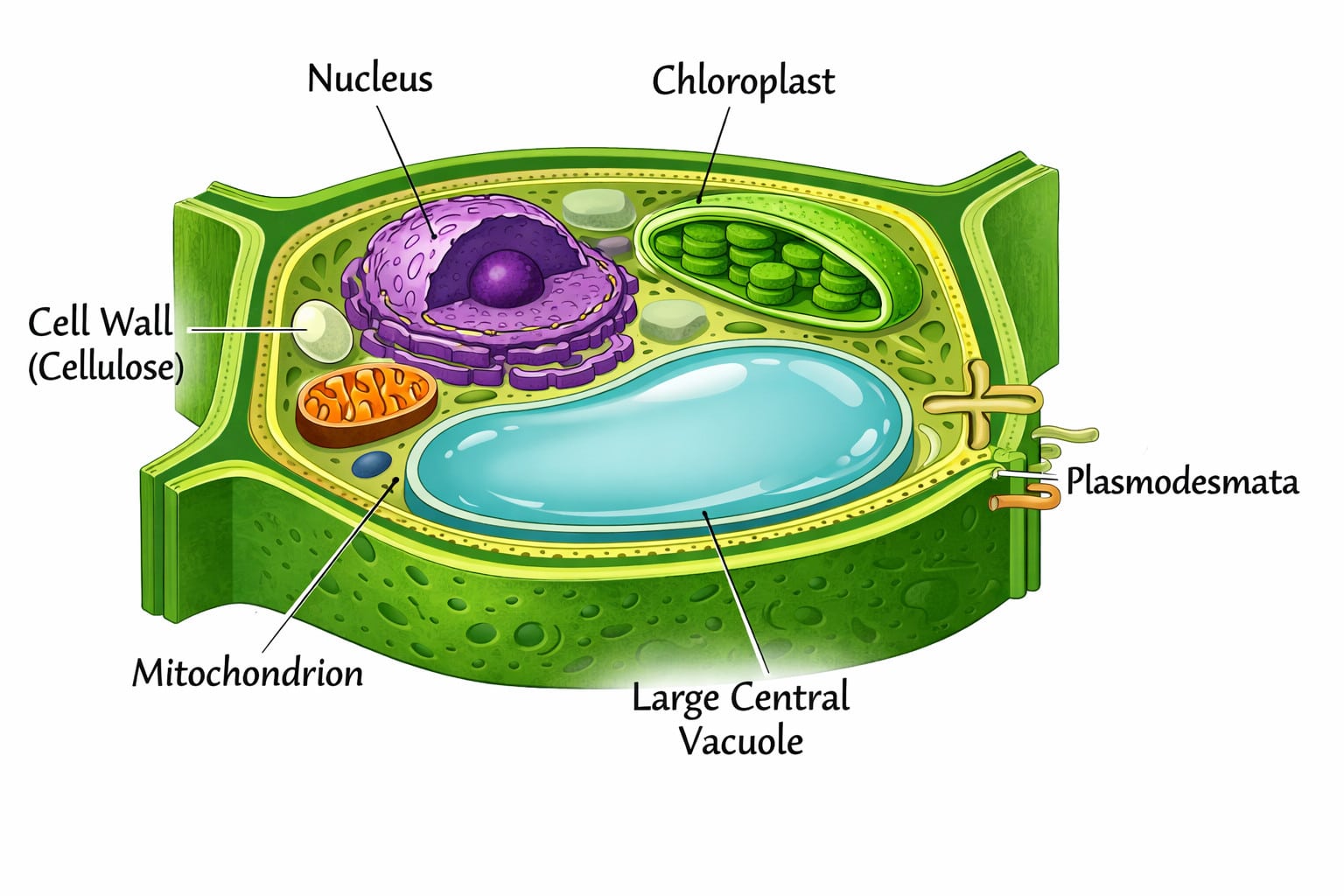
Plant cells feature chloroplasts, a cellulose cell wall, and a large central vacuole for holding water. They also have plasmodesmata, tiny channels between cells. And of course, photosynthetic chlorophyll.

Plant Ancestors Split from Animal and Fungi Ancestors

1.65 Billion Yeas Ago (+/- 50 million)
Life that later leads to these kingdoms separates.

Archaeplastida (Plant Lineage) Splits from Opisthokont Lineage. Around 1.65 billion years ago, a branch of protozoa, an advanced branch of the eukaryote cells, split into animals, plants, and fungi ancestors. These three separate lineages are the ancestors of modern plants, fungi and animals. 

These early branches were still microscopic and simple. Multicellularity did not appear immediately — but when cell adhesion and communication mechanisms evolved, it emerged repeatedly across different lineages, suggesting it is a powerful evolutionary strategy rather than a single destined outcome.

  • 1.7 billion years ago: Plants diverge from the common protozoa ancestor.
  • 1.5 billion years ago: Fungi and animal branch emerges.
  • 1.3 billion years ago: Fungi diverge from the common fungi-animal ancestor.

Later animals evolve into the animal kingdom which includes mammals, birds, reptiles, amphibians, fish, insects, crustaceans, arachnids, echiniderms, worms, mollusks, and sponges.

— map / TST —

TST Tracker
✓ Reading recorded.
Michael Alan Prestwood
Author & Natural Philosopher
Prestwood writes on science-first philosophy, with particular attention to the convergence of disciplines. Drawing on his TST Framework, his work emphasizes rational inquiry grounded in empirical observation while engaging questions at the edges of established knowledge. With TouchstoneTruth positioned as a living touchstone, this work aims to contribute reliable, evolving analysis in an emerging AI era where the credibility of information is increasingly contested.
Email
Print
The Prestwood Column
Menu
September 2026
Column Research….
1. Timeline Story
Hume’s Is–Ought Problem
2. Linked Quote
“I meet with no proposition that is not connected with an ought, or an ought not.”
3. Science FAQ »
Can science prove flourishing should be our goal?
4. Philosophy FAQ »
What is the difference between a normative aim and a normative directive?
5. Critical Thinking FAQ »
Is flourishing for all just utilitarianism?
6. History FAQ!
What is the history of the idea of flourishing in philosophy?
Bonus Deep-Dive Article
TST Normative Ethics: Flourishing as a Philosophical Goal

Comments

Join the Conversation! Currently logged out.

Leave a Reply

NEW BOOK! NOW AVAILABLE!!

30 Philosophers: A New Look at Timeless Ideas

by Michael Alan Prestwood
The story of the history of our best ideas!
Scroll to Top