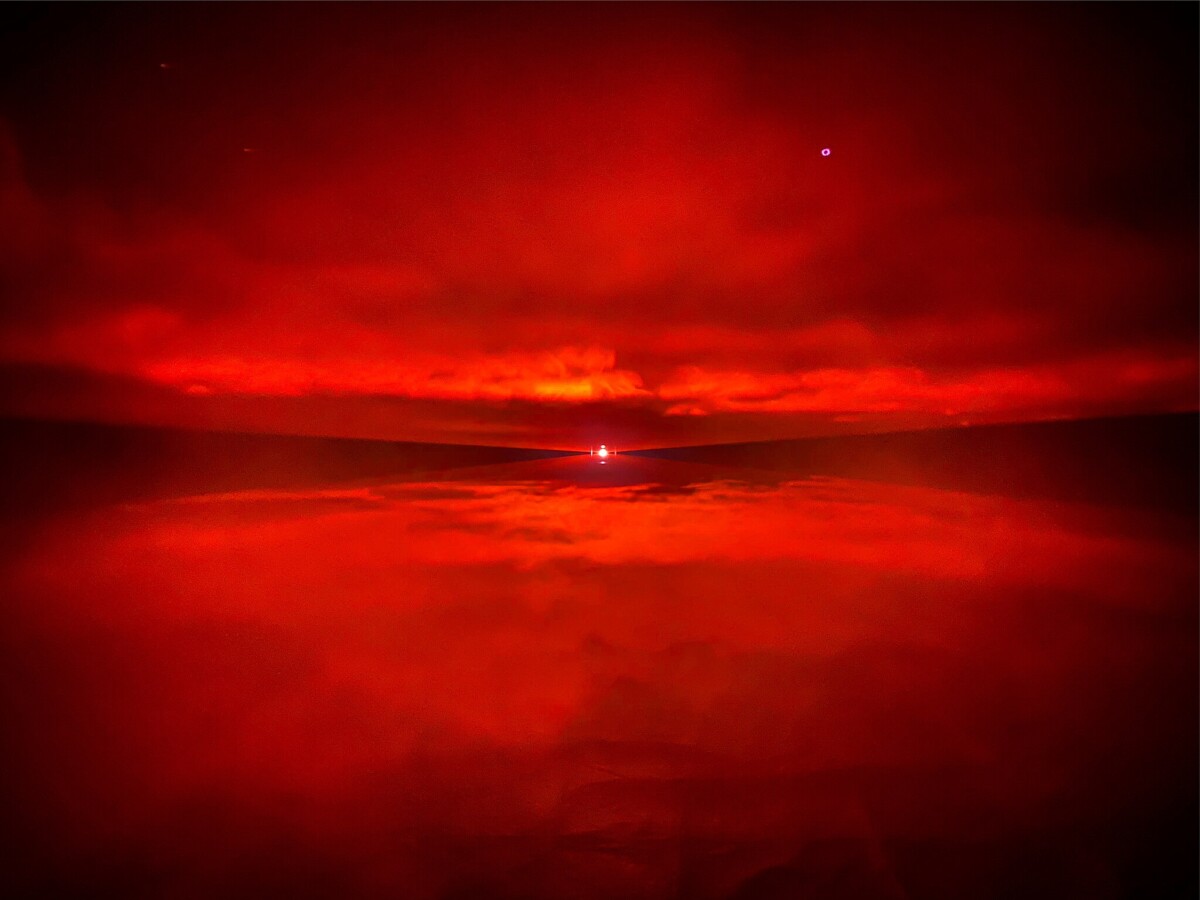
A 30 Philosophers touchstone: Chapter 1, “Origin Story.”
When we trace the expanding universe backward through the equations of general relativity, everything appears to converge toward an unimaginably hot, dense, and tiny state: the Big Bang singularity. It is often described as the beginning of space, time, matter, and energy — but this is where we must speak carefully.
The singularity is not something we have observed. It is what appears when our best-tested theory of gravity is pushed beyond the conditions where we know it works. At that extreme, density and temperature approach infinity, and the familiar laws of physics break down. In that sense, the singularity marks the edge of our current understanding.
Quantum mechanics whispers caution. The singularity may not be the universe packed into a tiny dot, but the edge of our current map. General relativity points to infinity; quantum physics suggests the first moment was stranger, deeper, and not yet fully understood.
Whatever truly happened at the beginning, the universe soon expanded and cooled, giving rise to space-time as we know it, the early fields of matter and energy, and eventually the laws and structures that shaped everything that followed. This moment stands at the boundary between science, mathematics, and mystery: not a finished explanation, but the doorway into the Big Bang story.
Yet even this origin moment remains an active area of investigation. The current best estimate — that the universe is about 13.8 billion years old — comes from careful measurements of the cosmic microwave background radiation and the rate of cosmic expansion. Still, this number is not set in stone. Some astronomers, looking at the brightness of very old stars or at how galaxies form in simulations, have suggested ages that could shift the timeline by hundreds of millions of years in either direction.
The debate arises because we are measuring the universe from within it, using the cosmic expansion as both a clock and a ruler. If the expansion rate, known as the Hubble constant, is even slightly different depending on the method of measurement, the implied age of the universe shifts too. Some results point to a universe a bit younger, around 12.5–13 billion years; others hint at a slightly older cosmos, closer to 14.5 billion years. This “Hubble tension” doesn’t overturn the Big Bang model, but it does remind us that science is a living process: our cosmic origin story continues to be refined as new data arrive.
A few speculative models have even suggested the universe might be far older than 13.8 billion years — closer to 20 or even 25 billion. These ideas, inspired partly by recent James Webb Space Telescope observations of surprisingly mature early galaxies, propose extensions to standard cosmology, such as varying physical constants or alternative explanations for redshift. While intriguing, these models remain highly speculative and face challenges when tested against the broad body of cosmological evidence, such as the cosmic microwave background and the observed abundances of light elements. Still, they serve as a reminder that science thrives on bold ideas and that our cosmic origin story is not yet complete.