
Explore Science-first Philosophy

STORY

Book: Christenings make not Christians

By Michael Alan Prestwood

Mon 4 Feb 2019
Published 7 years ago.
Updated 2 weeks ago.
Related Stories
15th Amendment
The Birth of Baroque Art
President of the Colony
Guru Nanak
4004 BCE, The Bible’s Earth Creation Date
Earliest Known Prepared Burial, “Mtoto”
Share :
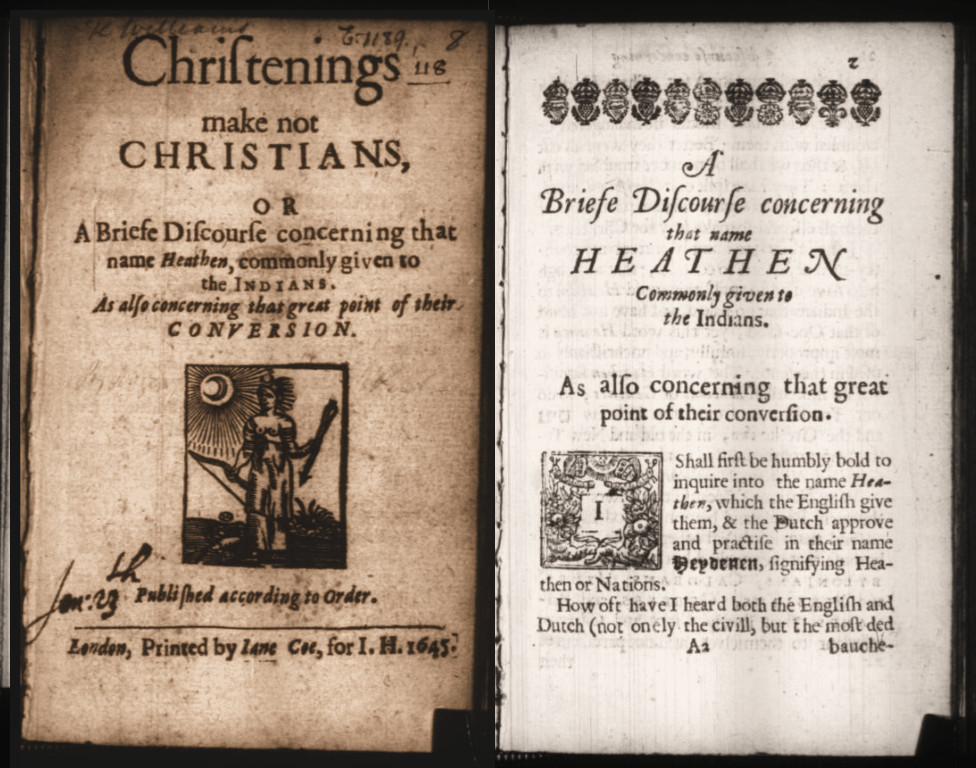
Roger Williams takes issue with the labeling of Native Americans as “heathens.” He argues against such prejudice terminology.

Book: Christenings make not Christians

1654

Not only did Roger Williams write one of the first major English studies of the local Native Americans, he also defended them in ways that were centuries ahead of his time.

In 1645, Williams published this small book, only about 25 pages long, under the fuller title Christenings Make Not Christians, or A Briefe Discourse concerning that name Heathen, commonly given to the Indians. The book was printed in London in 1645.

In it, Williams challenged the way English and Dutch colonists used the word “heathen” for Native Americans. He understood that the word was not being used merely as a neutral term for non-Christians. It was often used as a weapon: a label that made Indigenous people sound lesser, savage, disposable, or outside the circle of moral concern.

That is what makes the book so important. Williams was not simply debating vocabulary. He was exposing a category error with moral consequences. A label can seem harmless, but once a group is reduced to a demeaning category, cruelty becomes easier to justify. In philosophical terms, the word “heathen” had become more than a description. It had become a distorted idea inside a worldview.

Williams pushed back. He argued that Native Americans should not be dismissed or dehumanized by careless religious labeling. Whatever theological differences existed, they were still human beings deserving fairness, dignity, and moral concern. That was a radical position in a colonial world eager to convert, control, and sometimes destroy.

This is where Williams still matters. He reminds us that religion can give meaning, but reality gives common ground. If a religious word is used to deny another person’s humanity, the problem is no longer only theological. It has become ethical. TST asks us to slow down and sort the claim: Is this a fair description, or is it a label doing hidden harm?

In that sense, Christenings Make Not Christians is not just an old religious pamphlet. It is an early American lesson in language, belief, and moral clarity. Williams saw that bad labels can become bad thinking, and bad thinking can become bad treatment. Four centuries later, that lesson still has teeth.

— map / TST —

Michael Alan Prestwood
Author & Natural Philosopher
Prestwood writes on science-first philosophy, with particular attention to the convergence of disciplines. Drawing on his TST Framework, his work emphasizes rational inquiry grounded in empirical observation while engaging questions at the edges of established knowledge. With TouchstoneTruth positioned as a living touchstone, this work aims to contribute reliable, evolving analysis in an emerging AI era where the credibility of information is increasingly contested.
Email
Print
This month @ TST
Column Menu
May 2026
»COLUMN ARCHIVE
--COLUMN--
Column Research….
1. Timeline Story
Book: The Idea of History
2. Linked Quote
“The historian without his facts is rootless…the facts without their historian are…meaningless.”
3. Science FAQ »
Is science tainted by bias?
4. Philosophy FAQ »
Debating History: Should We Say “Dark Ages” or “Middle Ages?”
5. Critical Thinking FAQ »
What is the preservation bias?
6. History FAQ!
Did Einstein’s driver really give one of his early talks?
Bonus Deep-Dive Article
TST Philosophy of History

Comments

Join the Conversation! Currently logged out.

Leave a Reply

NEW BOOK! NOW AVAILABLE!!

30 Philosophers: A New Look at Timeless Ideas

by Michael Alan Prestwood
The story of the history of our best ideas!
Scroll to Top