

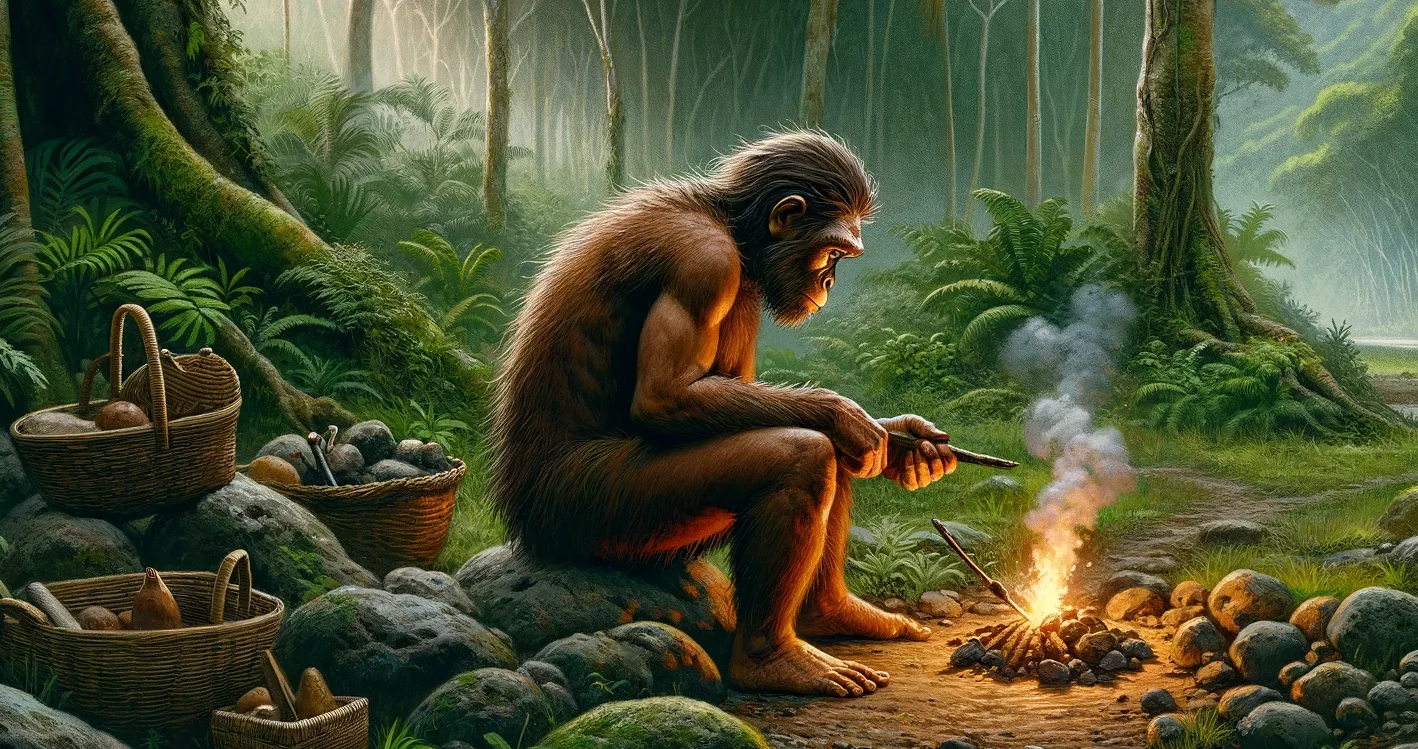
Homo erectus first emerged nearly 2 million years ago—and then they just… endured. Not as a brief evolutionary experiment, but as a long-running way of being human: upright, toolmaking, adaptable, and stubbornly successful across huge spans of time and geography.
Their existence is a near-miss with us. The last known Homo erectus population was in Java, and it faded out by 108,000 years ago. Modern humans (Homo sapiens) are thought to have reached Southeast Asia by around 70,000 years ago.
But…Imagine if we had arrived earlier while they were still there. They wouldn’t be “cavemen” in the cartoon sense. They’d be people with hands trained by stone, minds shaped by survival, and bodies built tough for a long, demanding world. Not beasts. Not modern. Just… another kind of human, carrying a million-year legacy right up to the edge of our own story. They were pretty smart too—not like us, but smart in the way survival demands. They likely communicated with complex gestures, signals, and shared routines, and it’s not crazy to imagine proto-language: structured sounds or calls that carried meaning beyond raw emotion. Not poetry. Not debates. But coordination, warning, teaching, planning. They likely used fire when they could—kept it going, carried it, protected it—because on an island, a flame is more than comfort. It’s light, safety, cooked food, and time stretched into the night.
Update note: A major re-dating of the Ngandong site published Dec 18, 2019 (Nature; 2020 print issue) places the last known Homo erectus at 117,000–108,000 years ago, which is why most current summaries no longer treat ~50k as viable for Java.
Imagined image above (unchanged vibe, updated context): A late-stage Homo erectus individual in Java, Indonesia—sapiens-like base with more robust, archaic features—shaping volcanic stone beside a small tended fire on a damp rainforest floor, canopy light cutting through the green.

