
Phil • Cr. Think • Science • Hist • …
TST PRACTICE

By Philosopher Michael Alan Prestwood

STORY

Thales of Miletus

☐ Read
☑ Read
You’ve read this 0 times.
You’ve listened to this 0 times.

By PrestwoodIT

Sun 20 Feb 2022
Published 5 years ago.
Updated 1 week ago.
Related Stories
Oracle Bone Script: China
Philo of Alexandria
Pythagoras (570-495 BCE)
Proto-Olmec People
Minoan Frescoes at Knossos
The Idea of Ideas
Share :

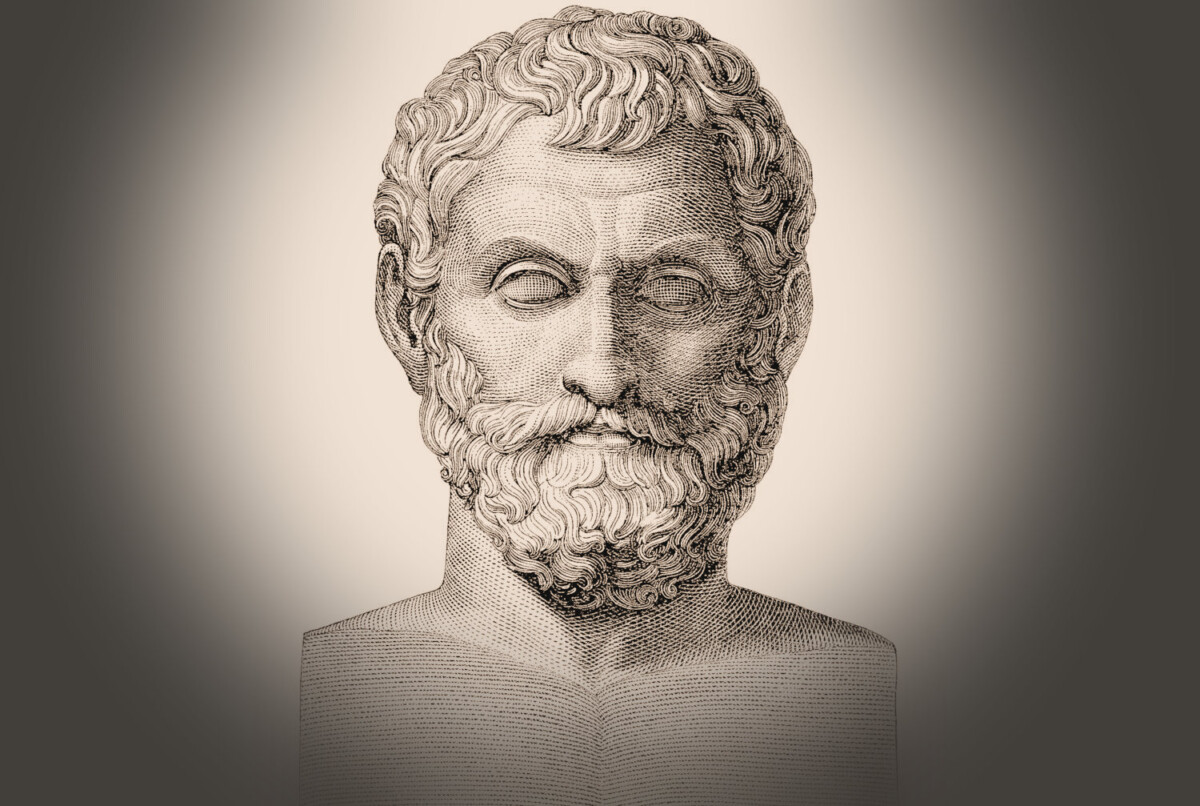
Thales of Miletus

Early or "First" Science
Born about 624 BCE, died about 546 BCE, at around age 78.

Thales of Miletus was a Greek philosopher, mathematician, and astronomer. Considered by many including Aristotle to be the first philosopher in the Greek tradition. He is also considered the father of science by many and I sometimes refer to him as the grandfather of Western Philosophy.

Picture the busy port city of Miletus around 600 BCE: ships arriving from distant lands, merchants, sailors, and people were still explaining the natural world through mythology. Into that world came a thinker asking a different kind of question:

What if nature has natural explanations?

That shift is why Thales is still remembered more than 2,500 years later. At the time, the prevailing explanations of storms, earthquakes, life, and the structure of the world were the actions of gods. He changed that and that is scientific in nature. Hence, father of science. He looked for natural causes. He famously proposed that water was the underlying substance, or first principle, behind everything. That idea was wrong, but the method behind it was profound. He looked at the world around him; he noticed patterns; he tried to explain one part of nature with another part of nature. In modern terms, he was asking whether what we see might emerge from something more fundamental.

His works were lost over the centuries, but we know Thales through later writers. About two centuries later, Aristotle looked back on him as the beginning of the Greek tradition: the search for the underlying causes and principles of nature. Aristotle specifically recording his claim that water was the first principle. Later ancient writers continued to place him among Greece’s earliest sages. His lasting importance is not that he gave us the right answers. It is that he helped point Western thought toward a new way of finding them.

Some of my favorite roughly translated sayings from an old language in an old time are:

  • What is difficult? To know thyself.
  • What is easy?  To give advice to another
  • Necessity is the strongest, for it masters all.
  • Many words do not declare an understanding heart. Seek one sole wisdom. Choose one sole good.

— map / TST —

TST Tracker
✓ Reading recorded.

Annotated References:

  • Aristotle, Metaphysics, Book I. Writing roughly two centuries after Thales, Aristotle identifies him as an early founder of Greek natural philosophy and records his view that water was the underlying principle of things. Aristotle also speculates that Thales may have been influenced by observations of moisture, nourishment, and generation.
  • Stanford Encyclopedia of Philosophy, “Presocratic Philosophy.” A scholarly overview of Thales and the other early Greek thinkers. It explains the difficulties involved in reconstructing Thales centuries after his life and discusses Aristotle’s interpretation of water as Thales’ archē, or fundamental principle.
  • Pseudo-Plutarch, Placita Philosophorum, Book I. A later ancient account preserving the tradition that Thales regarded water as the principle from which things arise. Useful as evidence for how Thales continued to be remembered and interpreted in the ancient philosophical tradition.
  • Diogenes Laërtius, Lives of the Eminent Philosophers, Book I. One of the major surviving ancient collections of stories and sayings associated with Thales and the Seven Sages. Written many centuries after Thales, it is best used cautiously for traditional sayings such as “Know thyself” and other remarks attributed to him rather than as a contemporary record.
  • Prestwood. 30 Philosophers. Provides the interpretive framework used here: Thales is important less because he possessed modern scientific knowledge than because he represents an early move toward explaining nature through observation and natural causes. The book places him within the larger transition from myth-centered explanations toward philosophy and eventually science.TouchstoneTruth.com.
Michael Alan Prestwood
Author & Natural Philosopher
Prestwood writes on science-first philosophy, with particular attention to the convergence of disciplines. Drawing on his TST Framework, his work emphasizes rational inquiry grounded in empirical observation while engaging questions at the edges of established knowledge. With TouchstoneTruth positioned as a living touchstone, this work aims to contribute reliable, evolving analysis in an emerging AI era where the credibility of information is increasingly contested.
Email
Print
The Prestwood Column
Menu
October 2026
Column Research….
1. Timeline Story
The Great Quaker Debates!
2. Linked Quote
“All men are prone to differ. It is no new thing in all former ages, in all parts. Each party is most right in his own eyes.”
3. Science FAQ »
Do facts actually change minds?
4. Philosophy FAQ »
When does persuasion become manipulation?
5. Critical Thinking FAQ »
How can you tell when a debate has stopped being productive?
6. History FAQ!
What is the history of debate?
Bonus Deep-Dive Article
Roger Williams Biography and Dedication to the Freedom of Conscience

Comments

Join the Conversation! Currently logged out.

Leave a Reply

NEW BOOK! NOW AVAILABLE!!

30 Philosophers: A New Look at Timeless Ideas

by Michael Alan Prestwood
The story of the history of our best ideas!
Scroll to Top