
Explore Science-first Philosophy

STORY

Prokaryotic Life

By Michael Alan Prestwood

Sun 31 Mar 2024
Published 2 years ago.
Updated 1 month ago.
Related Stories
Morganucodon: An Early Mammalian
The Last Stegosaurus: Wuerhosaurus
Animal Vocabulary: Thousands of Words (The Great Apes)
Snowball Earth: When Ice Reached the Equator
LECA: Likely Sexual Reproduction
Hyphae break rock
Share :
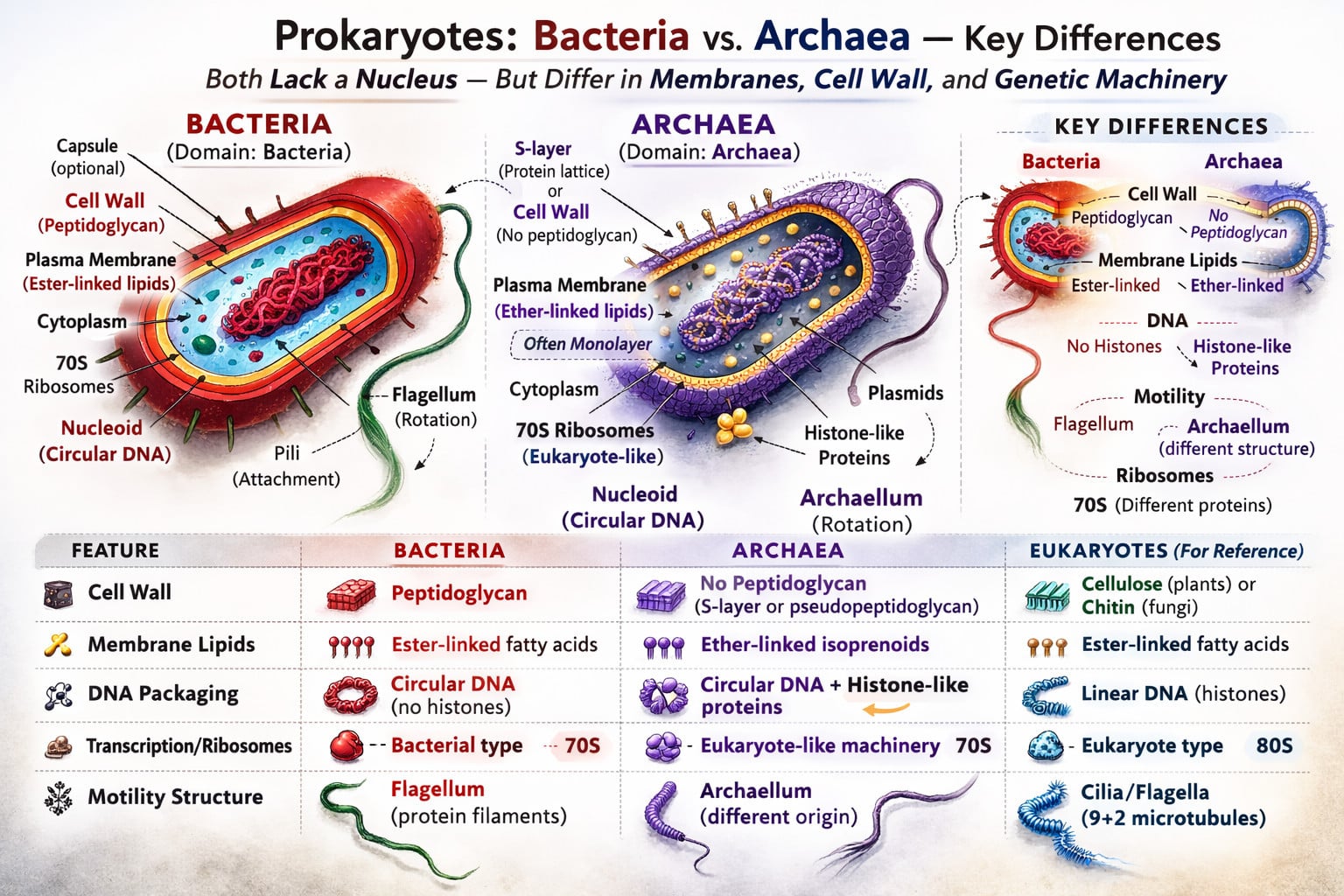
Archaea look like bacteria at first glance — small, simple, and lacking a nucleus. But they are fundamentally different.

Prokaryotic Life

3.73 Billion Years Ago (after LUCA)
Membrane and metabolic diversity.

First Prokaryotes: They evolved from replicating molecules and before LUCA (also a prokaryote). Prokaryotes lack a nucleus and organelles. Although research continues identifying when the first true prokaryotes evolved, it is believed they evolved sometime between 3.8 to 4 billion years ago. While the earliest prokaryotes are part of our direct-line ancestors, today we know their descendants as bacteria and archaea. Bacteria is part of our common knowledge, but archaea are mostly known to microbiologists because they mainly live in extreme temperatures. Interestingly, viruses are neither these prokaryotes nor later eukaryotes. They are a holdover from before prokaryotes and are not considered life.

  • Domain: Pre-Domain or none > Kingdom: not applicable

— map / TST —

Michael Alan Prestwood
Author & Natural Philosopher
Prestwood writes on science-first philosophy, with particular attention to the convergence of disciplines. Drawing on his TST Framework, his work emphasizes rational inquiry grounded in empirical observation while engaging questions at the edges of established knowledge. With TouchstoneTruth positioned as a living touchstone, this work aims to contribute reliable, evolving analysis in an emerging AI era where the credibility of information is increasingly contested.
Email
Print
This Week @ TST
April 8, 2026
»Column Archive
WWB Research….
1. Story of the Week
Pragmatism
2. Quote of the Week
“Our statements about the external world face the tribunal of sense experience not individually, but only as a corporate body.”
3. Science FAQ »
Why do scientific models work if they aren’t literally true?
4. Philosophy FAQ »
Is agnosticism a ludicrous position to occupy?
5. Critical Thinking FAQ »
Do my people and culture help or harm my critical thinking?
6. History FAQ!
Did Berger and Luckmann really say reality is just made up?
Bonus Deep-Dive Article
TST Doxastic Formation: Public Belief, Tribe, and Worldview
Scroll to Top