

In our everyday lives, time governs everything from when we wake up to how we schedule meetings. But what is time, really? Philosophically, time can be viewed as a social construct, an agreed-upon system that, while not aligning perfectly with the natural phenomena it aims to measure, serves crucial functions in societal organization and coordination. This conceptualization of time as a construct challenges us to think about the ways in which something so intangible shapes our concrete realities. The notion becomes particularly intriguing when we examine historical changes in timekeeping, such as those during Colonial America, where the very structure of the calendar was a matter of both practical concern and cultural significance. By exploring how dates, holidays, and calendars were established and altered, we delve into the profound impacts these constructs have on our understanding of history and on the rhythm of daily life.
English Double Dates
Before 1752 the first day of the year was 25 March. So, days of the year that fell from Jan 1 – Mar 24 were notated using the previous year, or double dating. So, the double date Jan 1, 1600/1 matches our Jan 1 in the year 1601. You might see (O.S.) for old style, or (N.S.) for new style added.
Bottom Line: When you see a double date notation such as Jan 1, 1750/1, it’s an overlapping start of the year. Just remember the later date matches our modern use of starting the year with January.
In particular, you’ll see English double dates used from 1582-1752 in England, Wales, and English colonies such as America. The cause of double dates is because of the transition from the Julian calendar (new year is March 25) to the Gregorian calendar (new year is January 1). Many Catholic countries switched over in 1582 and started using double dates through 1752 on legal documents. Other countries did so at different times. For example, Russia only did so in 1918.
If you work with budgets in business, you might be able to relate to John Winthrop’s time during this period of each year. In modern business, a “fiscal year” is sometimes different than the calendar year. If your fiscal year starts on April 1, and it’s December, your day-to-day thinking is that it’s the end of the calendar year, and we’re about to enter the 4th quarter of the fiscal year.
English Chesterfield Act
In 1752, England fully switched to the Gregorian calendar. The new legal year began on January 1st rather than March 25th, and we lost 11 days–Wednesday September 2nd was followed by Thursday September 14th. In my date analysis below, I add back in these 11 days for comparison to other dates around the world. It has the added benefit of helping me think about the year in terms of our common daily life. For example, Roger Williams arrived on February 5, 1631, but if you apply our calendar, it’s equivalent to February 15th. Tradition says you use the date in use at the time. After all, if you asked Roger Williams what day he arrived, he would have said February 5th, 1630/1.
To conform, it implemented the following changes:
- The new legal year began on January 1st rather than March 25th.
- Wednesday 2 September 1752 was followed by Thursday 14 September 1752–we lost 11 days!
As a result:
- 1751 was our shortest year of only 282 days (March 25, 1751 through December 31, 1751).
- 1752 was a short year of only 355 days (Wednesday, September 2 was followed by Thursday, September 14).
- The dates from 3 Sep 1752 through 13 Sep 1752 DO NOT EXIST!
In general, you should use reference dates in use at the time. These changes really only affect calculations of duration such as one’s exact age at a particular event like death.
Quarter Days
The four quarter days in England, Wales, and the colonies were:
- Lady Day (25th March),
- Midsummer Day (24th June, the Feast of St John the Baptist),
- Michaelmas Day (29th September, the Feast of St Michael and all Angels)
- and Christmas Day(25th December).
Keeping Time
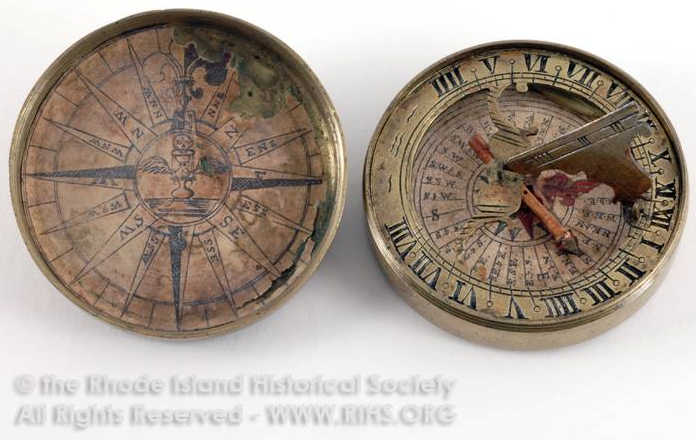
Pocket watches were manufactured for the wealthy as early as 1524. Prior to that, the wealthy might own a clock-watch which was too big to put in a pocket so you might wear it on a chain around your neck, or have a coat pocket to hold the large timepiece. Clock-watches, or Nuremberg eggs, were a luxury item starting about 1510.
In Colonial America, the wealthy might own a pocket watch–perhaps a governor and the like. One might own a combination compass plus sundial. If a poor person owned a pocket watch, it usually meant it was either a passed down family heirloom, or it was stolen. Theft of pocket watches was a common problem during this time.
Old English
The following list of outdated words and phrases were common in colonial times.
- Fortnight – A fortnight is fourteen nights, or two weeks. A literal shortening of fourteen nights.
As we’ve seen, the calendars and timekeeping methods of Colonial America were more than mere practicalities; they were profound reflections of the social, political, and cultural currents of the era. Understanding these historical nuances not only enlightens us about the past but also offers a mirror to our present-day engagements with time. It compels us to question how our current constructs might be influencing our perception of reality and our interactions within it. Just as the switch from the Julian to the Gregorian calendar marked a significant shift in societal rhythms and historical recording, our own methods of measuring and valuing time continue to shape our world in fundamental ways. This exploration is not just about historical facts but about understanding the deeper philosophical questions that such facts raise about the nature of reality and our place within it.

