

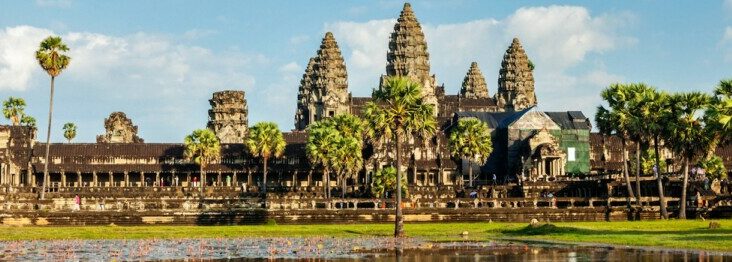
I’ve never been to Angkor Wat, but I think about it in context of the “Dark Ages” debate. In Cambodia, Angkor Wat’s transition from a Hindu to a Buddhist temple mirrors the wider religious and cultural shifts taking place around the globe. Today, its surviving Hindu carvings and later Buddhist additions, stand as a testament to shifting traditions and religious continuity.
Cambodia is south of China, kind of on the way to Australia, but still on the mainland. Angkor Wat was built around 1115 CE. This is during the High Middle Ages: around the time of the Crusades and roughly a century before Thomas Aquinas. Although its original name is currently lost to history, it became known as Angkor Wat, or simply “City Temple.” By 1431, Angkor lost power. It was around this time that it became a major Buddhist temple and pilgrimage.
The wider area of Cambodia, Thailand, Vietnam, and Laos has an interesting and common evolution of traditions. Before organized church states, it was like most places, a wilderness of spiritual ideas. By the Middle Ages, governments of all types, all around the world, started “enforcing” their one story. Some subtle, some harsh, all in an effort to control. So, for me, the Dark Ages is not a European thing; it is the rise of organized religious control around their one story. So, when you think of Angkor Wat, think about how traditions evolve and spread. Think about how power seeks to control people. Think about the value of the separation of church and state.

