
Phil • Cr. Think • Science • Hist •
TST PRACTICE

The Philosophy Website

STORY

Earliest Known Prepared Burial, “Mtoto”

☐ Read
☑ Read
You’ve read this 0 times.
You’ve listened to this 0 times.

By Michael Alan Prestwood

Sun 4 Jul 2021
Published 5 years ago.
Updated 4 months ago.
Related Stories
Book: The Bloudy Tenent of Persecution
Philo of Alexandria
New Look: The Flood Stories
Major Religion: Hinduism
Augustine of Hippo
Secular Spirituality Settles
Share :

Earliest Known Prepared Burial, “Mtoto”

76,000 BCE

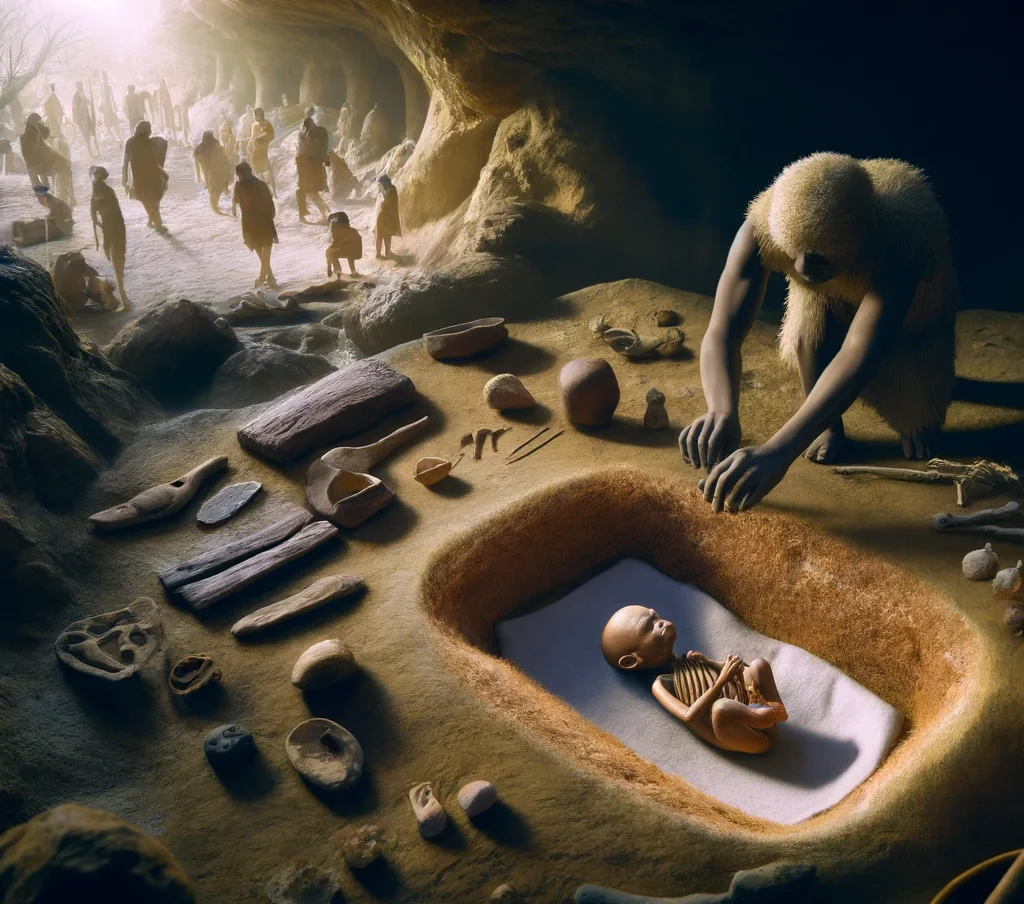
Circa 76,000 BCE someone in Africa, perhaps the child’s parents, carefully prepared a human child aged about three years old for burial. They dug a circular pit at the entrance to a cave (likely their cave), placed the child in the hole on his or her right side with knees drawn toward the chest. The Mtoto burial was discovered at Panga ya Saidi Cave, dating to roughly 76,000 BCE, making it the earliest known example of a deliberately prepared human burial.

After proper analysis of the surrounding soil and the decomposition that has taken place in the pit over the years, the archaeologists believe the child, now nicknamed Mtoto, was intentionally buried shortly after death.

— map / TST —

TST Tracker
✓ Reading recorded.
Michael Alan Prestwood
Author & Natural Philosopher
Prestwood writes on science-first philosophy, with particular attention to the convergence of disciplines. Drawing on his TST Framework, his work emphasizes rational inquiry grounded in empirical observation while engaging questions at the edges of established knowledge. With TouchstoneTruth positioned as a living touchstone, this work aims to contribute reliable, evolving analysis in an emerging AI era where the credibility of information is increasingly contested.
Email
Print
The Prestwood Column
Menu
September 2026
Column Research….
1. Timeline Story
Hume’s Is–Ought Problem
2. Linked Quote
“I meet with no proposition that is not connected with an ought, or an ought not.”
3. Science FAQ »
Can science prove flourishing should be our goal?
4. Philosophy FAQ »
What is the difference between a normative aim and a normative directive?
5. Critical Thinking FAQ »
Is flourishing for all just utilitarianism?
6. History FAQ!
What is the history of the idea of flourishing in philosophy?
Bonus Deep-Dive Article
Flourishing for All: The Normative Aim of TST Philosophy

Comments

Join the Conversation! Currently logged out.

Leave a Reply

NEW BOOK! NOW AVAILABLE!!

30 Philosophers: A New Look at Timeless Ideas

by Michael Alan Prestwood
The story of the history of our best ideas!
Scroll to Top