
Phil • Cr. Think • Science • Hist •
TST PRACTICE

The Philosophy Website

STORY

Early Intelligence Emerges: Aegyptopithecus zeuxis

☐ Read
☑ Read
You’ve read this 0 times.
You’ve listened to this 0 times.

By Michael Alan Prestwood

Tue 2 Apr 2024
Published 2 years ago.
Updated 4 months ago.
Related Stories
Fire-Altered Stone Tools
Oldest Surviving Spear
First Cynodonts
Adam: Haplogroup A
The K-Pg Extinction
Mammals: First Live Births
Share :
True Primate: Within mammals, only primates have binocular vision, grasping hands, and flat nails--instead of claws.

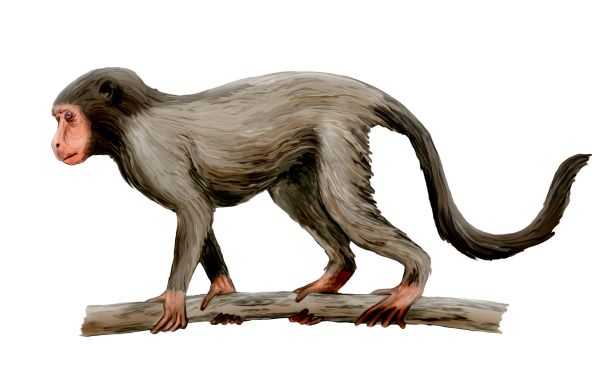
Early Intelligence Emerges: Aegyptopithecus zeuxis

30 Million BCE
Complex Brains; Long-Term Memory; Complex Sentience; Semi Self-awareness settles in.

True Primate: Within mammals, only primates have binocular vision, grasping hands, and flat nails–instead of claws.

Intelligent: Within the dense forests of the Oligocene epoch, Aegyptopithecus zeuxis marked a significant advance in the evolution of intelligence among primates. As an early forerunner to both the great apes and humans, Aegyptopithecus possessed adaptations crucial for enhanced cognitive function, such as a larger brain relative to its body size and eyes positioned for depth perception. These physical traits supported the development of behaviors requiring problem-solving, learning, and adaptation—hallmarks of emerging intelligence. The social life of Aegyptopithecus, inferred from its anatomy and fossil context, likely involved complex interactions and the use of rudimentary tools, setting the stage for the exponential growth in intelligence that characterizes later primates, including humans.

— map / TST —

TST Tracker
✓ Reading recorded.
Michael Alan Prestwood
Author & Natural Philosopher
Prestwood writes on science-first philosophy, with particular attention to the convergence of disciplines. Drawing on his TST Framework, his work emphasizes rational inquiry grounded in empirical observation while engaging questions at the edges of established knowledge. With TouchstoneTruth positioned as a living touchstone, this work aims to contribute reliable, evolving analysis in an emerging AI era where the credibility of information is increasingly contested.
Email
Print
The Prestwood Column
Menu
September 2026
Column Research….
1. Timeline Story
Hume’s Is–Ought Problem
2. Linked Quote
“I meet with no proposition that is not connected with an ought, or an ought not.”
3. Science FAQ »
Can science prove flourishing should be our goal?
4. Philosophy FAQ »
What is the difference between a normative aim and a normative directive?
5. Critical Thinking FAQ »
Is flourishing for all just utilitarianism?
6. History FAQ!
What is the history of the idea of flourishing in philosophy?
Bonus Deep-Dive Article
TST Normative Ethics: Flourishing as a Philosophical Goal

Comments

Join the Conversation! Currently logged out.

Leave a Reply

NEW BOOK! NOW AVAILABLE!!

30 Philosophers: A New Look at Timeless Ideas

by Michael Alan Prestwood
The story of the history of our best ideas!
Scroll to Top