
Explore Science-first Philosophy

STORY

Heraclitus

By Michael Alan Prestwood

Tue 9 Apr 2024
Published 2 years ago.
Updated 4 weeks ago.
Related Stories
Spherical Earth
Cuneiform Writing
Democritus (460 BCE – circa 370 BCE)
Indus Valley Script: Northwest India
Proto-Inca People
Plato
Share :
Impermanence is the idea that things do not stay the same forever. Becoming is the process of changing, growing, and unfolding over time.

Heraclitus

born circa 535 BCE
circa 535 to 475 BCE, likely aged about 60 years old
102 Generations Ago

30 Phil, Chapter 7: Heraclitus and Your Worldview
Chapter 7 in part one transitions from Eastern luminaries to their counterparts in the West. The pre-Socratic philosophers, guided by a new rational perspective, challenged the stronghold of mythology, and propelled human thought onto a trajectory marked by reason. Little is known for sure about Heraclitus. Born around 535 BCE, stories indicated he lived about 60 years.

My Favorite Sayings:
  • Everything is in Flux.
  • No man ever steps in the same river twice.

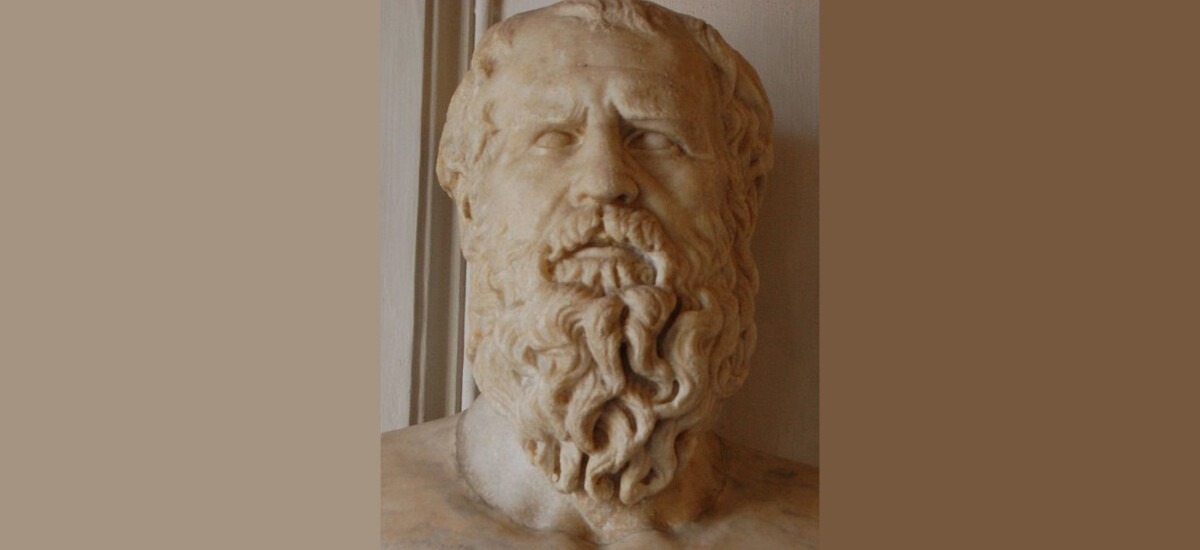
Pictured: Bust of an unknown philosopher. Some believe this might be Heraclitus. This bust is in the Capitoline Museum in Rome, but the museum makes no such identity assumption.

— map / TST —

Michael Alan Prestwood
Author & Natural Philosopher
Prestwood writes on science-first philosophy, with particular attention to the convergence of disciplines. Drawing on his TST Framework, his work emphasizes rational inquiry grounded in empirical observation while engaging questions at the edges of established knowledge. With TouchstoneTruth positioned as a living touchstone, this work aims to contribute reliable, evolving analysis in an emerging AI era where the credibility of information is increasingly contested.
Email
Print
This month @ TST
Column Menu
May 2026
»COLUMN ARCHIVE
--COLUMN--
Column Research….
1. Timeline Story
Book: The Idea of History
2. Linked Quote
“The historian without his facts is rootless…the facts without their historian are…meaningless.”
3. Science FAQ »
Is science tainted by bias?
4. Philosophy FAQ »
Debating History: Should We Say “Dark Ages” or “Middle Ages?”
5. Critical Thinking FAQ »
What is the preservation bias?
6. History FAQ!
Did Einstein’s driver really give one of his early talks?
Bonus Deep-Dive Article
TST Philosophy of History

Comments

Join the Conversation! Currently logged out.

Leave a Reply

NEW BOOK! NOW AVAILABLE!!

30 Philosophers: A New Look at Timeless Ideas

by Michael Alan Prestwood
The story of the history of our best ideas!
Scroll to Top