

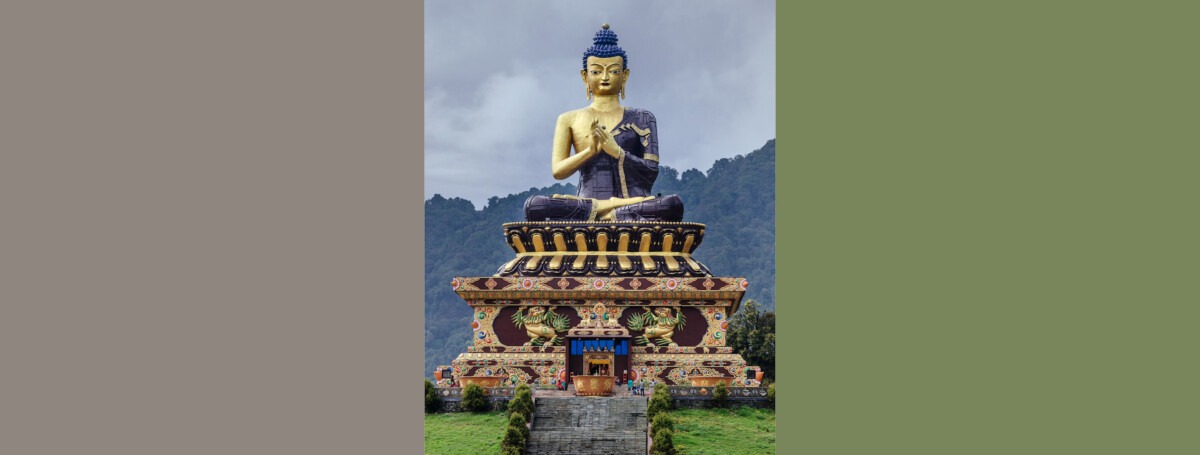
30 Philosophers, Chapter 6: Gautama Buddha and Buddhism.
In a much simpler time, the royal family of the Shakya dynasty lived in a palace located at the capital of the Shakya kingdom in present-day Nepal. Around 563 BCE, a boy named Siddhartha Gautama was born in the palace. At the age of 29, he left the luxury of his palace, and became one of the many wandering ascetics. After six years of wandering, in a flash, he suddenly attained enlightenment at the age of 35 under a Bodhi tree. Over the centuries, Buddhist Councils reorganized and revised the Canon, eventually adding the third text containing philosophical and psychological analysis. The degree to which these revisions deviated from the Buddha’s original words remains unknown. It was not until the 1st century BCE that the orally transmitted Pali Canon was finally committed to writing.
The Buddha’s philosophy was grounded in this world. He downplayed as best he could anything supernatural. His main concern was a problem directly in front of him: human suffering. He taught that craving, attachment, and the illusion of a permanent self keep people trapped in distress. The doctrine of non-self cuts deeply against the idea of a soul and against a reincarnating “self.” He taught that belief in an eternal personal soul moving unchanged from one life to another caused suffering in this life. In my writing, I call what he described rebirth, not reincarnation. I treat cause and effect as well as karma as separate. I write nothing about future lives. The practical force driving the original Buddha’s philosophy is powerful for all, not just Buddhists. He points back to this life. To a life disciplined with right attention, ethical conduct, compassion, and to the direct examination of experience.
This is why Buddhism can be powerful for all, not just Buddhists. Lean into the practical and psychological philosophy, and embrace the more religious later traditions only if one of them fits your authentic self.
Do not wait for another life or unseen realm to rescue you. Understand suffering here, loosen the grip of craving here, and cultivate clarity, compassion, and peace in the life you are actually living.

