
Phil • Cr. Think • Science • Hist • …
TST PRACTICE

By Philosopher Michael Alan Prestwood

STORY

Marcus Aurelius

☐ Read
☑ Read
You’ve read this 0 times.
You’ve listened to this 0 times.

By PrestwoodIT

Thu 10 Feb 2022
Published 5 years ago.
Updated 1 month ago.
Related Stories
Worldview
Identity
Philo of Alexandria
Pyrrho of Elis
Spherical Earth
New Look: The Flood Stories
Share :
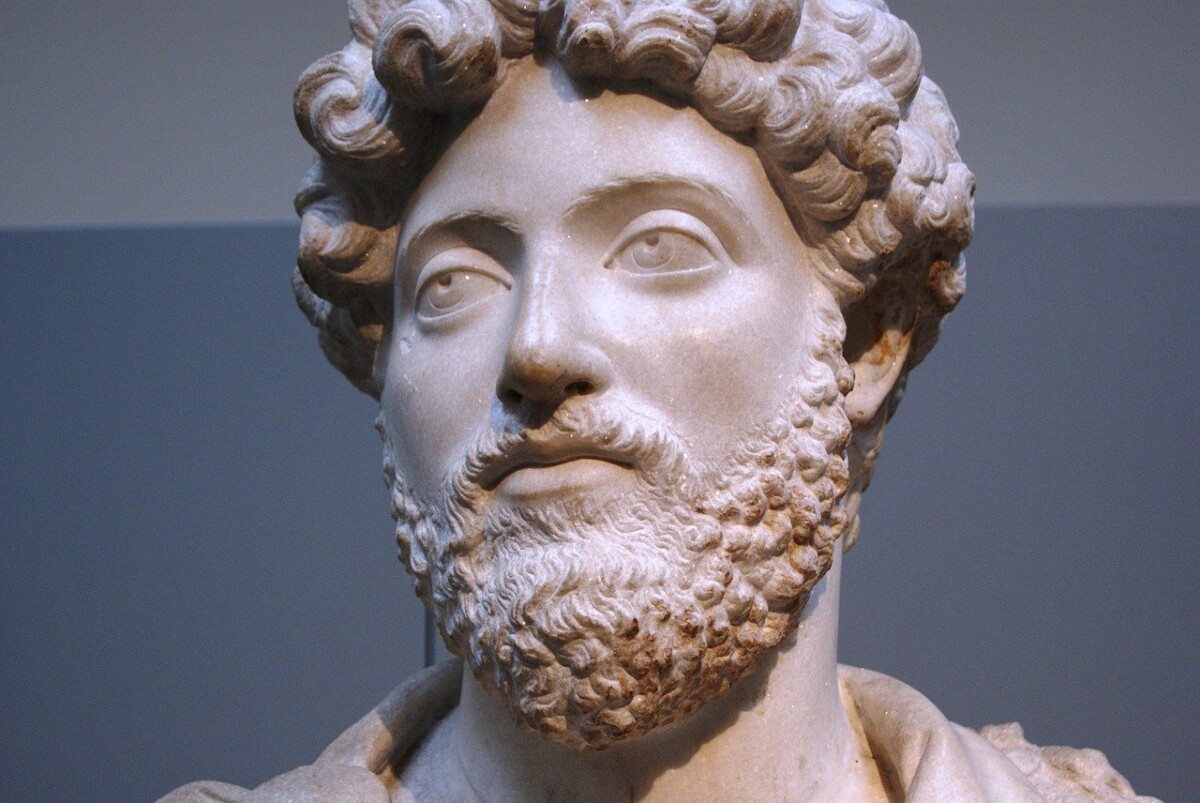
Marcus Aurelius inherited centuries of Stoic thought and put it to work in the difficult reality of governing an empire. His life reminds us that Stoicism is not about controlling the world. It is about governing yourself within it—your judgments, intentions, choices, and actions—while striving to act with virtue.

Marcus Aurelius

born 121, died 180 CE.
76 generations ago.

30 Philosophers, Chapter 13: Marcus Aurelius and Stoicism.

Stoicism began centuries before Marcus Aurelius. Zeno placed virtue at its center, especially the four cardinal virtues of wisdom, courage, justice, and temperance. Later Stoics refined the tradition. Chrysippus emphasized virtuous intent and accepting results outside our control, while Epictetus developed the Dichotomy of Control and the Three Disciplines of desire, action, and assent. By the time Marcus was born in 121 CE, Stoicism had developed into a rich philosophy of virtue, self-command, and living well within reality.

Marcus Aurelius inherited that tradition under extraordinary circumstances. Raised within Rome’s ruling class, he eventually became emperor of a vast empire. Yet he continually reminded himself that power did not make him fundamentally different from everyone else. He tried to live as Plato’s philosopher-king: using reason and virtue to guide his decisions while remaining conscious of how those decisions affected others. His famous reminder captures the practical spirit of his philosophy:

“Waste no more time arguing about what a good man should be. Be one.”

Marcus did not merely write about Stoicism; he tried to practice it while governing. His private reflections, preserved in Meditations, reveal a man repeatedly working on his judgments, responsibilities, relationships, and character. In my book, I frame his Stoicism through the Stoic Virtue Framework: one goal of virtue, the Dichotomy of Control, the Three Disciplines, and the four cardinal virtues. Marcus stands near the end of a long Stoic tradition, but he gave that tradition one of its most enduring examples: focus on what is yours to govern, accept what is not, and try to act with virtue anyway.

— map / TST —

TST Tracker
✓ Reading recorded.
Michael Alan Prestwood
Author & Natural Philosopher
Prestwood writes on science-first philosophy, with particular attention to the convergence of disciplines. Drawing on his TST Framework, his work emphasizes rational inquiry grounded in empirical observation while engaging questions at the edges of established knowledge. With TouchstoneTruth positioned as a living touchstone, this work aims to contribute reliable, evolving analysis in an emerging AI era where the credibility of information is increasingly contested.
Email
Print
The Prestwood Column
Menu
October 2026
Column Research….
1. Timeline Story
The Great Quaker Debates!
2. Linked Quote
“All men are prone to differ. It is no new thing in all former ages, in all parts. Each party is most right in his own eyes.”
3. Science FAQ »
Do facts actually change minds?
4. Philosophy FAQ »
When does persuasion become manipulation?
5. Critical Thinking FAQ »
How can you tell when a debate has stopped being productive?
6. History FAQ!
What is the history of debate?
Bonus Deep-Dive Article
Roger Williams Biography and Dedication to the Freedom of Conscience

Comments

Join the Conversation! Currently logged out.

Leave a Reply

NEW BOOK! NOW AVAILABLE!!

30 Philosophers: A New Look at Timeless Ideas

by Michael Alan Prestwood
The story of the history of our best ideas!
Scroll to Top