
Explore Science-first Philosophy

STORY

Successful Out of Africa Migration

By Michael Alan Prestwood

Sun 4 Jul 2021
Published 5 years ago.
Updated 10 months ago.
Related Stories
Share :

Successful Out of Africa Migration

70,000 BCE
Starting by 70,000 BCE

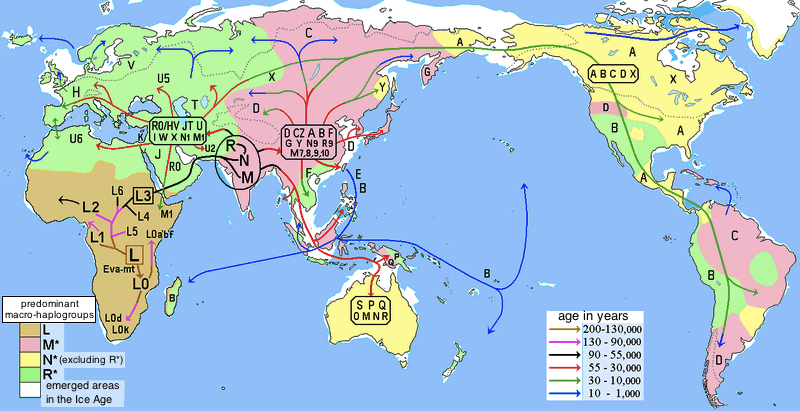
Through minor DNA changes, we know which early humans have descendants alive today. This successful “out of Africa” migration, the Southern Dispersal, took place around 70,000 to 50,000 BCE. Our ancestors proceeded to colonize all the continents and larger islands, arriving in…

Dark Skin Diversification: Africa’s intense UV radiation continues to select for darker skin, which protects against UV-related damage and helps in managing folate levels. The mention of some populations developing even darker skin tones could be linked to local environmental adaptations within the continent.

— map / TST —

Michael Alan Prestwood
Author & Natural Philosopher
Prestwood writes on science-first philosophy, with particular attention to the convergence of disciplines. Drawing on his TST Framework, his work emphasizes rational inquiry grounded in empirical observation while engaging questions at the edges of established knowledge. With TouchstoneTruth positioned as a living touchstone, this work aims to contribute reliable, evolving analysis in an emerging AI era where the credibility of information is increasingly contested.
Email
Print
This Week @ TST
April 8, 2026
»Column Archive
WWB Research….
1. Story of the Week
Pragmatism
2. Quote of the Week
“Our statements about the external world face the tribunal of sense experience not individually, but only as a corporate body.”
3. Science FAQ »
Why do scientific models work if they aren’t literally true?
4. Philosophy FAQ »
Is agnosticism a ludicrous position to occupy?
5. Critical Thinking FAQ »
Do my people and culture help or harm my critical thinking?
6. History FAQ!
Did Berger and Luckmann really say reality is just made up?
Bonus Deep-Dive Article
TST Doxastic Formation: Public Belief, Tribe, and Worldview
Scroll to Top