

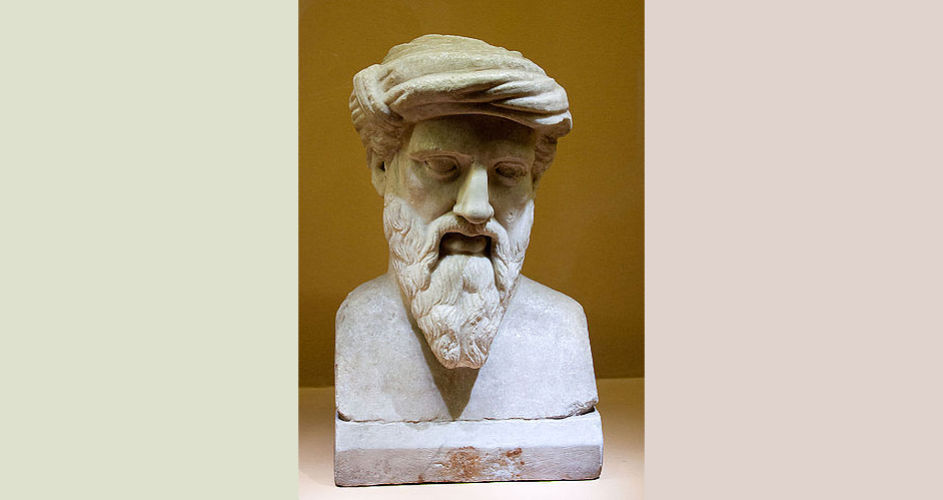
The Greek philosopher and mathematician Pythagoras was born in Ancient Greece on the island Samos which is about a mile off the coast of modern Turkey. History looks at Pythagoras as an educator and philosopher as well as a cult leader. He discovered the musical octave, used deductive reasoning, and embraced an early version of forms which was a stepping stone to Plato’s forms. His early theories on math as the answer to the universe are elementary and off course, but these first attempts led the path for future mathematicians to explore. He is most remembered for his Pythagorean theorem which states the square of the length of the hypotenuse of a right triangle equals the sum of the squares of the lengths of the other two sides
As a cult leader, he spent his life brainwashing anyone who would follow him. Like Jesus, he said he was the son of God. His cult had strange rules including that you had to be silent for five years before you could join. A clever trick that meant only true believers who would not tell others of the crazy could get in. The crazy ran deep. You must spit on your finger clippings. You cannot urinate toward the sun. They sacrificed an ox whenever they proved a mathematical formula.
Pythagoras never wrote anything down or at least none of his writings survived so we have to rely on what others say he said and did, but we’re likely never to know what was Pythagoras’ pure ideas from the evolved or altered ideas of later writers.
Some of my favorite translated sayings attributed to Pythagoras:
- Reason is immortal, all else mortal.
- There is geometry in the humming of the strings, there is music in the spacing of the spheres.
- As soon as laws are necessary for men, they are no longer fit for freedom.
- Do not say a little in many words but a great deal in a few.

