
Phil • Cr. Think • Science • Hist •

The Philosophy Website

STORY

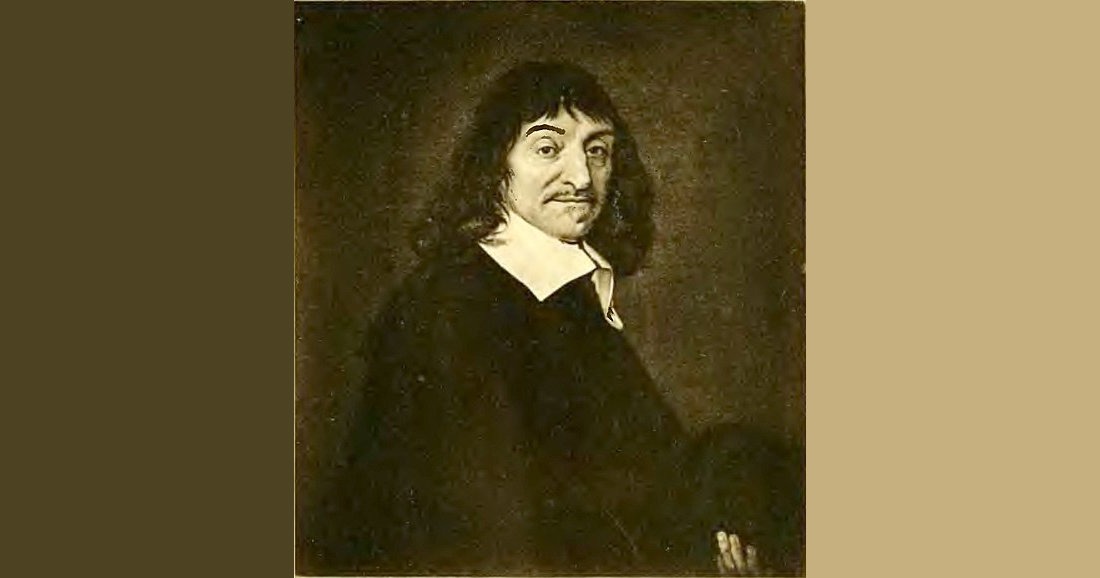
Rene Descartes

☐ Read
☑ Read
You’ve read this 0 times.
You’ve listened to this 0 times.

By Michael Alan Prestwood

Wed 10 Apr 2024
Published 2 years ago.
Updated 1 month ago.
Related Stories
Long-Term Memory Evolves: Tiktaalik
Laughter Emerges
Ontology
Arthur Schopenhauer
Early Play Evolves in Mammals
Absolute Truth
Share :
René Descartes was born into minor nobility in the Kingdom of France on March 31, 1596. In 1637, Descartes published "Discourse on the Method," he sought to identify certain knowledge by using doubt to strip away uncertain beliefs. Cartesian Skepticism is a system of doubt aimed at identifying certainties by dismissing all beliefs susceptible to even the slightest uncertainty. On February 11, 1650, in the presence of a small circle of friends, he exhaled his last breath.

Rene Descartes

Lived from 1596 to 1649.
17 Generations Ago.

30 Philosophers, Chapter 22: Descartes and Cartesian Dualism.

René Descartes was born into minor nobility in 1596, and lived during the Scientific Revolution. He is important because he became dissatisfied with inherited teachings and searched for a more dependable foundation for knowledge. In 1637, he published Discourse on the Method. In this book, he introduced his disciplined process of questioning beliefs, an early treasure of a work for a great mind. Essentially it boiled down to this: rather than accepting knowledge merely because they were traditional, authoritative, or familiar, you discover why.

This process became known as Cartesian Skepticism, or methodic doubt. Descartes temporarily suspended any belief that could be doubted, including the evidence of his senses. He even imagined that an evil demon might be manipulating his thoughts. Yet the act of doubting revealed one certainty: something must exist to do the doubting. He captured this in his famous statement, *Cogito, ergo sum*—“I think, therefore I am.” It was a brilliant thought experiment, but a strange one too. Descartes used an irrational possibility to tear knowledge down, then tried to rebuild it from the thinking mind.

Descartes also argued that the mind and body were fundamentally different substances, a position now called Cartesian Dualism. The body occupied physical space, while the mind thought and experienced. But to rebuild knowledge, he soon relied on another supernatural step: a perfect God who would not deceive us. In that sense, Descartes tore knowledge down and rebuilt it using irrational tools. His journey into doubt was groundbreaking and remains useful, but his doubt deserves some doubt of its own.

— map / TST —

TST Tracker
✓ Reading recorded.
Michael Alan Prestwood
Author & Natural Philosopher
Prestwood writes on science-first philosophy, with particular attention to the convergence of disciplines. Drawing on his TST Framework, his work emphasizes rational inquiry grounded in empirical observation while engaging questions at the edges of established knowledge. With TouchstoneTruth positioned as a living touchstone, this work aims to contribute reliable, evolving analysis in an emerging AI era where the credibility of information is increasingly contested.
Email
Print
The Prestwood Column
Menu
August 2026
»COLUMN ARCHIVE
--COLUMN--
Column Research….
1. Timeline Story
Ethical Roadmap
2. Linked Quote
“The greatest weapon against stress is our ability to choose one thought over another.”
3. Science FAQ »
Did morality evolve?
4. Philosophy FAQ »
Is the Me Too movement consistent with TST Ethics?
5. Critical Thinking FAQ »
When should you stop following the crowd?
6. History FAQ!
What did the Nuremberg Trials clarify about moral agents?
Bonus Deep-Dive Article
TST Ethical Roadmap: A Process Model for Ethical Guidance and Moral Choice

Comments

Join the Conversation! Currently logged out.

Leave a Reply

NEW BOOK! NOW AVAILABLE!!

30 Philosophers: A New Look at Timeless Ideas

by Michael Alan Prestwood
The story of the history of our best ideas!
Scroll to Top