

--Disciplined Thought--
Breaking Through Illusion
Critical Thinking
Process and clarity.
CRITICAL THINKING START
Think Well Path: 5-4-3
Start here if your first question is:
“How do I think more clearly?”
The Think Well Path begins with the tools of judgment. You’ll explore how ideas form, how reasoning works, how thinking goes wrong, and how public truth is tested through science, law, and journalism.
This is the 5-4-3 path: Five Thought Tools, Four Mind Traps, and Three Truth Hammers. It is TST’s practical path for sharpening your mind, testing claims, and building intellectual discipline.
CORE READING
A 5-4-3 structured model for disciplined thinking.
Today's Tip
Critical thinking belongs in everyday reasoning, not just formal debate or academic argument.
Recent Tidbits:
Stories, Quotes, and FAQs.
The wisdom builder tidbits that feed the columns, articles, and trainer.
Critical Thinking
Featured Story
Updated This Week
Critical Thinking
Story
Maya, Illusion.
Cognitive Biases
Four Mind Traps
We all live with cognitive biases, the mental shortcuts that help simplify a complex world. They are useful, but they also distort judgment. They are not moral failures, but they do require correction. To take control of your biases, start by owning them. Notice the pattern. Name it. Slow down. Then use structured reasoning and evidence to recalibrate your confidence. This helps reduce inflated certainty, emotional reaction, and tribal thinking.
Featured QUOTE
THINK WELL
Quote
“I know that I am wise, because I know that I know nothing.”
- Socrates
- 399 BCE
Skepticism
As written by Plato.
The essence of the phrase “I know that I know nothing” originates from Plato’s Apology, where Socrates reflects on his reputation for wisdom. While not a direct quote, Plato attributes to Socrates the idea that true wisdom comes from recognizing one’s own ignorance. I think Socrates wants you to uncover the truth, no matter what it is, reconcile it with your beliefs, and make sense of it in a way that is consistent with common knowledge.
Featured FAQ
Updated This Week
Critical Thinking
FAQ
What is the preservation bias?
Preservation Bias
Preservation shapes perception: What we know about the past is shaped by what survives. From fossils to ancient artifacts, the story of history is incomplete, skewed toward what was preserved. Understanding preservation bias reminds us to question the gaps and look beyond the surface. In daily life, remember that the evidence you can see may not be all the evidence there is.
Updated Tidbits
Critical Thinking
Story
David Hume
- Scottish Enlightenment Philosopher
Skeptical Empiricism
08 Aug 2026
(Updated 1 day ago)
08 Aug 2026
(Updated 2 days ago)
Critical Thinking
FAQ
Are there more Christians or Muslims in the world today?
Hasty Generalization
08 Aug 2026
(Updated 3 days ago)
No more posts to show
Critical Thinking
Intellectual Discipline
Don’t just believe: analyze.
Critical thinking is the practice of evaluating claims with clarity and structure. It asks not only what is being said, but how it is being justified. In a world saturated with noise, persuasion, and partial truths, disciplined thinking separates evidence from assumption and coherence from contradiction.
Reason-based Thinking
The tools that keep our ideas honest.
Deep-Dive Articles
TST Philosophy of Fiction: Imaginative Realism
Michael Alan Prestwood
July 1, 2026
Fiction is not created from nothing; it is the recombination of real impressions into imagined things.
The Material-Spiritual Framework: A Philosophy of Spirituality
Michael Alan Prestwood
June 1, 2026
The Material-Spiritual Framework separates shared empirical reality from personal spiritual meaning, allowing people to respect belief while still testing public claims against the material world.

A Higher Power for Everyone: God, Logos, and Recovery
May 31, 2026
Recovery from addiction, or even just a bad habit, begins when the craving self stops acting like the highest authority. Build new habits with help: ...

TST Doxastic Formation: Public Belief, Tribe, and Worldview
April 8, 2026
This is your life. Embrace the beliefs you understand and believe in, not just the beliefs you inherited.
Rational Ideas: The Subtypes
April 6, 2026
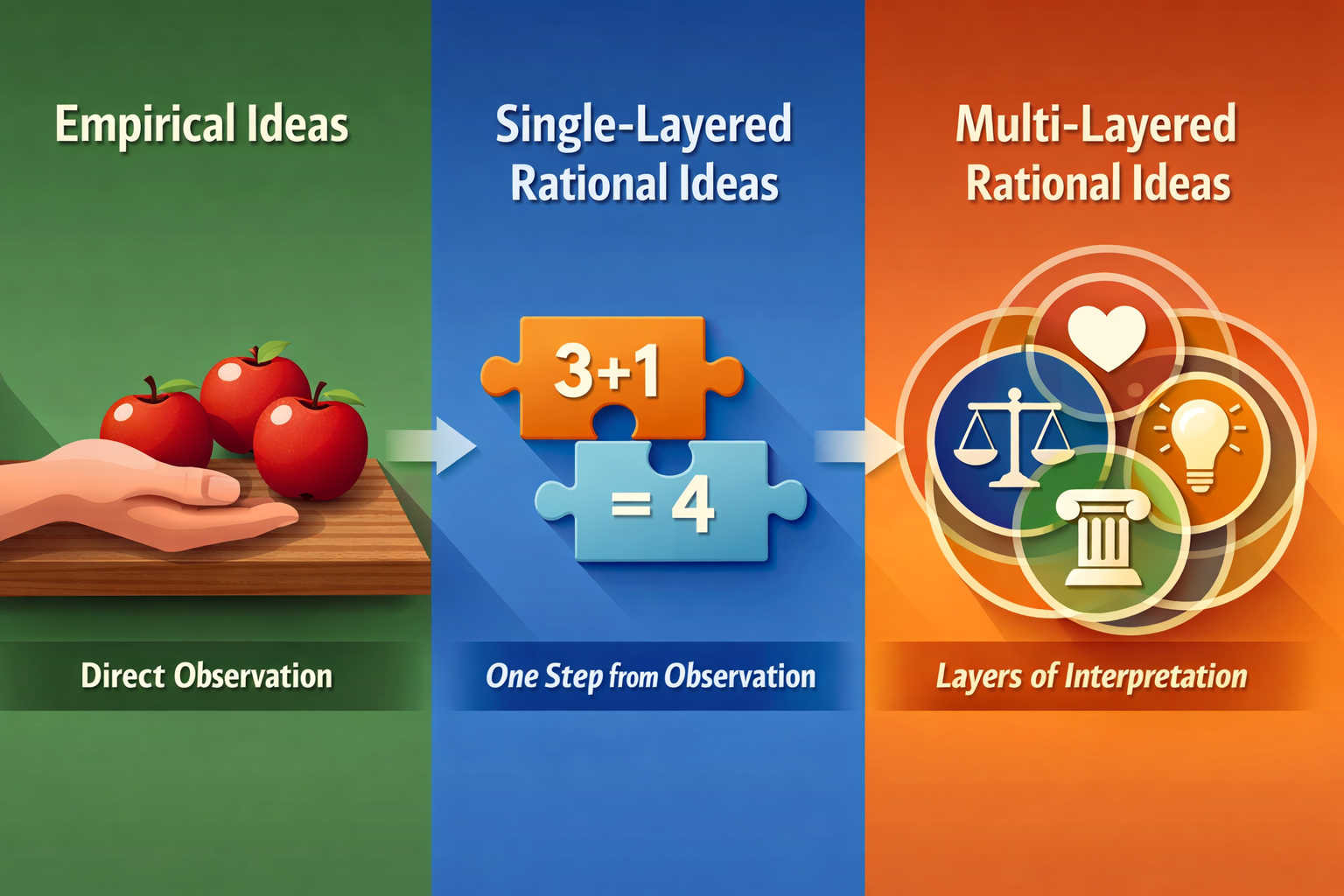
When you encounter a rational idea, first ask whether it is single-layered or multi-layered. Is it one step, or more than one step, away from ...
Must-Reads
Ancient History
Pragmatism and Pythagoras
Pythagoras exemplifies rational pragmatism and reminds us that authority is often topic specific. Choose your authorities carefully, because good authority is usually limited to a ...
Epistemology
The Limits of Language and Understanding
Some skepticism questions our words. Deeper skepticism questions whether we can ever truly know.
Reasoning
Reasoning: An Overview of Inference and Logic
Reason uses inference and logic to make sense.

New Ideas
OVM
The Material-Spiritual Framework: A Philosophy of Spirituality
The Material-Spiritual Framework separates shared empirical reality from personal spiritual meaning, allowing people to respect belief while still testing public claims against the material world.

2 Layers (Metaphysics)
TST Metaphysics: The Split
The split separates our ideas and the material world. To live in harmony with nature, embrace the idea that our rational ideas must be internally ...
Idea of Ideas
Idea Theory Framework
The Idea Theory Framework within the Idea of Ideas is a promotion ladder for ideas to move from speculation to hypothesis, theory, and law.
Updated Articles
TST COLUMN
08 Apr 2026
Debut
Philosophy
Paper
TST Doxastic Formation: Public Belief, Tribe, and Worldview
Personal Belief
Wed 8 Apr 2026
(4 months ago)
Updated 3 weeks ago.
TST COLUMN
24 Dec 2019
Debut
Critical Thinking
Article
The Anti-Vaxxer Movement and the Scientific Method
Vaccines
Tue 24 Dec 2019
(7 years ago)
Updated 4 weeks ago.
TST COLUMN
03 May 2026
Critical Thinking
Paper
TST Philosophy of History
Idea of Ideas
Tue 3 Mar 2026
(5 months ago)
Updated 4 weeks ago.
No more posts to show


