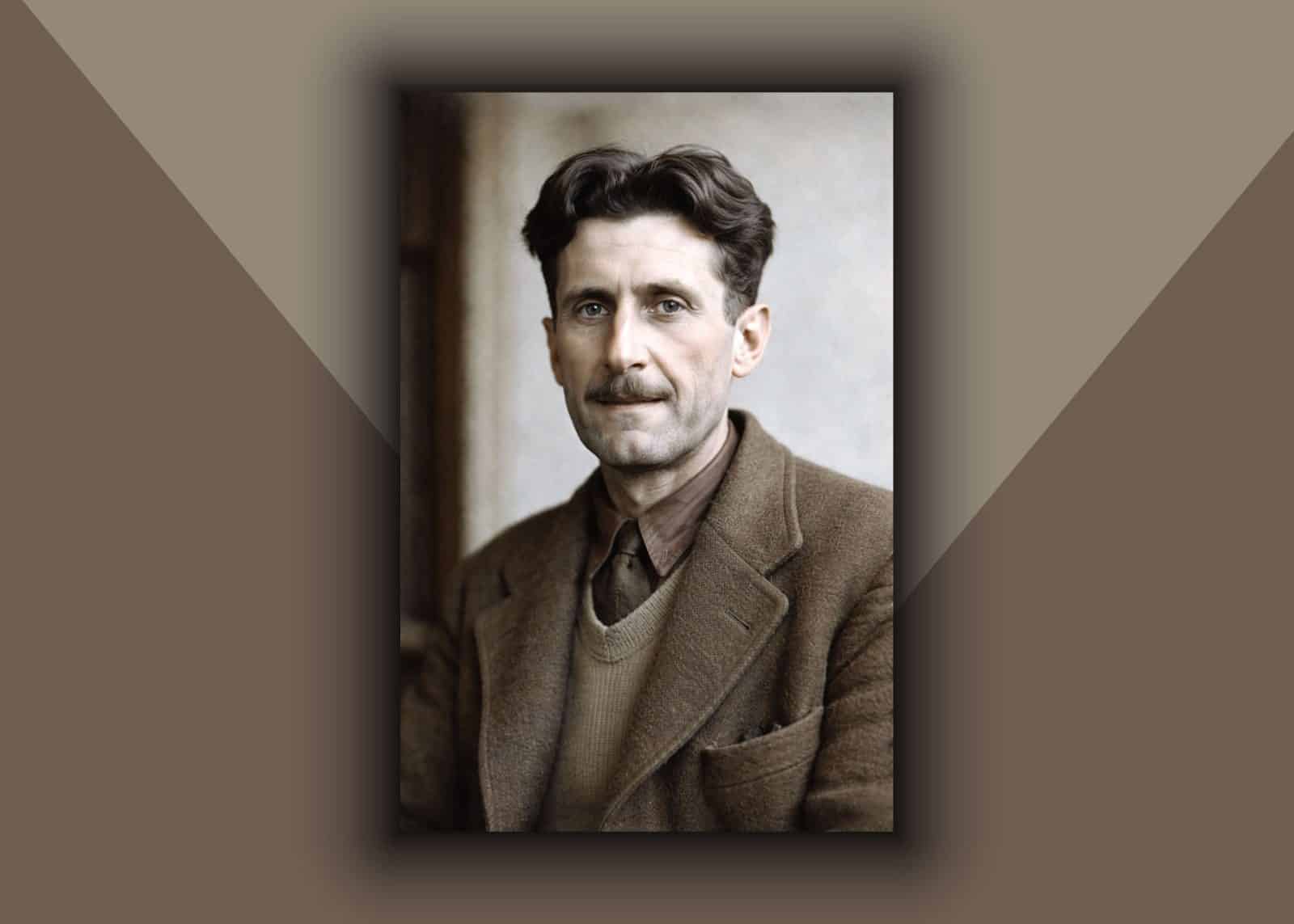
George Orwell
George Orwell wrote about how corruption starts when language is twisted, facts are manipulated, and authority demands loyalty over reality.


Rational ideas that are not historical stories nor empirical observations. Things like algebra and logic which help us indirectly describe the empirical. Also, things like the rational idea that dinosaurs once existed which is based on empirical evidence like fossils.
George Orwell wrote about how corruption starts when language is twisted, facts are manipulated, and authority demands loyalty over reality.

30 Phil, Chapter 30: In this telling of Nietzsche ideas, we take a new look at it and forge it into a five-step authentic recipe. Step one is the Übermensch. It is often translated as the “Overman” or “Superman.” It is a call to individual empowerment and liberation from societal norms and traditional values. Step two
Authentic Recipe: Nietzsche’s Five-step Approach Read More »

30 Phil, Chapter 22: In this new look at Descartes thought experiment, we first take a look at his hyperbolic doubt, and then run his thought experiment a second time using rational doubt transforming his thought experiment from the irrational to the rational.
Descartes Thought Experiment Read More »

Build happiness by choosing the long-term over the short-term. Epicureanism was one of the first traditions to foster simple pleasures like friendship.
Epicurean Happiness Toolkit: A 4-Step Structure Read More »

Heidegger’s existentialism centers on the concept of “being-there” (Dasein), which refers to the unique way humans exist and relate to the world. Heidegger explores the nature of being and emphasizes the importance of understanding one’s own existence within the context of time and space. His philosophy delves into the idea of being authentic by confronting
Heidegger’s Existentialism Read More »

Sartre’s existentialism emphasizes individual freedom, choice, and responsibility. It posits that existence precedes essence, meaning that individuals are not defined by any preexisting essence but instead create their own essence through actions and decisions. Sartre’s philosophy focuses on the concept of “bad faith,” where people deny their freedom by conforming to societal expectations, and encourages
Sartre’s Existentialism Read More »

30 Phil, Chapter 31, Sartre, Touchstone 80: Bad Faith. Bad faith is the idea of living a lie; it is the act of denying your inherent freedom and responsibility associated with self-awareness. When you go along to get along, you are not yourself, you are being a rock, you are a “being-in-itself.” To live for

30 Phil, Chapter 31, Sartre, Touchstone 79: Consciousness. Consciousness is a continuous, self-aware state of existence, an incessant ebb and flow of perceptions, ideas, and emotions. Consciousness is part of your worldview with two basic states: awake and asleep. It’s a complex spectrum of levels while awake, and stages while asleep.

30 Phil, Chapter 31, Sartre, Touchstone 78: Anxiety. The birth of modern psychology: In existentialism, anxiety is the result of confronting the inherent freedoms and responsibilities of human existence. It is not necessarily about fearing specific outcomes or events but rather the realization of the vast possibilities and choices one faces in life, and the

Eternal Recurrence turns your life into a test of moral agency. Others may guide or pressure you, but you are the decider. Own your own agency.
Eternal Recurrence Read More »

30 Phil, Chapter 30, Nietzsche, Touchstone 76: Übermensch. The Übermensch, or superman, is the ideal person who transcends societal norms and self-imposed limitations. They overcome the existing values and moralities of society, creating their own values, and living in a way that is true to themselves.

30 Phil, Chapter 30, Nietzsche, Touchstone 75: Nihilism. Shake off societal pressures: Nihilism is a tool to examine and potentially overcome the problem of illusion in reality. You use the idea that life lacks objective meaning, purpose, and intrinsic value to break free of the illusions of life like social constructs and pressures. This updated

30 Phil, Chapter 29, Mill, Touchstone 74: Harm Principle. You’re free to do what you want, as long as you don’t harm others. It delineates between self-regarding and other-regarding actions as a basis for when societal intervention is justified. Self-regarding actions are those that primarily affect the individual who undertakes them. Other-regarding actions have broader

30 Phil, Chapter 28, Kant, Touchstone 73: Categorical Imperative. The Categorical Imperative says you should act only in a manner that you would be comfortable seeing transformed into a universal law.
Categorical Imperative Read More »

30 Phil, Chapter 28, Kant, Touchstone 72: Transcendental Idealism. The Split and Three-Tine Fork: Transcendental Idealism is Kant’s view on epistemology. His distinction between phenomena and noumena and his three-tiered approach to knowledge. Kant introduced a crucial distinction between phenomena—the world as we see and understand it—and noumena—the world as it exists independently of our
Transcendental Idealism Read More »

30 Phil, Chapter 27, Hume, Touchstone 71: Hume’s Fork. Hume’s Fork is a philosophical tool that categorizes meaningful statements into two distinct types: relations of ideas and matters of fact. It offers a clear demarcation between different kinds of truths. Relations of ideas are statements that are necessarily true, such as “all bachelors are unmarried.”

30 Phil, Chapter 27, Hume, Touchstone 70: The Problem of Induction. The logic behind induction is inherently circular, hence, the problem of induction. We expect future events to be like past events because this has generally been true in the past. This justification itself is inductive, making the whole process circular and self-referential. Although induction
The Problem of Induction Read More »

30 Phil, Chapter 27, Hume, Touchstone 69: Skeptical Empiricism. Skeptical Empiricism challenges the idea of innate knowledge, asserting all we know stems from our experiences.
Skeptical Empiricism Read More »

Journalism is a public truth system. When done right, the public can rely on its accurate reporting and journalists can write stories about what it all means.

You need a fully free press because public truth needs watchdogs, not just officials and institutions.