

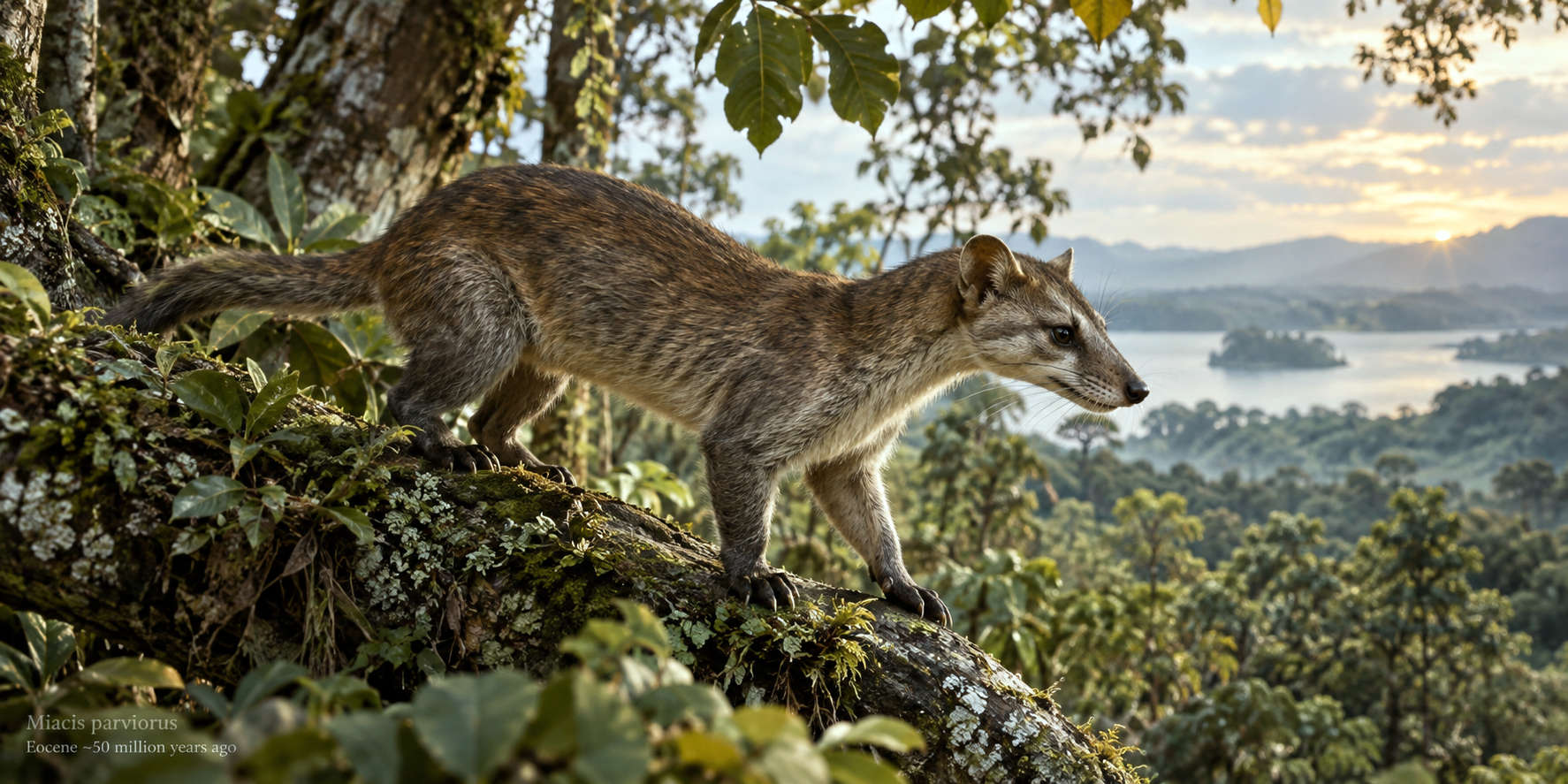
Emerging in the lush forests of the Eocene, Miacis represents a useful waypoint in the evolution of increasingly complex mammalian cognition. This small early carnivoraform lived an active life navigating its environment, finding prey, avoiding danger, and controlling a highly mobile body. By this time, mammals were developing and elaborating many of the cognitive abilities associated with proto-self-awareness. Not the full reflective self-awareness seen in some living animals, but more basic forms of awareness involving a self moving through the world.
The modern view is that animal cognition was not a simple one-species aware/not-aware divide. Evolution was more experimental than that. Different lineages developed different pieces of the puzzle at different times and to different degrees. This type of early or proto-self-awareness does not mean looking inward and thinking things like “I am me.” It refers to more basic layers of self-related awareness: distinguishing one’s body from the surrounding world, tracking one’s position and movement, responding to internal states, remembering actions, and separating self-caused events from events caused by the environment. These abilities are not reflective self-awareness, but rather small steps along the cognitive journey. Think loosely of the differences in cognitive abilities among a mouse, a cat or dog, an elephant, or a dolphin—not as a single evolutionary ladder, but as different degrees and combinations of increasingly sophisticated cognition.

