
Explore Science-first Philosophy

STORY

Emergence of the Chimpanzee Family

By Michael Alan Prestwood

Tue 2 Apr 2024
Published 2 years ago.
Updated 3 days ago.
Related Stories
Cenozoic Era: Age of Mammals & Birds
Bilaterian Split: The Origin of Agency
Chimpanzee-Bonobo Split
Early Complex Sentience Emerges: Dimetrodon
The K-Pg Extinction
Plesiadapis: First fruit-insect eaters.
Share :
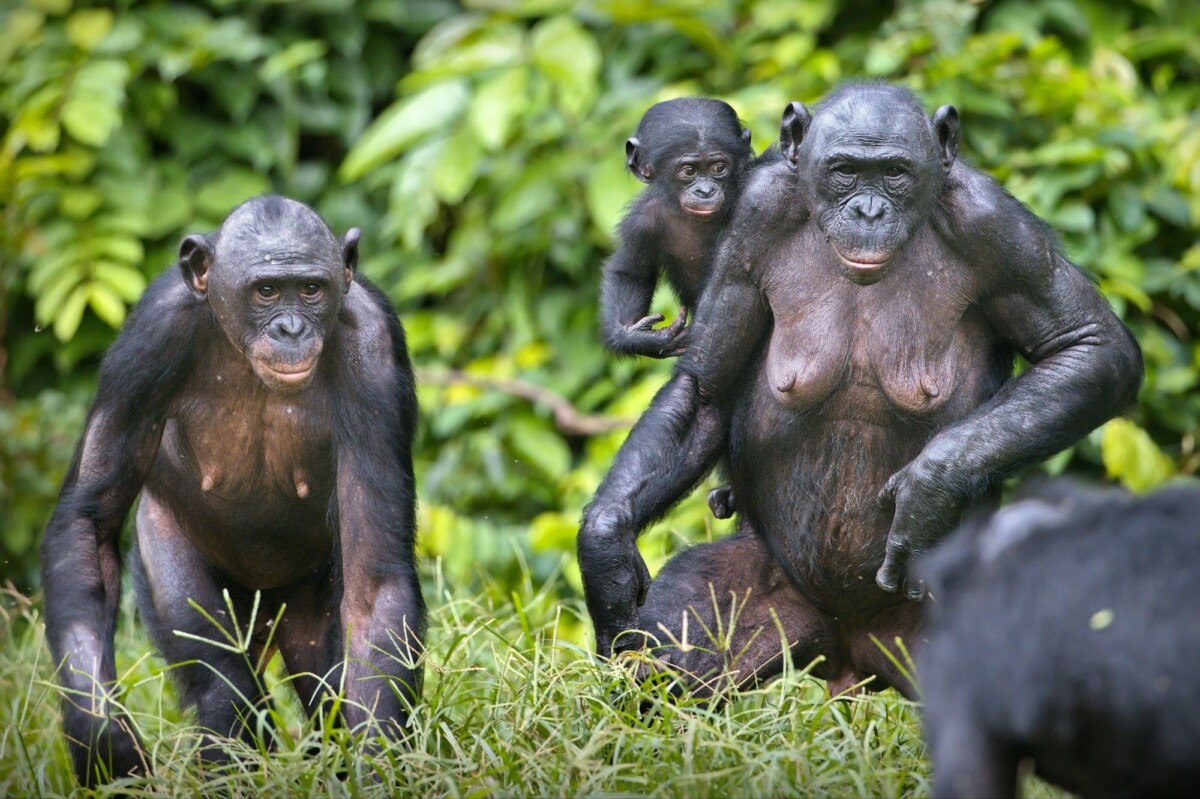
Bonobo chimpanzees in the wilderness in Democratic Republic of the Congo
The genus Pan gave rise to two living cousins: chimpanzees and bonobos. Their split shows how one intelligent ape lineage can become two distinct evolutionary stories.

Emergence of the Chimpanzee Family

2 Million years ago (+/- 500,000)
Hominids, Not Us (different branch)

After the broader great ape story unfolded, and after the human line split from the chimpanzee-bonobo line about 7 million years ago, the genus Pan continued along its own path. Around 1.5 to 2 million years ago, ancient African ape populations gave rise to the two living species we now know as chimpanzees and bonobos.

This pivotal moment unfolded roughly 5 million years after our last common ancestor with chimpanzees and bonobos took a different evolutionary road. As with so many chapters in primate evolution, the stage was Africa: the cradle of humans, chimpanzees, bonobos, gorillas, and so much of the great ape story.

This era does not mark the beginning of chimp-like intelligence, but it does mark the modern split within the chimpanzee family. North of the Congo River, the common chimpanzee continued its path. South of it, the bonobo evolved along a gentler but equally fascinating road. One ancestral family became two living cousins.

Chimpanzees are smart. Very smart. They use tools, learn socially, cooperate, deceive, comfort, and wage conflict. But compared with early Homo, especially Homo habilis around 2.3 million years ago, they were likely still on a different cognitive path. Homo habilis had a larger average brain and is strongly associated with early stone tools, while chimpanzees and bonobos remained brilliant forest apes with rich but more limited tool cultures.

Chimps are smart, but nowhere near Homo habilis from 2.3 million years ago.

Size: 3’ to 4’5″ (a bit shorter than Homo habilis)
Brain Size: 273 to 500 cm³ (much smaller than Homo habilis at 510 to 600 cm³)
Brain to Body EQ: 2.2 to 2.5 (much less than Homo habilis at 3.3 to 3.8, and humans at 7.4 to 7.8)

— map / TST —

Michael Alan Prestwood
Author & Natural Philosopher
Prestwood writes on science-first philosophy, with particular attention to the convergence of disciplines. Drawing on his TST Framework, his work emphasizes rational inquiry grounded in empirical observation while engaging questions at the edges of established knowledge. With TouchstoneTruth positioned as a living touchstone, this work aims to contribute reliable, evolving analysis in an emerging AI era where the credibility of information is increasingly contested.
Email
Print
This month @ TST
Column Menu
May 2026
»COLUMN ARCHIVE
--COLUMN--
Column Research….
1. Timeline Story
Book: The Idea of History
2. Linked Quote
“The historian without his facts is rootless…the facts without their historian are…meaningless.”
3. Science FAQ »
Is science tainted by bias?
4. Philosophy FAQ »
Debating History: Should We Say “Dark Ages” or “Middle Ages?”
5. Critical Thinking FAQ »
What is the preservation bias?
6. History FAQ!
Did Einstein’s driver really give one of his early talks?
Bonus Deep-Dive Article
TST Philosophy of History

Comments

Join the Conversation! Currently logged out.

Leave a Reply

NEW BOOK! NOW AVAILABLE!!

30 Philosophers: A New Look at Timeless Ideas

by Michael Alan Prestwood
The story of the history of our best ideas!
Scroll to Top