
Phil • Cr. Think • Science • Hist •
TST PRACTICE

The Philosophy Website

STORY

Oldest Modern Human-like Footprints

☐ Read
☑ Read
You’ve read this 0 times.
You’ve listened to this 0 times.

By Michael Alan Prestwood

Thu 8 Jul 2021
Published 5 years ago.
Updated 4 months ago.
Related Stories
Extinction: Homo floresiensis
Hyoid Bone: Speach Emerges
Homo rhodesiensis: A Hybrid Lesson
Bhimbetka Petroglyphs, Cupules
Fire-Altered Stone Tools
Genus: Orrorin
Share :

Oldest Modern Human-like Footprints

1.52 Million BCE
1.53 to 1.51 Million BCE
60,800 Generations Ago

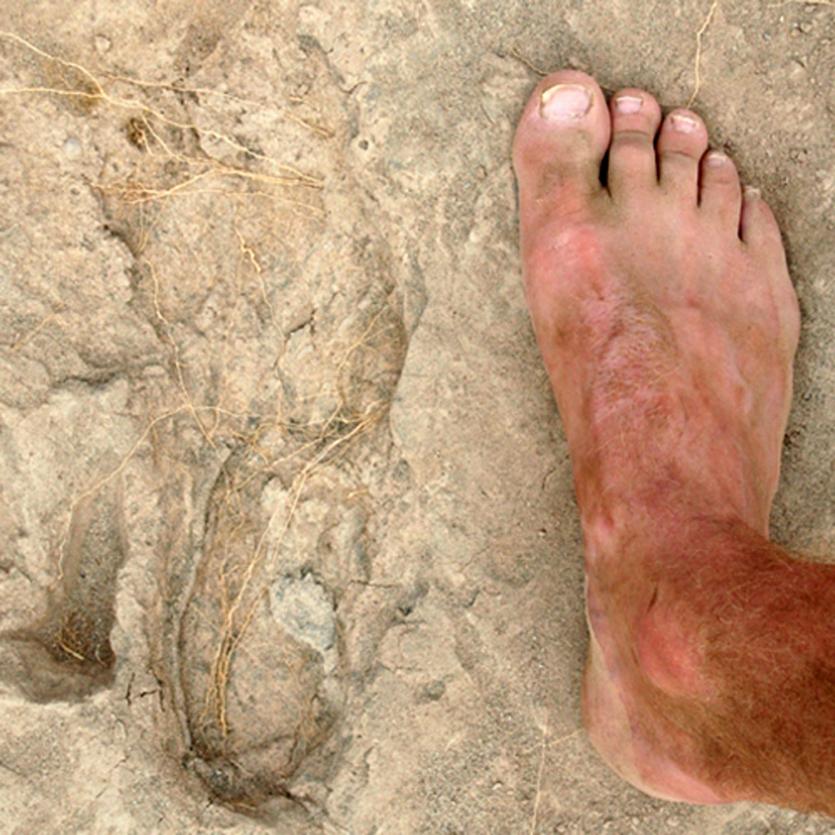
Species: Likely Homo erectus, our direct ancestor. The footprints found in Ileret, Kenya represent the oldest undisputed evidence of hominins walking upright in an efficient manner characteristic of modern humans. Our style of upright walking, which Homo erectus appears to have shared, is energy-efficient and adapted for long distances. It involves a long stride with a spring-like mechanism in the arch of the foot. These particular footprints demonstrate a well-developed arch and a long stride, culminating in a propulsive toe-off similar to us.

By this period, Homo erectus set a precedent for the locomotion seen in future hominin species, including Homo heidelbergensis, Neanderthals, Denisovans, and even the shorter Homo floresiensis.

Primary Timeline…

— map / TST —

TST Tracker
✓ Reading recorded.
Michael Alan Prestwood
Author & Natural Philosopher
Prestwood writes on science-first philosophy, with particular attention to the convergence of disciplines. Drawing on his TST Framework, his work emphasizes rational inquiry grounded in empirical observation while engaging questions at the edges of established knowledge. With TouchstoneTruth positioned as a living touchstone, this work aims to contribute reliable, evolving analysis in an emerging AI era where the credibility of information is increasingly contested.
Email
Print
The Prestwood Column
Menu
September 2026
Column Research….
1. Timeline Story
Hume’s Is–Ought Problem
2. Linked Quote
“I meet with no proposition that is not connected with an ought, or an ought not.”
3. Science FAQ »
Can science prove flourishing should be our goal?
4. Philosophy FAQ »
What is the difference between a normative aim and a normative directive?
5. Critical Thinking FAQ »
Is flourishing for all just utilitarianism?
6. History FAQ!
What is the history of the idea of flourishing in philosophy?
Bonus Deep-Dive Article
Flourishing for All: The Normative Aim of TST Philosophy

Comments

Join the Conversation! Currently logged out.

Leave a Reply

NEW BOOK! NOW AVAILABLE!!

30 Philosophers: A New Look at Timeless Ideas

by Michael Alan Prestwood
The story of the history of our best ideas!
Scroll to Top