

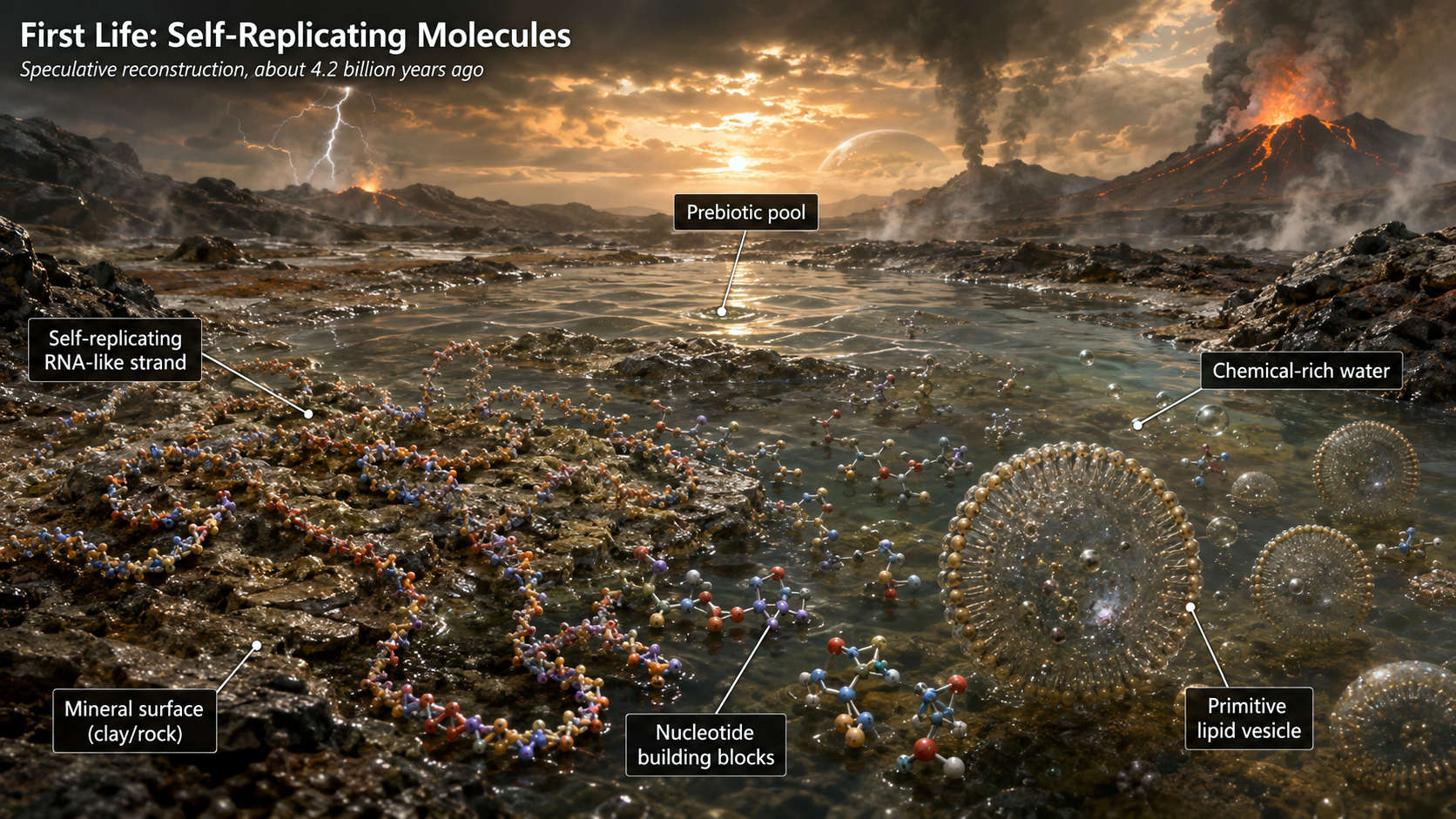
The first true step toward life likely came when molecules began copying themselves. These were not cells yet. They had no bodies, no brains, no hunger, and no purpose. But once a molecule could store information, make copies, and occasionally copy imperfectly, the stage was set for heredity, variation, and natural selection. Chemistry had crossed a threshold. The universe now had a way to remember.
This moment did not appear from nowhere. Over hundreds of millions of years, early Earth added necessary ingredients, naturally: water, volcanic energy, carbon chemistry, mineral surfaces, lightning, ultraviolet light, tidal pools, hydrothermal vents, and perhaps organic molecules delivered by meteorites. Across countless tiny natural laboratories, simple molecules formed, broke apart, recombined, and tried again. Nearly all went nowhere. But in the right setting, under the right rhythm of wet and dry, hot and cold, acid and alkaline, some chemistry became more organized. The variables were finally in place.
The leading idea is the RNA world, or something like it. RNA is especially interesting because it can do two life-like things: it can store information, and some RNA molecules, called ribozymes, can catalyze chemical reactions. That makes RNA a possible bridge between raw chemistry and living biology.
From there, the road led toward cells. Self-replicating molecules likely became enclosed in simple fatty membranes, forming protocells: tiny chemical bubbles with an inside and an outside. Some captured better chemistry. Some copied more reliably. Some managed energy more effectively. Over time, RNA-like systems gave way to the more stable DNA-protein world. By the time LUCA appeared, life was no longer just chemistry experimenting in puddles and vents. It was a working biological system with genetic code, metabolism, and inheritance.

