
Explore Science-first Philosophy

STORY

Big Bang Expansion

By Michael Alan Prestwood

Mon 1 Apr 2024
Published 2 years ago.
Updated 3 weeks ago.
Related Stories
Formation of a New Solar System
First Atoms
Interstellar Clouds: Organic Molecules
Population I Stars: Like our Sun
Death of the Sun
Birth of the Milky Way
Share :
13.8 billion years ago, space itself began expanding and cooling, setting the stage for particles, atoms, stars, galaxies, planets, life, and us.

Big Bang Expansion

13.8 Billion Years Ago
Verified. Empirically supported and rationally deduced.

30 Philosophers, Chapter 1, Touchstone 1 of 80: Big Bang.

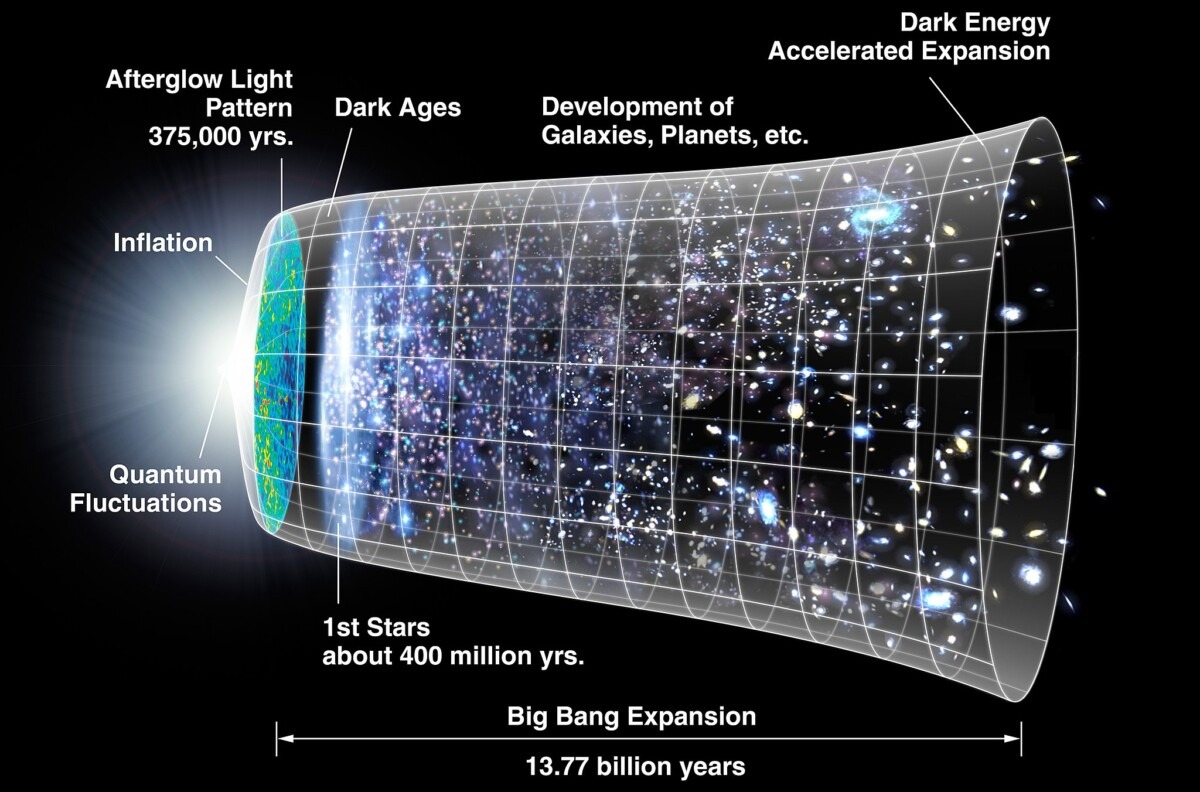
Immediately after the earliest state we can model, the universe entered a period of rapid expansion and cooling. This is the Big Bang Expansion: not an explosion in space, but the expansion of space itself.

That distinction matters. The Big Bang did not happen at one location inside an empty universe. There was no outside room waiting for it. Space itself expanded, carrying matter and energy with it. As the universe stretched, it cooled. That cooling allowed the first physical processes to unfold: fields changed, particles formed, forces separated, and eventually the long road toward atoms, stars, galaxies, planets, and life began.

The Big Bang is the first threshold in Big History: the beginning of our known universe. It marks the start of the cosmic story that leads, billions of years later, to chemistry, stars, planets, life, agriculture, science, and us.

The expansion itself is well supported by multiple lines of evidence, including the observed expansion of the universe, the cosmic microwave background, and the large-scale structure of galaxies. The cosmic microwave background is especially important: it is the oldest light we can observe, released about 380,000 years after the Big Bang when the universe cooled enough for light to travel freely. NASA describes this glow as a 2.7 K afterglow, stretched by cosmic expansion and still visible today.

The singularity before this expansion remains highly speculative. But the expansion of the early universe is one of the strongest pillars of modern cosmology.

Big History Thresholds: 1=Big Bang | 2=Stars&Galaxies | 3=Chemicals | 4=Solar System | 5=First Life | 6=TI | 7=Agrarian | 8=Science

— map / TST —

Michael Alan Prestwood
Author & Natural Philosopher
Prestwood writes on science-first philosophy, with particular attention to the convergence of disciplines. Drawing on his TST Framework, his work emphasizes rational inquiry grounded in empirical observation while engaging questions at the edges of established knowledge. With TouchstoneTruth positioned as a living touchstone, this work aims to contribute reliable, evolving analysis in an emerging AI era where the credibility of information is increasingly contested.
Email
Print
This month @ TST
Column Menu
May 2026
»COLUMN ARCHIVE
--COLUMN--
Column Research….
1. Timeline Story
Book: The Idea of History
2. Linked Quote
“The historian without his facts is rootless…the facts without their historian are…meaningless.”
3. Science FAQ »
Is science tainted by bias?
4. Philosophy FAQ »
Debating History: Should We Say “Dark Ages” or “Middle Ages?”
5. Critical Thinking FAQ »
What is the preservation bias?
6. History FAQ!
Did Einstein’s driver really give one of his early talks?
Bonus Deep-Dive Article
TST Philosophy of History

Comments

Join the Conversation! Currently logged out.

Leave a Reply

NEW BOOK! NOW AVAILABLE!!

30 Philosophers: A New Look at Timeless Ideas

by Michael Alan Prestwood
The story of the history of our best ideas!
Scroll to Top