
Printing Press Invented
Publishing, whether the printing press or digital, transforms your ideas from private claims into public debate.
Printing Press Invented Read More »


The historical milestones in 30 Philosophers.
Publishing, whether the printing press or digital, transforms your ideas from private claims into public debate.
Printing Press Invented Read More »

Earliest undeciphered writing in the Asian zone. The Indus Valley script, emerging around 2600 BCE in one of the world’s earliest urban civilizations, remains one of archaeology’s greatest puzzles. Found across a vast expanse from today’s northeast Afghanistan to Pakistan and northwest India, this script comprises over 400 unique symbols, ranging from geometric shapes to
Indus Valley Script: Northwest India Read More »

Blue eyes emerging stands out as a striking example of a genetic mutation that spread across populations. Traced back to a single individual living between 6,000 and 8,000 BCE in the region near the Black Sea. The mutation involved is a specific change in the OCA2 gene, which alters the way melanin is produced in
Phenotype Variation: Blue Eyes Read More »

In the vibrant intellectual climate of Ancient Greece, the 6th century BCE marks the embryonic stage of formal logic, attributed to the philosopher Thales of Miletus (around 624-546 BCE). Thales, recognized as the first of the Seven Sages of Greece, embarked on a quest that laid the foundational stones of logical thought. He shifted the
The Birth of Logic Read More »

The Greeks knew the Earth is spherical. For example, Pythagoras (570-495 BCE), Aristotle (384-322 BCE), and Euclid (circa 450 BCE) wrote about the Earth as a sphere. Eratosthenes (276-194 BCE) even calculated the circumference of the Earth to within 1%. He also wrote about the idea that India could be reached by sailing westward from
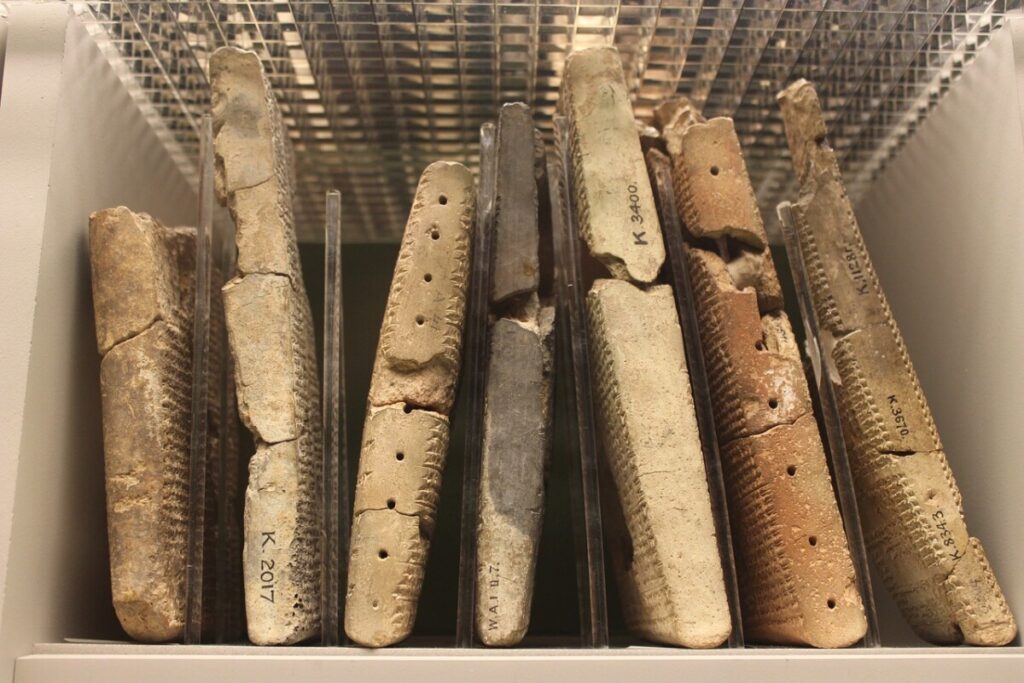
Earliest known writing in Africa/Middle East zone. Human DNA today is the same as 50,000 BCE. There is no doubt there were many dozens and perhaps thousands of civilizations prior to the Sumer civilization, but Sumer is the earliest known, or at least the earliest well known. The Sumer civilization first established between 6500 and

Hinduism, one of the world’s oldest religions, emerged around 1100 BCE, several centuries after the Indus Valley Civilization collapsed. Hinduism has no known roots in the IVC, but it’s a topic to follow as we uncover clues. There was a several century gap from the collapse of the IVC to the rise of the early
Major Religion: Hinduism Read More »