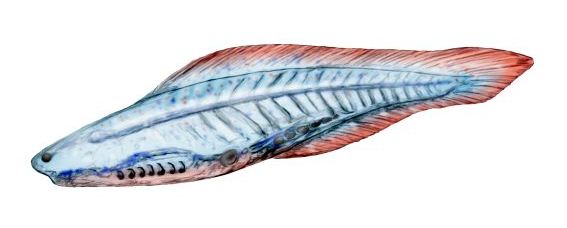
From no sentience or presentience to solidly “Simple Sentience,” early fish during this time represent our ancestral beings that started to suffer and feel the dichotomy of pleasure and pain.
Haikouichthys (circa 520 Million Years Ago): Dwelling in the ancient seas of the Cambrian period, Haikouichthys is among the earliest forms of vertebrate life, showcasing fundamental advancements in the complexity of the nervous system. Unlike its precursors in the Ediacaran period, which exhibited only the most rudimentary forms of interaction with their environment, Haikouichthys possessed a more developed nervous system, allowing for more nuanced responses to stimuli. This development marks a significant evolutionary leap towards the ability to experience basic forms of what we might consider suffering and pleasure. Its existence underscores a pivotal transition in the evolution of life, bridging the gap between the simplicity of early multicellular organisms and the complexity required for the nuanced experiences of sentience.
- Phylum: Chordata > Class: Agnatha (jawless fish)