

It’s the c in Einstein’s equation:
E = mc2
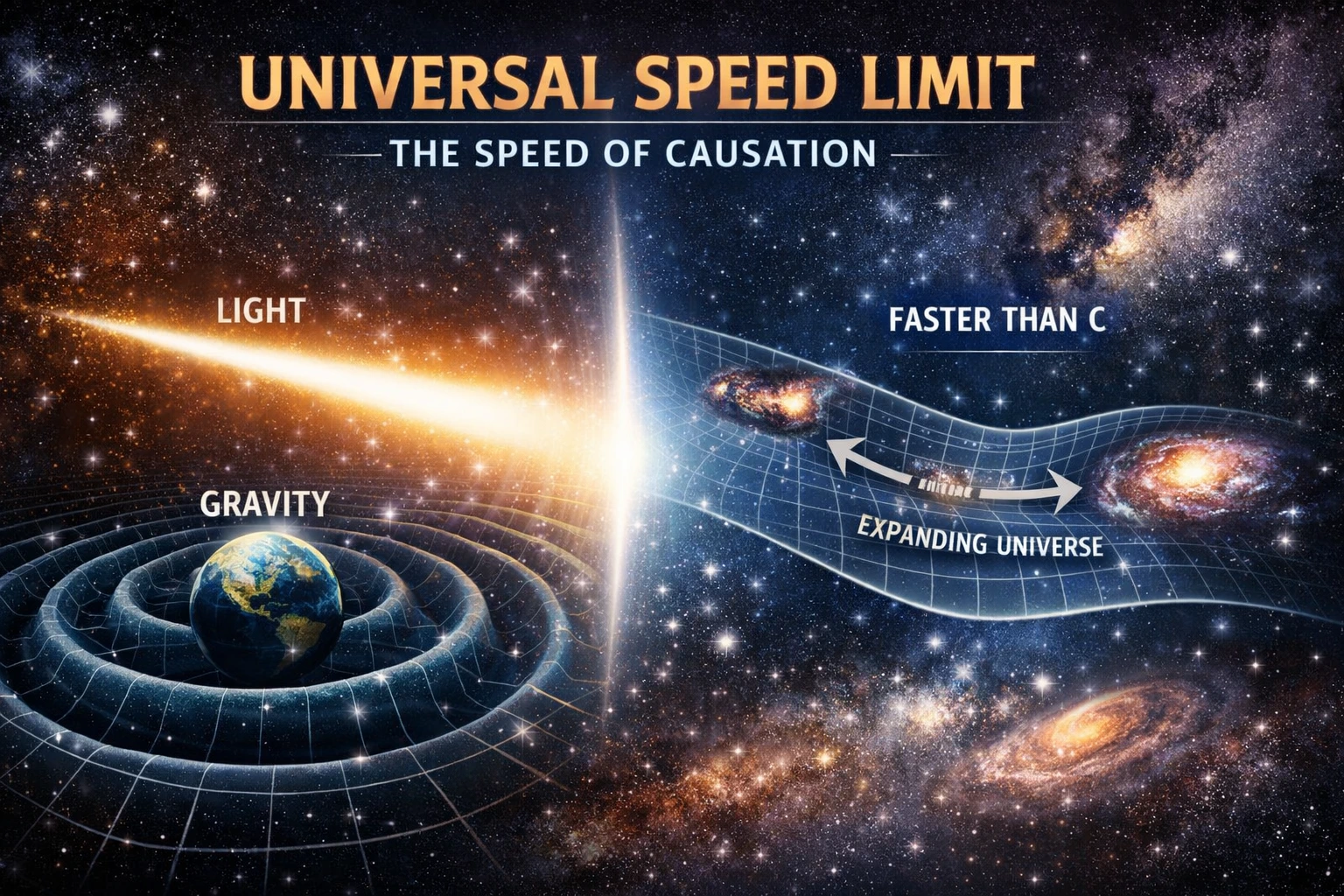
We call it the speed of light, but that name hides what the constant really is. Light is just one thing that travels at this speed, and it does this only in a vacuum. Other things travel at this speed too, for example, the effects of gravity. The constant isn’t about light—it’s about limits.
The so-called “speed of light” isn’t really about light at all. It’s the speed of causation, a fundamental limit built into spacetime itself as seen “within” our universe.
In modern physics, this constant defines the spacetime speed limit: the fastest rate at which cause and effect can propagate. It’s the speed of causality. Nothing carrying information, influence, or change can outrun it.
Light can appear slower because it interacts with matter. Glass, water, and plasma delay light. Gravity doesn’t interact that way, so its effects can arrive sooner. Light sometimes waits. Gravity does not.
This reveals a language problem. “Speed of light” is historically accurate but conceptually misleading. A better mental model is speed of causality, the maximum rate at which the universe allows events to affect other events.
There’s one more wrinkle: space itself is expanding, and that expansion can exceed the spacetime speed limit without violating it. No information travels faster than causality, but distances can grow faster than signals can cross. Any future unified theory will need to account for that distinction.
Since “speed of light” is clearly not the best term, how about we use “universal speed limit,” and many do now. And, define it as “the speed of causation.”

