

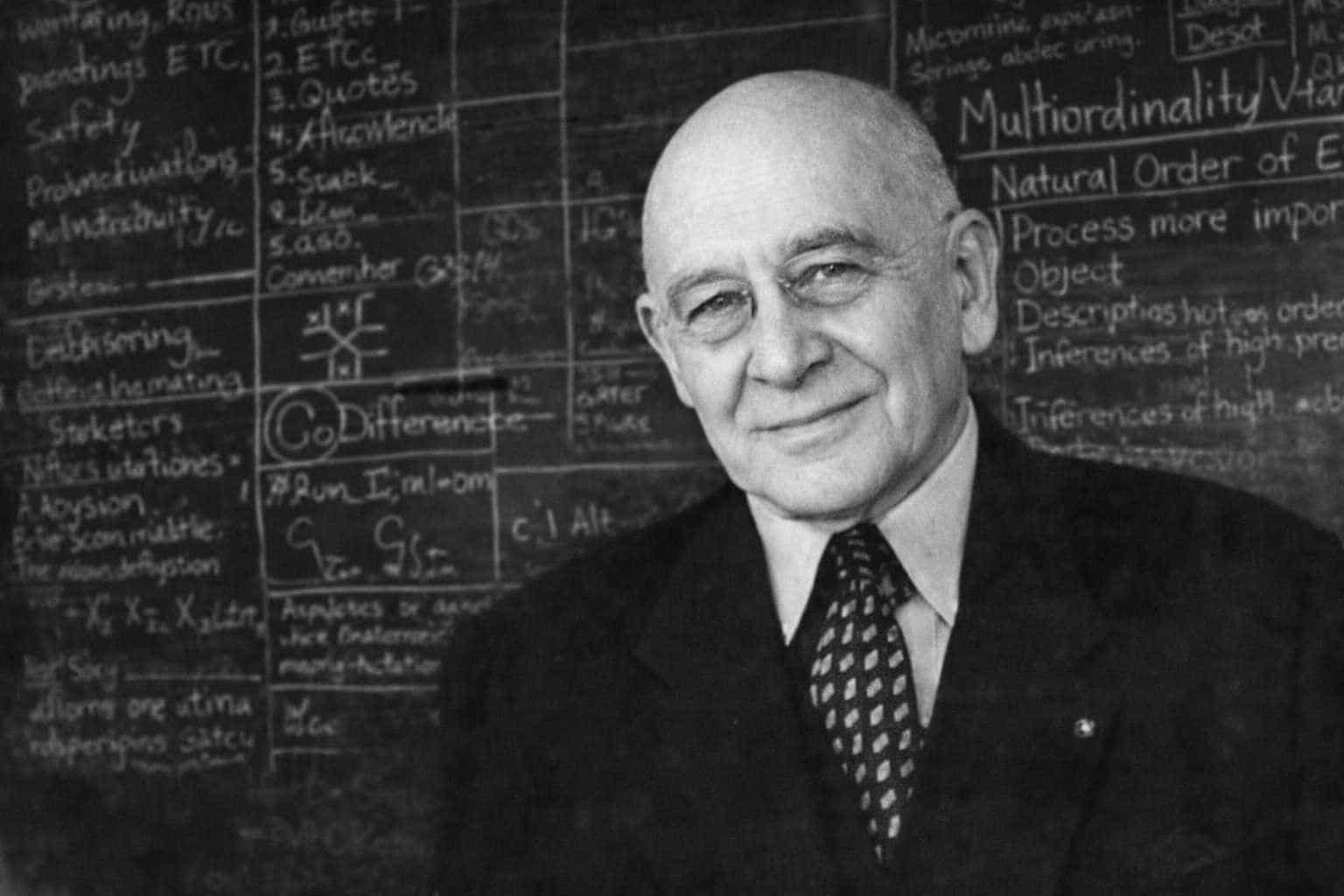
Alfred Korzybski was a Polish-American thinker trained in engineering and mathematics. After serving in World War I, he emigrated to the United States and devoted his life to studying how language shapes human thought.
“The map is not the territory.”
Korzybski devoted his life to a deceptively simple insight: humans confuse their descriptions of reality with reality itself. Trained as an engineer and shaped by the devastation of World War I, he became obsessed with how language, symbols, and models quietly shape belief and behavior. His work in general semantics wasn’t anti-science or anti-reason—it was a warning about abstraction. Models are indispensable, but when we forget they are models, they harden into dogma. Korzybski saw this mistake everywhere: in politics, ideology, education, and even science itself.
In 1933, he published Science and Sanity, where he introduced General Semantics — a framework for understanding how humans confuse words with reality. He later founded the Institute of General Semantics to develop and teach these ideas.
Korzybski was not primarily a traditional philosopher. He was closer to a systems thinker — someone concerned with how humans build models, how those models influence behavior, and how misuse of language distorts reasoning.
