

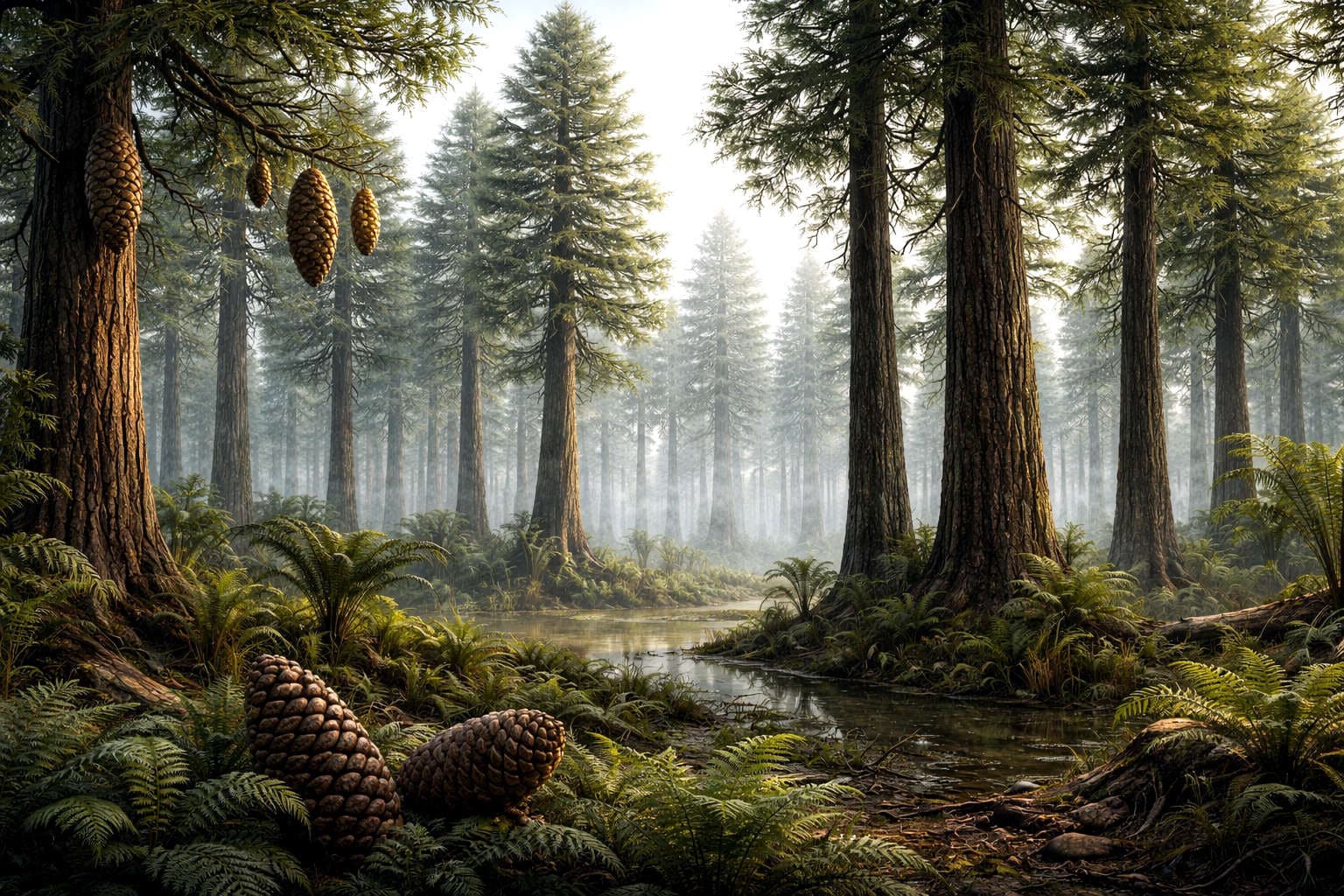
Conifers branch off during the late Carboniferous about 300 million years ago. This is when Earth’s vast coal swamps began to contract. Climates shifted. Regions became drier and more seasonal. Earlier seed plants already possessed the revolutionary advantage of seeds — embryos packaged with protection and stored food. But a new lineage refined survival on dry land even further.
Conifers emerged as specialists of aridity. They strengthened their trunks through robust secondary growth, producing dense wood that allowed greater height and long-term stability. This woody architecture supported long-lived trees capable of outlasting harsh cycles of drought and fire.
They also evolved extensive resin production — a chemical defense system that sealed wounds, repelled insects, and inhibited fungal invasion. Resin was not merely sticky sap; it was an evolutionary shield, preserving vascular integrity in an unforgiving environment.
Finally, conifers reduced water loss through narrow needle-like or scale-like leaves with thick cuticles and sunken stomata. These leaves minimized surface area while maintaining photosynthetic efficiency, allowing conifers to thrive where broad-leafed plants would wither.
Earlier seed plants cracked the code of reproduction away from water. Conifers perfected survival away from moisture.
