
Weekly Insights for Thinkers

Science  Philosophy  Critical Thinking  History  Politics RW  AI  Physics  •  Evolution  Astronomy 30 Phil Book More…
Science  Phil  Cr. Think  Hist 

STORY

Early Complex Sentience Emerges: Dimetrodon

By Michael Alan Prestwood

Sun 31 Mar 2024
Published 2 years ago.
Updated 2 years ago.
Share :

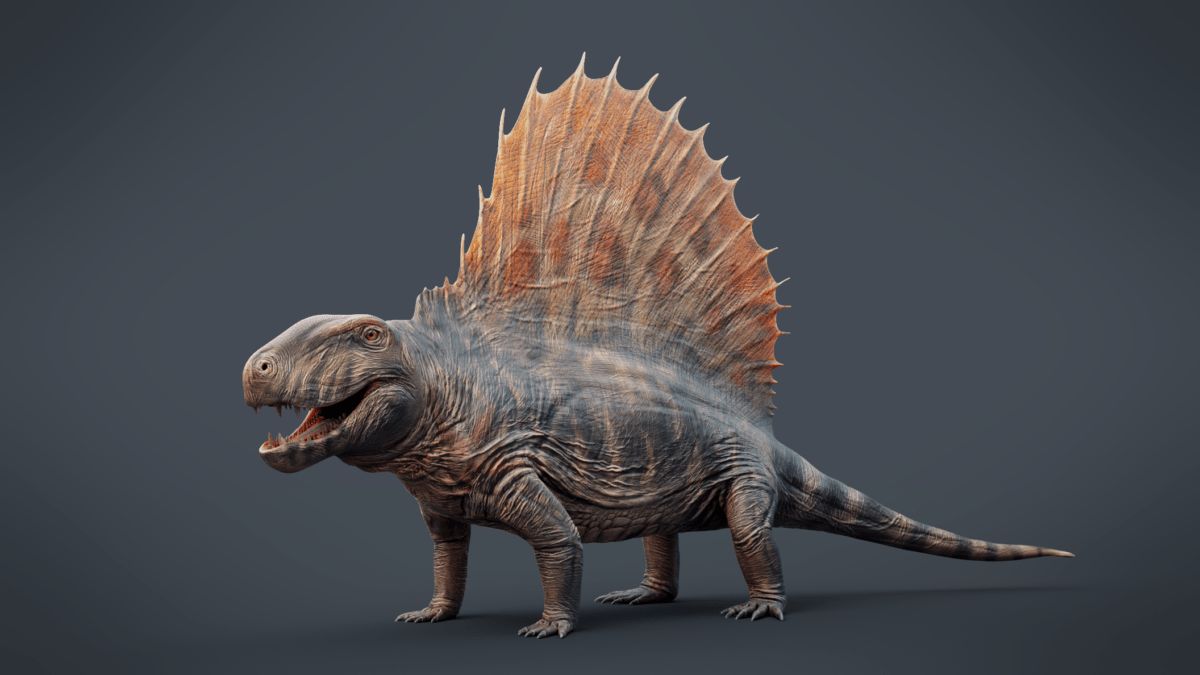
Early Complex Sentience Emerges: Dimetrodon

295 Million BCE
Complex Brains; Long-Term Memory; Early Complex Sentience.

Both reptiles and our ancestor synapsids evolved from amphibians. While reptiles evolved better amniotic eggs, synapsid eggs were like amphibian eggs. Synapsid’s birthing process eventually led to mammalian live births. These are the animals that evolved Complex Sentience, the ability to feel various emotions. While it is unknown when this complex spectrum fully evolved, it is defined as the ability to suffer and feel the dichotomy of pleasure and pain. Dimetrodon is an example of a meat eater, which if any of our ancestors were meat eaters. Although not a While dimetrodons were not direct ancestor of mammals, our mammalian ancestors might have been similar to our direct-line ancestors around this time. 

Class: Synapsids (pre-mammal, not a dinosaur, not pre-dinosaur)
Evolution: Amphibians > Amniotes > Early Reptiles > Synapsids
Time Period: Late Triassic to Early Jurassic; 295-272 Mya; Diet: Carnivore

— map / TST —

Michael Alan Prestwood
Author & Natural Philosopher
Prestwood writes on science-first philosophy, with particular attention to the convergence of disciplines. Drawing on his TST Framework, his work emphasizes rational inquiry grounded in empirical observation while engaging questions at the edges of established knowledge. With TouchstoneTruth positioned as a living touchstone, this work aims to contribute reliable, evolving analysis in an emerging AI era where the credibility of information is increasingly contested.
This Week @ TST
February 25, 2026
»Edition Archive
WWB Research….
1. Story of the Week
Alfred Korzybski
2. Quote of the Week
Live legal, moral, and fair.
3. Science FAQ »
What does neuroscience say about “identity?”
4. Philosophy FAQ »
Why do people confuse explanations with reality?
5. Critical Thinking FAQ »
What is worldview humility?
6. History FAQ!
What does history teach us about authoritarian rule?
Bonus Deep-Dive Article
Mindscape Framework
Scroll to Top