
Weekly Insight for Thinkers
Science  Philosophy  Critical Thinking  History  Politics RW  AI  Physics  •  Evolution  Astronomy 30 Phil Book More…

TIMELINE STORY

Earliest Known Domesticated Animal: Dogs

By Michael Alan Prestwood

Author and Natural Philosopher

04 Apr 2024
Published 2 years ago.
Updated 1 year ago.
Share :

Earliest Known Domesticated Animal: Dogs

By 20,000 BCE
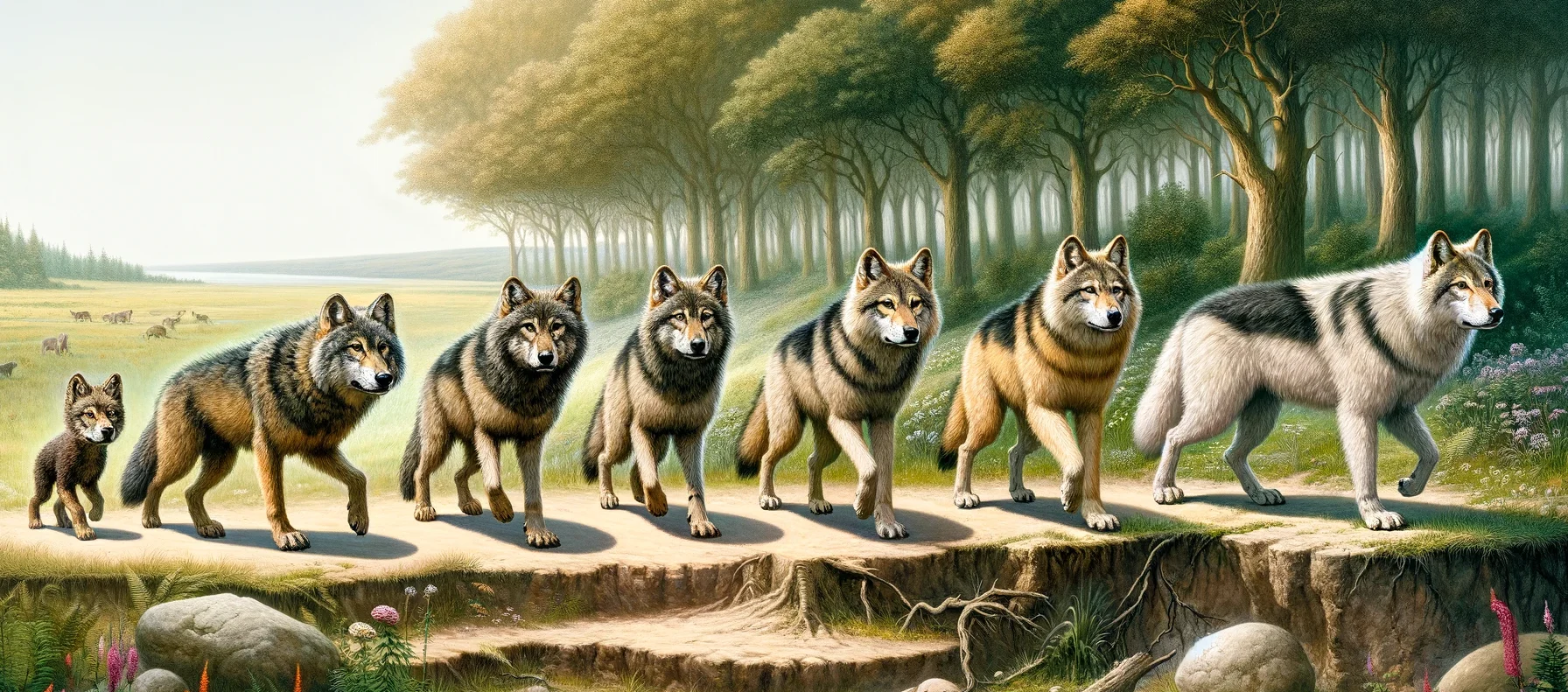
Wolf-to-dog: same species, dogs are a subspecies
Wolves were domesticated between 15 to 40 thousand BCE and evolved to a subspecies. Dogs (Canis lupus familiaris) are generally considered the same species as wolves (Canis lupus) but are classified as a subspecies.

Earliest Known Domesticated Animal: Dogs

Eastern Asia and Europe: The domestication of dogs marks one of the most remarkable and earliest examples of animal domestication by humans. This significant event occurred approximately 20,000 years ago, with some studies suggesting an even earlier date. The process began when wolves, drawn by the waste and remnants of hunting left by human groups, started to linger around the fringes of hunter-gatherer camps. Over time, a mutual relationship developed: these ancestral wolves provided humans with alertness to dangers and help in hunting, while humans provided a steady food source.

The transformation from wild wolves to domesticated dogs likely took place in several regions independently, but genetic evidence points to significant early domestication events occurring in Eastern Asia and Europe. Through a natural and then increasingly intentional process of selection, humans favored wolves that exhibited traits beneficial to their lifestyle—traits like reduced fear and aggression, which made them better companions and guards. This led to genetic divergence from their wild counterparts, morphing wolves into various forms and breeds of dogs as we recognize them today.

These early dogs were not just pets but integral to human societies, assisting in hunting, guarding territories, and providing companionship. Their roles expanded as human societies grew more complex, with dogs adapting to various climates and cultural expectations. The domestication of dogs not only highlights the adaptability and intelligence of these animals but also underscores the deep, symbiotic relationship that developed between two distinct species, setting the stage for the later domestication of other animals and the rise of agrarian societies.

Michael Alan Prestwood
Author & Natural Philosopher

Prestwood writes on science-first philosophy, with particular attention to the convergence of disciplines. Drawing on his TST Framework, his work emphasizes rational inquiry grounded in empirical observation while engaging questions at the edges of established knowledge. With TouchstoneTruth positioned as a living touchstone, this work aims to contribute reliable analysis in an emerging AI era where the credibility of information is increasingly contested.

WWB Menu
31 Dec 2025 Edition
Story of the Week
Platypus–Ape Common Ancestor
Quote of the Week
“I have a worldview. So do you.”
Weekly Crossroads!
1. Science »
Is “the speed of light” really the best name for the universe’s maximum speed?
2. Philosophy »
Was Einstein’s Theory of Relativity ever irrational?
3. Critical Thinking »
Why we only remember the good parts of vacations and forget the bad?
4. History!
Who is the father of numerology?
WWB Menu
31 Dec 2025 Edition
Story of the Week
Platypus–Ape Common Ancestor
Quote of the Week
“I have a worldview. So do you.”
Weekly Crossroads!
1. Science »
Is “the speed of light” really the best name for the universe’s maximum speed?
2. Philosophy »
Was Einstein’s Theory of Relativity ever irrational?
3. Critical Thinking »
Why we only remember the good parts of vacations and forget the bad?
4. History!
Who is the father of numerology?
Scroll to Top