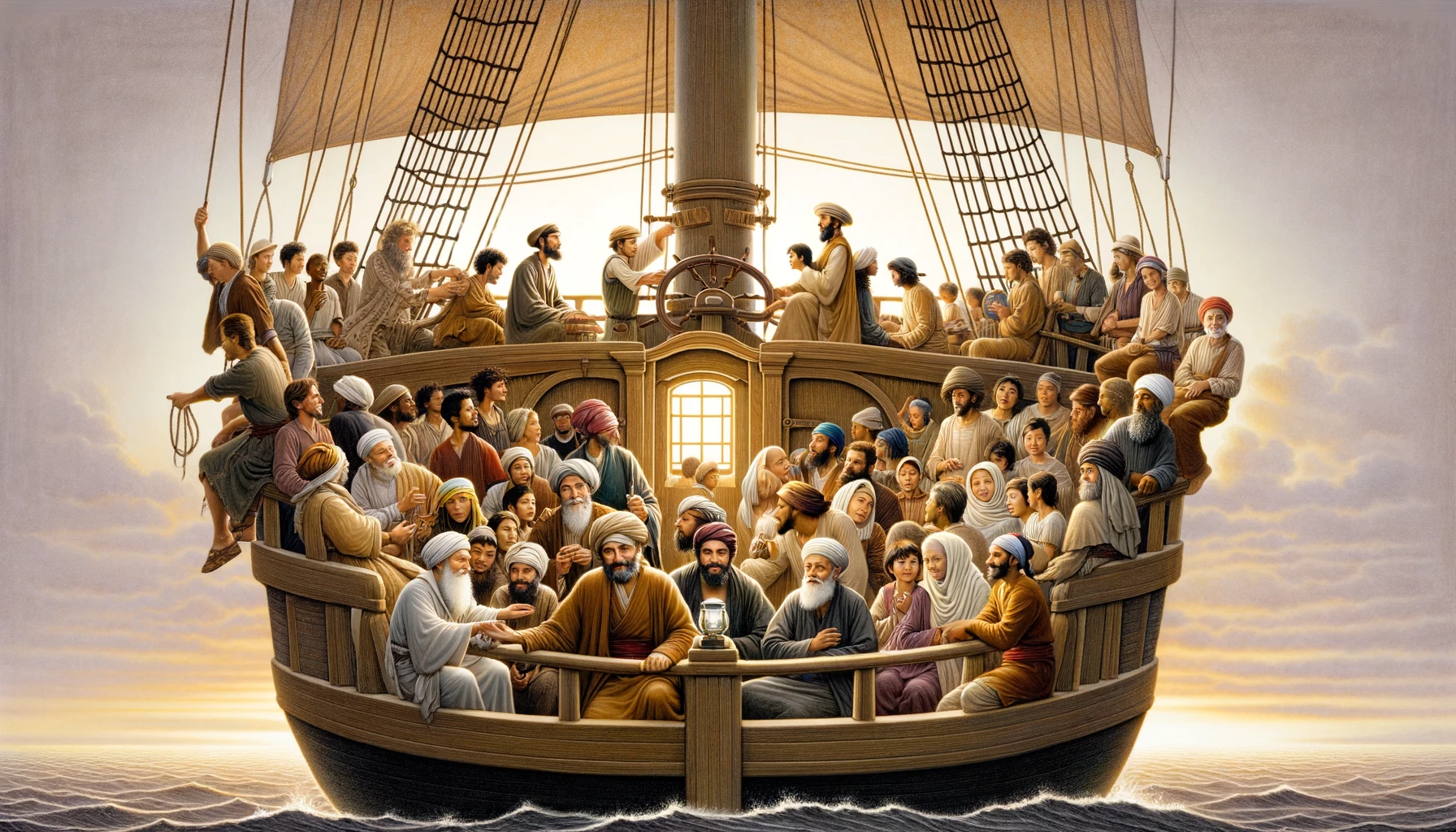
Buckle up! We’re about to embark on a fascinating journey through history. Roger Williams wrote his Parable of the Ship in 1655 to promote his groundbreaking idea for the separation of church and state.
Here it is in a nutshell…
Imagine a rickety old ship, creaking its way across the ocean. Crammed on board are folks from all walks of life – Protestants saying grace, Catholics muttering Hail Marys, and a rabbi studying scripture by the light of a flickering lantern. This diverse crew is like a miniature society, and Williams, a sharp thinker aboard this metaphorical vessel, used it to sell his idea.
Back then, folks believed the captain, think government, should also be their religious leader. They figured everyone on board should sing the same hymns and follow the same religious practices.
His Parable argued that forcing everyone to follow one religion was a recipe for mutiny. He proposed a system where the captain (the government) focuses on keeping the ship afloat – making sure everyone has enough food, the sails are in good order, and nobody goes overboard. As for religion? That’s a personal choice, like choosing your favorite sea shanty to sing while you swab the deck.
Fast-forward to the 18th century, the Founding Fathers included his idea as the very First Amendment. So, the next time you hear about the First Amendment, remember Roger Williams and his Parable of the Ship. It’s a reminder that a smooth-sailing society is one where everyone has the freedom to choose their own religious course, or no religious course, so long as they contribute to the common good and don’t rock the boat too much!