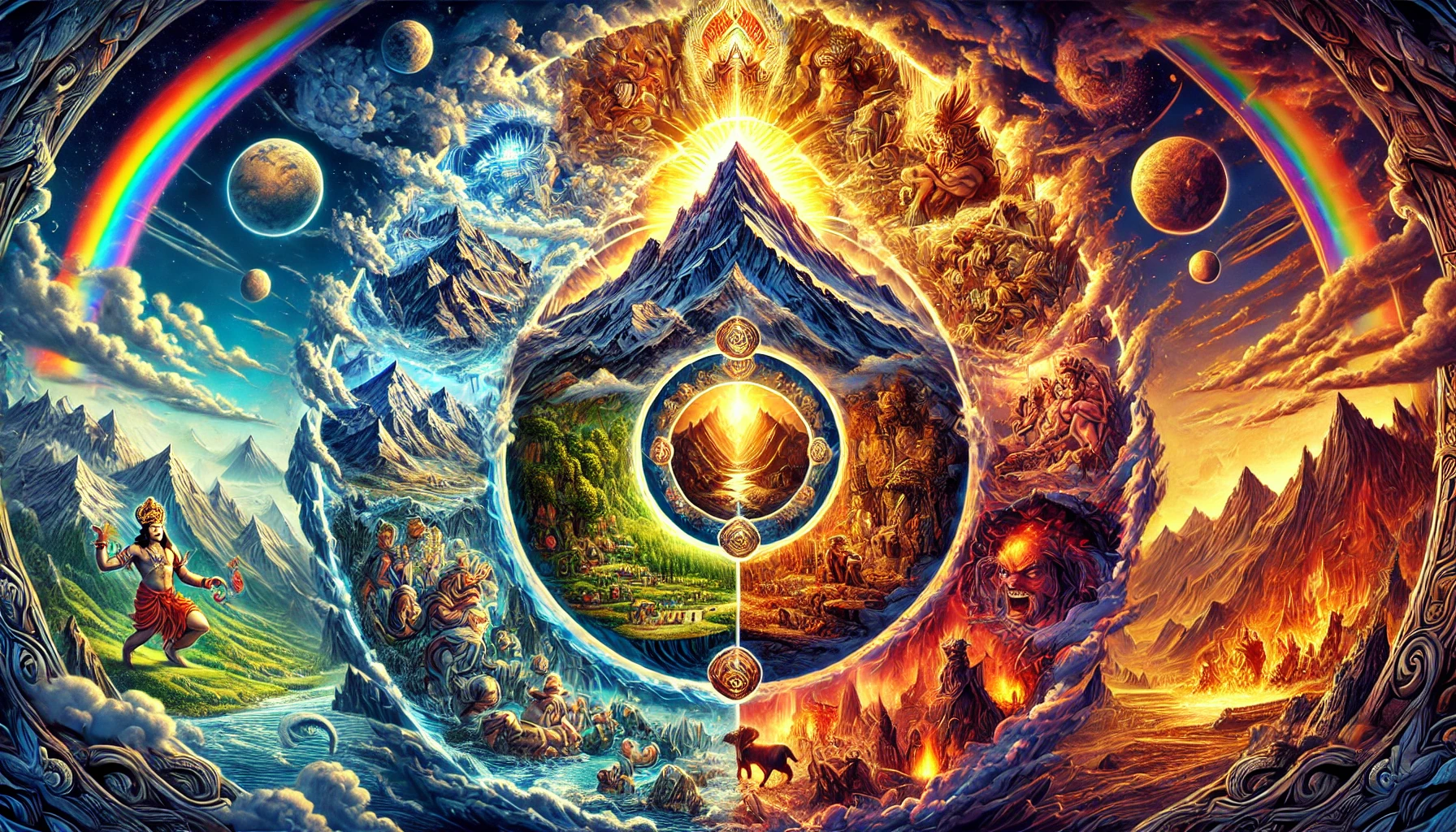
Did the Buddha believe in Mount Meru and the six realms of existence?
< 1 minute read
Not likely, but we do not know for sure. For sure, his teachings on overcoming suffering in this life suggests he didn’t. Also, he did not believe in an afterlife for the self you feel today. That is clear with his teachings on non-self. His focus was on overcoming suffering in this life, not the next.
In ancient India, Mount Meru was widely understood as the cosmic mountain at the center of the universe, with realms of gods above and lower realms below. This worldview included six realms of existence: gods, demigods or asuras, humans, animals, hungry ghosts, and hell beings. These ideas shaped ancient India and influenced traditions such as Hinduism, Jainism, Buddhism, and later Sikhism. Even today, some believers take these realms literally, while others treat them more symbolically.
The Buddha incorporated local cosmology as teaching tools, not as the center of his message. This fits well with the broader Buddhist shift away from a permanent self. What continues is not the self, but more like a lingering essence shaped by karma. Not a soul in the self-identity sense, but a continuity of non-self. Non-self is key to overcoming suffering in this life. In this framework, local beliefs were not the focus.
So the cautious answer is this: the Buddha taught within a worldview that included Mount Meru and the six realms, but his enduring message does not depend on those ideas being literally true. Buddhism allows you to honor the story, learn from it, and still ask hard questions about what should be treated as belief, symbolism, and truth.
Thanissaro Bhikkhu, trans. 2005. “Sammādiṭṭhi Sutta: Right View (MN 9).” Majjhima Nikāya. Describes abandoning ignorance and attachment as putting an end to suffering right in the here and now.
Bodhi, Bhikkhu, trans. 2007. “Brahmajāla Sutta: The All-embracing Net of Views (DN 1).” Dīgha Nikāya. 2nd ed. SuttaCentral. Originally published 1978. Describes Gautama abstaining from divination, omens, astrology, dream interpretation, charms, demonology, sacrifices to gods, fortune-telling, magical protections, and related practices, categorizing them as wrong livelihood or “debased arts.”
Sujato, Bhikkhu, trans. 2018. “Sattasūriya Sutta: Seven Suns (AN 7.66).” Aṅguttara Nikāya. SuttaCentral. Gautama uses the imagined destruction of Mount Meru to teach impermanence, supporting the interpretation that inherited cosmology could function as a teaching device rather than as the central point of the lesson.
Wynne, Alexander. 2010. “The Buddha’s ‘Skill in Means’ and the Genesis of the Five Aggregate Teaching.” Journal of the Royal Asiatic Society 20, no. 2: 191–216. https://doi.org/10.1017/S1356186309990496. Wynne argues that the didactic structure of an early discourse preserves evidence of Gautama adapting teachings in response to particular problems rather than merely repeating doctrine.
Siderits, Mark. 2011. “Buddha.” Stanford Encyclopedia of Philosophy. Substantively revised March 6, 2023. Siderits notes that early sources portray Gautama refusing speculative questions concerning the postmortem existence of the liberated person because they do not contribute to ending suffering. He also explains how non-self undermines the assumption of an enduring person whose existence after death must be explained.
Prestwood. 2024. 30 Philosophers. Page Publishing. Chapter 6 interprets Gautama’s philosophy around suffering, non-self, impermanence, attachment, and delusion, distinguishing his practical teachings from supernatural elements that accumulated within later Buddhist traditions.
Prestwood. 2024. “Did the Buddha Believe in Rebirth or Reincarnation?” TouchstoneTruth.com. Distinguishes Gautama’s concept of rebirth from reincarnation, emphasizing that Buddhism rejects an eternal self or soul that survives death while allowing for a causal continuity shaped by karma.
The Buddha used Mount Meru and the six realms as metaphors to guide followers toward enlightenment. His teachings focused on overcoming suffering in this life, suggesting that the essence of his message transcends the mythologies of his time, urging us to seek deeper meaning beyond the surface of beliefs.
Michael Alan Prestwood Author & Natural Philosopher
Prestwood writes on science-first philosophy, with particular attention to the convergence of disciplines. Drawing on his TST Framework, his work emphasizes rational inquiry grounded in empirical observation while engaging questions at the edges of established knowledge. With TouchstoneTruth positioned as a living touchstone, this work aims to contribute reliable, evolving analysis in an emerging AI era where the credibility of information is increasingly contested.