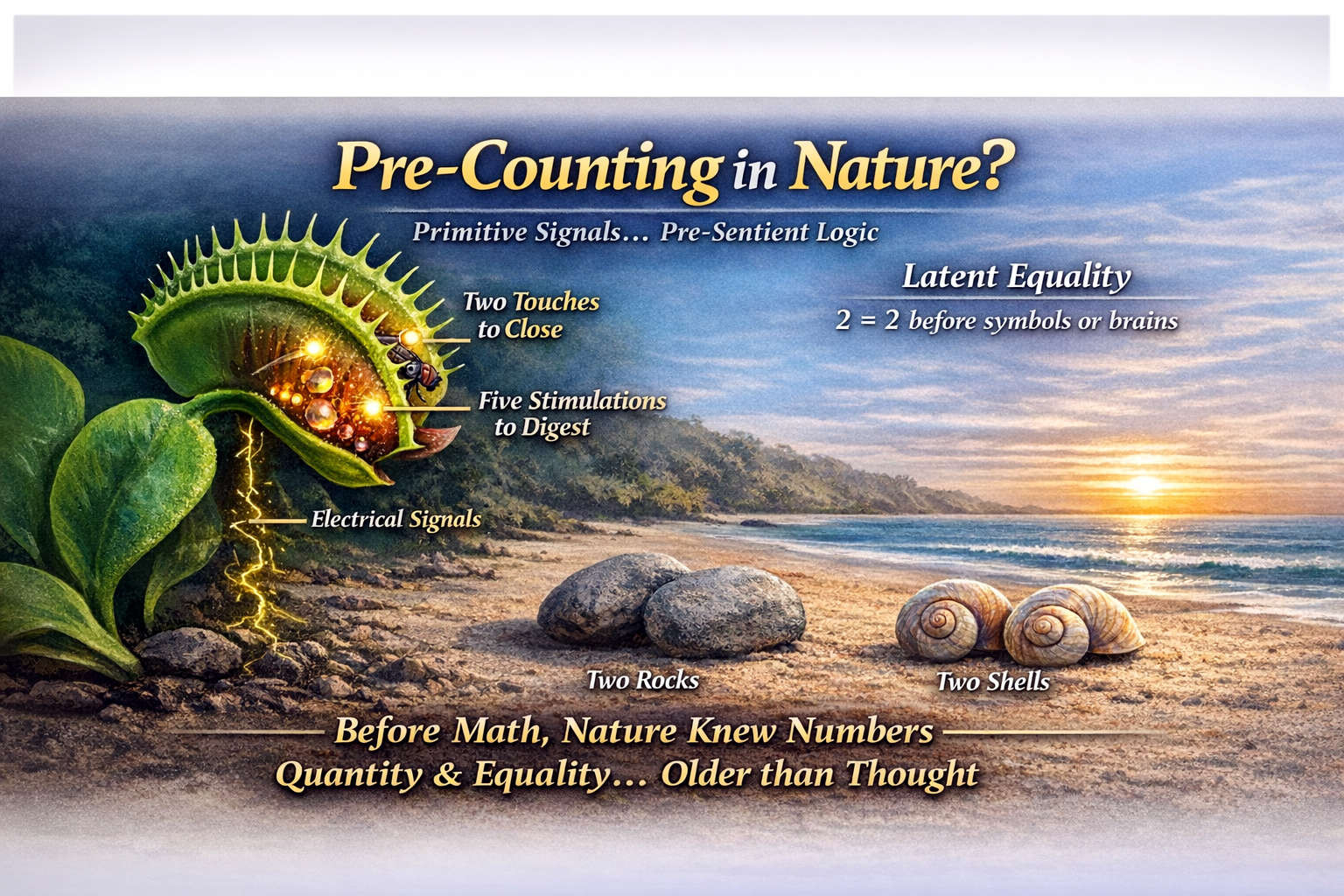
No. But pre-counting? Yes. And that’s surprisingly interesting — a clue to how evolution might sometimes lead toward cognition and, eventually, brains.
Let’s explore.
In my writing, I often use a simple image: two rocks next to two shells on a beach. Long before humans existed, those rocks and shells already stood in numerical equality. We didn’t invent that relation. We eventually noticed it, named it, symbolized it — but the structure itself was there.
Keep that in mind as we turn to the Venus flytrap.
In 30 Philosophers, I used what the flytrap does to explore the schema of eating. Is what it does the same as what we do? Should it carry the same label?
The flytrap captures prey, digests it, and absorbs nutrients. Biologically, that qualifies as feeding. But there’s no hunger, no awareness, no inner experience. It performs the function without the feeling. So perhaps it is a kind of pre-sentient eating — structurally similar, experientially absent.
The same question applies to movement. In general, animals move and plants don’t. Yet the so-called walking tree slowly shifts position through directional root growth. The Venus flytrap snaps shut through rapid hydraulic changes in its leaf cells. These are movements — just not locomotive movement directed by a nervous system. Again, we might call them pre-animal forms of movement.
Now consider counting.
A Venus flytrap usually requires two touches within about twenty seconds to trigger closure. After it closes, additional internal touches increase digestive enzyme production. Around five or so stimulations and digestion ramps up fully.
Is it counting to 20 while also counting to 2? Is it then counting to 5? No. There are no numbers involved.
What’s happening is electrical signal accumulation. Each touch generates an action potential. When enough signals accumulate within a short time window, a biochemical threshold is crossed and the trap responds.
But look at the structure:
It distinguishes one touch from two.
It distinguishes two from several.
It distinguishes “not enough” from “enough.”
That isn’t symbolic counting. But it is pre-counting — the tracking of discrete events over time with different outcomes based on quantity.
And now return to the rocks and shells.
Two rocks equaling two shells didn’t begin when humans arrived. That quantitative relation existed long before language, long before symbols, long before brains capable of arithmetic.
Humans invented mathematical notation.
But quantity, equality, thresholds — these are woven into nature.
The Venus flytrap doesn’t know what “two” means.
Yet nature already distinguishes between one and two.
And that suggests something profound: cognition, and even mathematics, may not appear out of nowhere. They may emerge gradually from pre-sentient structures already present in the fabric of life itself.