Explore Science-first Philosophy

FAQ

Can the Venus Flytrap Count?

Sat 28 Feb 2026
Published 2 months ago.
Updated 2 weeks ago.
Related FAQs
What is Ninio’s Extinction Illusion?
Was Plato’s Academy the first university?
When did the first flowers evolve?
What does superposition tell us about metaphysics?
Evolution: Why did we start walking upright?
What great apes have fur and which have hair?
Share :
Email
Print

Can the Venus Flytrap Count?

No. But pre-counting? Yes. And that’s surprisingly interesting — a clue to how evolution might sometimes lead toward cognition and, eventually, brains.

Let’s explore.

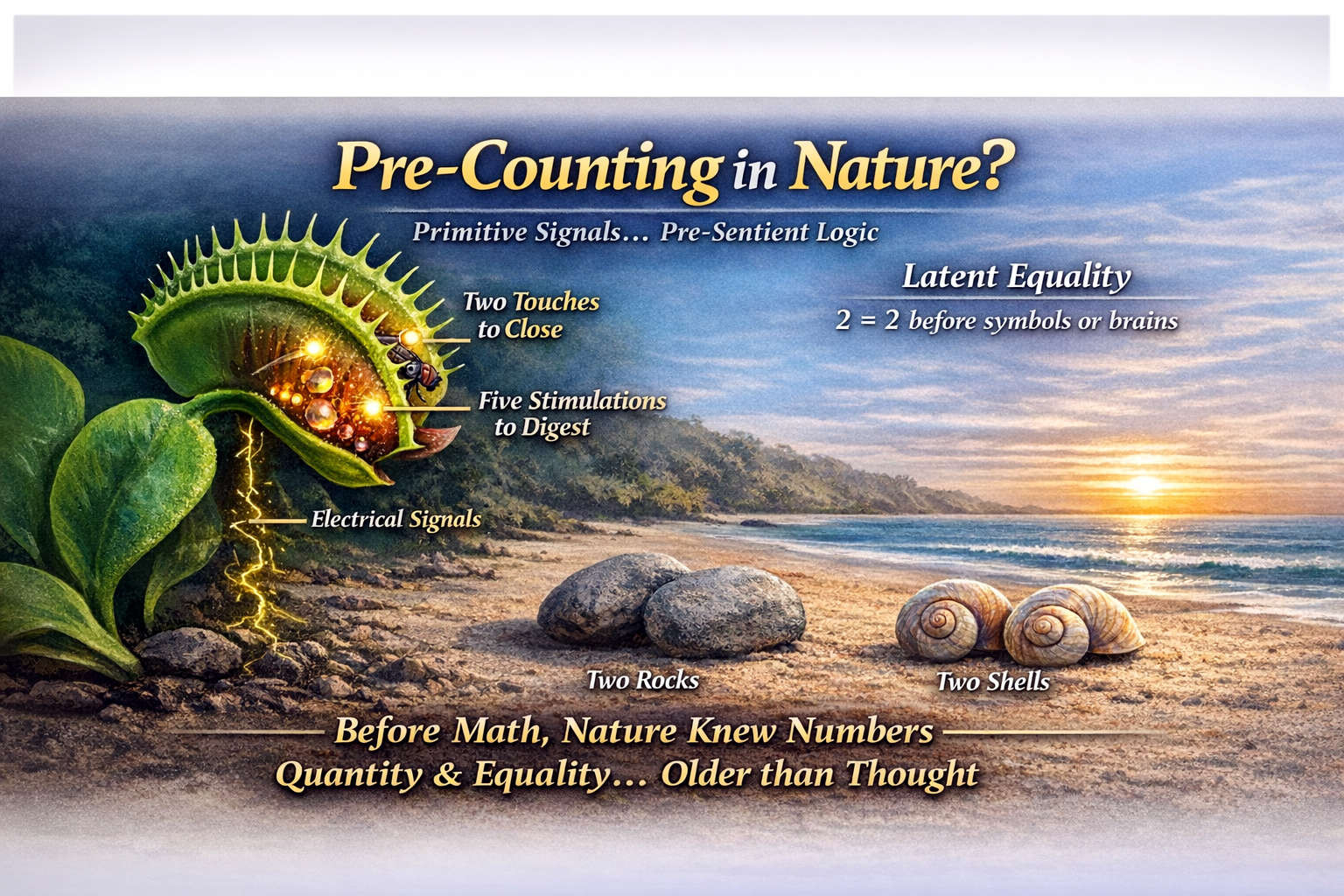
In my writing, I often use a simple image: two rocks next to two shells on a beach. Long before humans existed, those rocks and shells already stood in numerical equality. We didn’t invent that relation. We eventually noticed it, named it, symbolized it — but the structure itself was there.

Keep that in mind as we turn to the Venus flytrap.

In 30 Philosophers, I used what the flytrap does to explore the schema of eating. Is what it does the same as what we do? Should it carry the same label?

The flytrap captures prey, digests it, and absorbs nutrients. Biologically, that qualifies as feeding. But there’s no hunger, no awareness, no inner experience. It performs the function without the feeling. So perhaps it is a kind of pre-sentient eating — structurally similar, experientially absent.

The same question applies to movement. In general, animals move and plants don’t. Yet the so-called walking tree slowly shifts position through directional root growth. The Venus flytrap snaps shut through rapid hydraulic changes in its leaf cells. These are movements — just not locomotive movement directed by a nervous system. Again, we might call them pre-animal forms of movement.

Now consider counting.

A Venus flytrap usually requires two touches within about twenty seconds to trigger closure. After it closes, additional internal touches increase digestive enzyme production. Around five or so stimulations and digestion ramps up fully.

Is it counting to 20 while also counting to 2? Is it then counting to 5? No. There are no numbers involved.

What’s happening is electrical signal accumulation. Each touch generates an action potential. When enough signals accumulate within a short time window, a biochemical threshold is crossed and the trap responds.

But look at the structure:

It distinguishes one touch from two.
It distinguishes two from several.
It distinguishes “not enough” from “enough.”

That isn’t symbolic counting. But it is pre-counting — the tracking of discrete events over time with different outcomes based on quantity.

And now return to the rocks and shells.

Two rocks equaling two shells didn’t begin when humans arrived. That quantitative relation existed long before language, long before symbols, long before brains capable of arithmetic.

Humans invented mathematical notation.

But quantity, equality, thresholds — these are woven into nature.

The Venus flytrap doesn’t know what “two” means.

Yet nature already distinguishes between one and two.

And that suggests something profound: cognition, and even mathematics, may not appear out of nowhere. They may emerge gradually from pre-sentient structures already present in the fabric of life itself.

— map / TST —

A Venus flytrap does not "count" the way humans do. But it integrates signals over time which is the core idea. Two trigger hairs within about twenty seconds cause it to close. A pre-counting pre-sentient thing.
Michael Alan Prestwood
Author & Natural Philosopher
Prestwood writes on science-first philosophy, with particular attention to the convergence of disciplines. Drawing on his TST Framework, his work emphasizes rational inquiry grounded in empirical observation while engaging questions at the edges of established knowledge. With TouchstoneTruth positioned as a living touchstone, this work aims to contribute reliable, evolving analysis in an emerging AI era where the credibility of information is increasingly contested.
This Week @ TST
April 15, 2026
»Column Archive
WWB Research….
1. Story of the Week
John Snow and the Broad Street Pump
2. Quote of the Week
“A wise man proportions his belief to the evidence.”
3. Science FAQ »
Were dinosaurs Jurassic movie smart?
4. Philosophy FAQ »
How does the idea of Identity in Christ fit within TST?
5. Critical Thinking FAQ »
What is the difference between Public Truth and Public Belief?
6. History FAQ!
Did Einstein’s driver really give one of his early talks?
Bonus Deep-Dive Article
TST Epistemic Calibration: Credence and Degrees of Belief

Comments

Join the Conversation! Currently logged out.
NEW BOOK! NOW AVAILABLE!!

30 Philosophers: A New Look at Timeless Ideas

by Michael Alan Prestwood
The story of the history of our best ideas!
Scroll to Top