

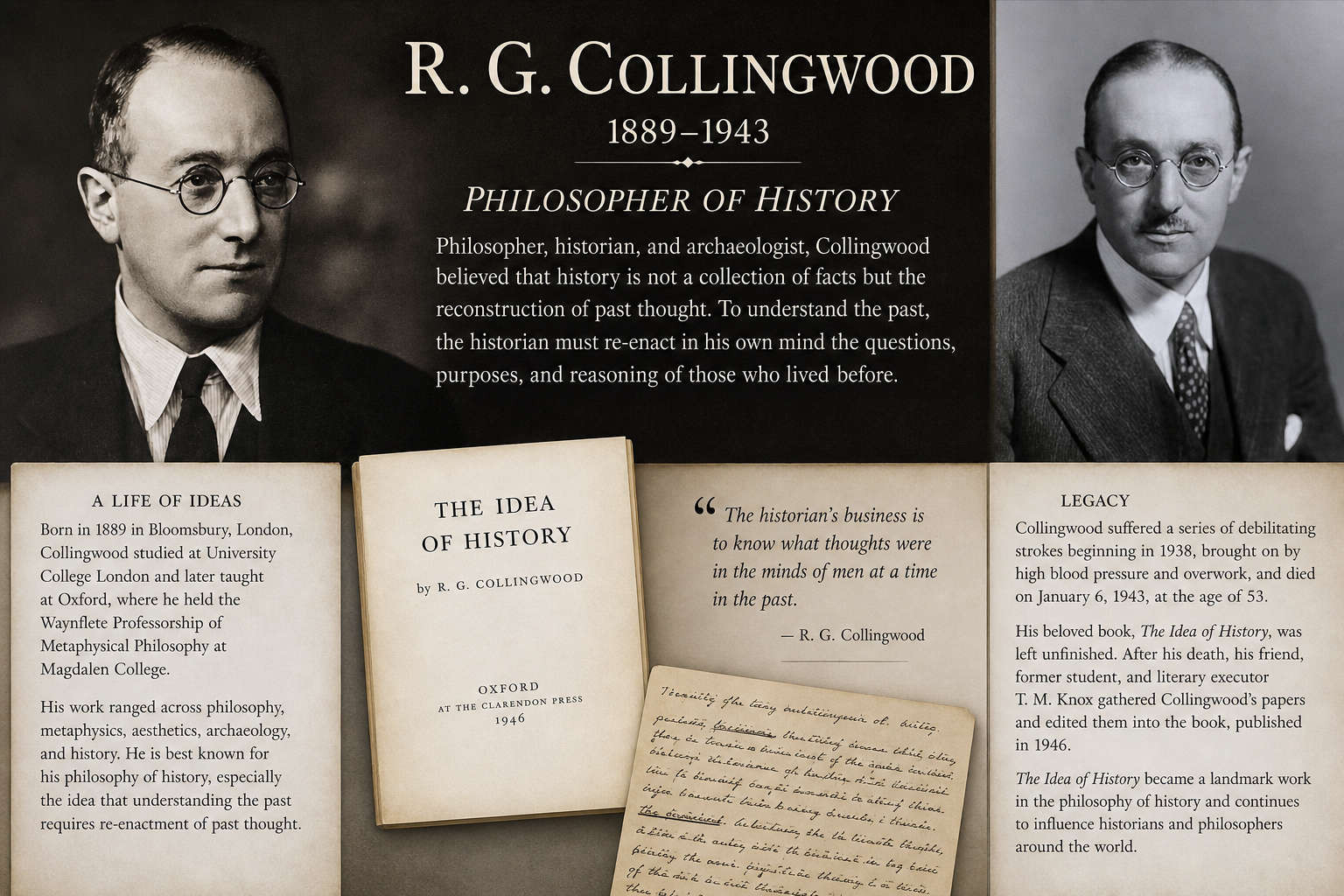
R. G. Collingwood’s ideas in his 1946 book The Idea of History helped recraft the philosophy of history. To understand the past, the historian must do more than collect evidence akin to reporting; the historian must also be like a journalist and think through the actions, purposes, and questions of those who lived before. The goal? To document the roots, intent, and influence of the facts of history.
Collingwood’s ideas align strongly with empirical narrative realism. His famous idea of historical “re-enactment” means that historians try to reconstruct the thought behind past human actions. The past is a retelling. The event happened in the material world, but the historical account requires rational thought. Collingwood supported the idea that history is indirect rational reconstruction, not direct empirical observation.
Collingwood treated history as a kind of science, and placed it near the center of serious academic inquiry. History deserves that seriousness, but it fits more specifically within journalism: a public-truth discipline that gathers evidence, investigates conflict, builds narratives, and calibrates confidence.
The surviving traces are empirical. A diary, fossil, photograph, or ruin gives history an empirical anchor. The narrative built from those traces is rational because it arranges evidence into sequence, cause, context, and meaning. This also gives us the language of confidence: some historical stories align with reality strongly, some are weak, and some collapse when reality pushes back. Historical writing becomes irrational when it outruns the evidence and drifts into unsupported speculation.

