

In wave-particle duality, a quantum object exists in a superposition of all possible paths—until we measure it. The double-slit experiment shows that an electron, photon, or atom can produce an interference pattern like a wave, yet arrive at a detector as a single localized hit. As strange as that is, that is what the evidence is showing us. And until someone can explain that evidence better, we have to treat it as what is happening—or at least what seems to be happening.
That brings us to a cat.
Schrödinger’s Cat isn’t just a thought experiment—it’s a metaphor for reality itself. It forces us to ask:
Is the world deterministic, or does it exist as a cloud of possibilities until we observe it?
Schrödinger’s Cat exposes the measurement problem in quantum mechanics.
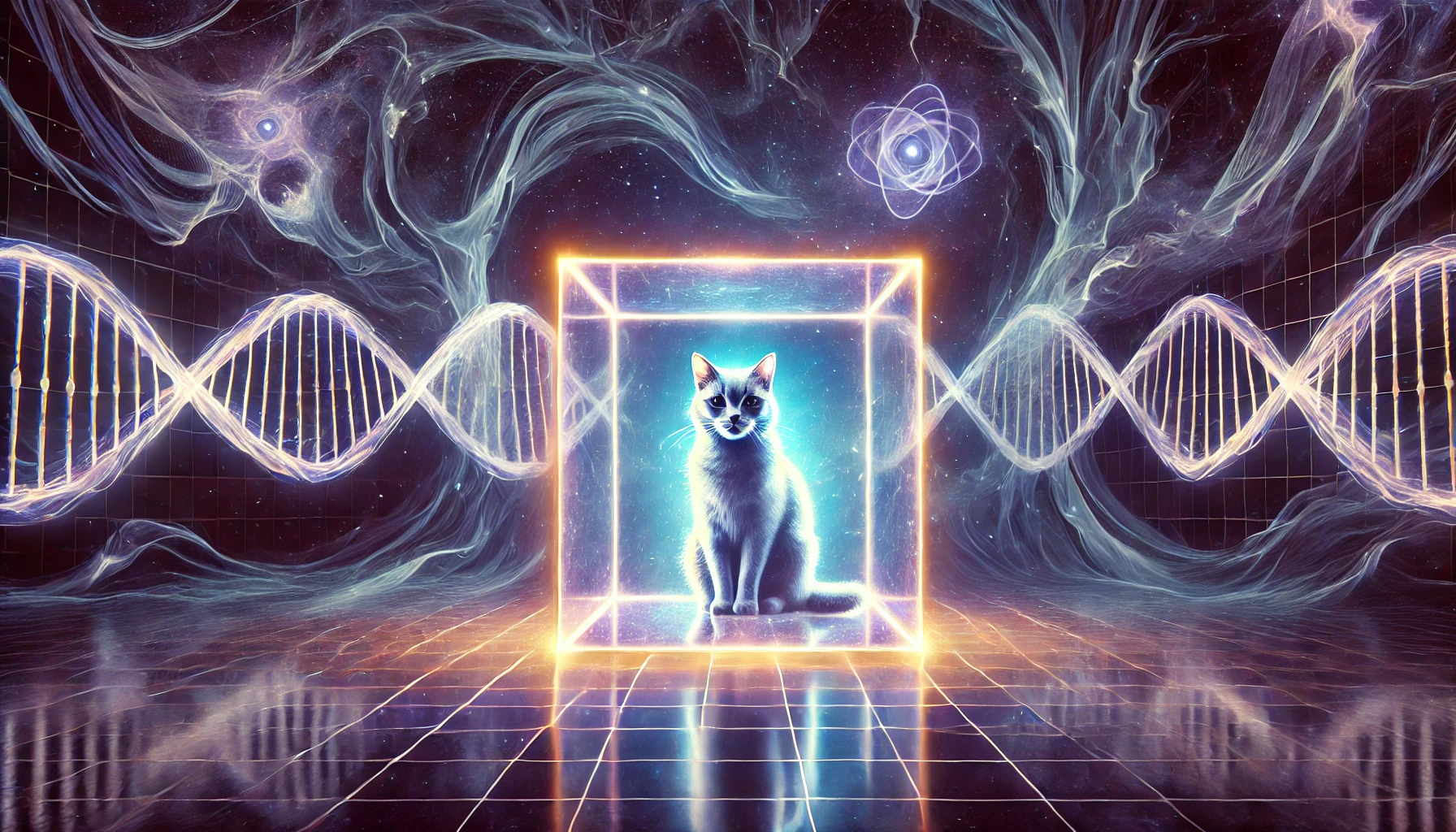
In 1935, Einstein was arguing that quantum mechanics could not be the whole story, famously saying things like, “God does not play dice with the universe.” During this unsettled time, Schrödinger leaned in that direction and introduced the world to a cat. He sealed it, in thought, inside a box with a radioactive atom, a detector, and a vial of poison. If the atom decays, the poison is released and the cat dies. If it does not, the cat lives. Yet before the box is opened, quantum theory seems to describe the whole system as if both outcomes are somehow still in play: alive and dead. Schrödinger was highlighting how bizarre the discussion had become, how strange quantum language sounds when applied to the visible world of boxes, poison, and cats. And we are still having that debate. But for now, the bizarreness seems to be part of the evidence itself.
This is where the multiverse enters the story. Schrödinger’s Cat takes the weirdness of quantum superposition and pushes it into the macro world. If quantum mechanics applies all the way up, then what becomes of the two possible outcomes? In the Copenhagen-style view, measurement gives one actual result. In the Many-Worlds Interpretation, there is no single collapse in the usual sense. Instead, both outcomes continue in different branches of reality: in one, the cat lives; in another, the cat dies. So the cat does not merely help explain wave-particle duality. It turns that mystery into a metaphysical challenge:
Is reality fixed and singular, or does it branch into multiple equally real outcomes?

