

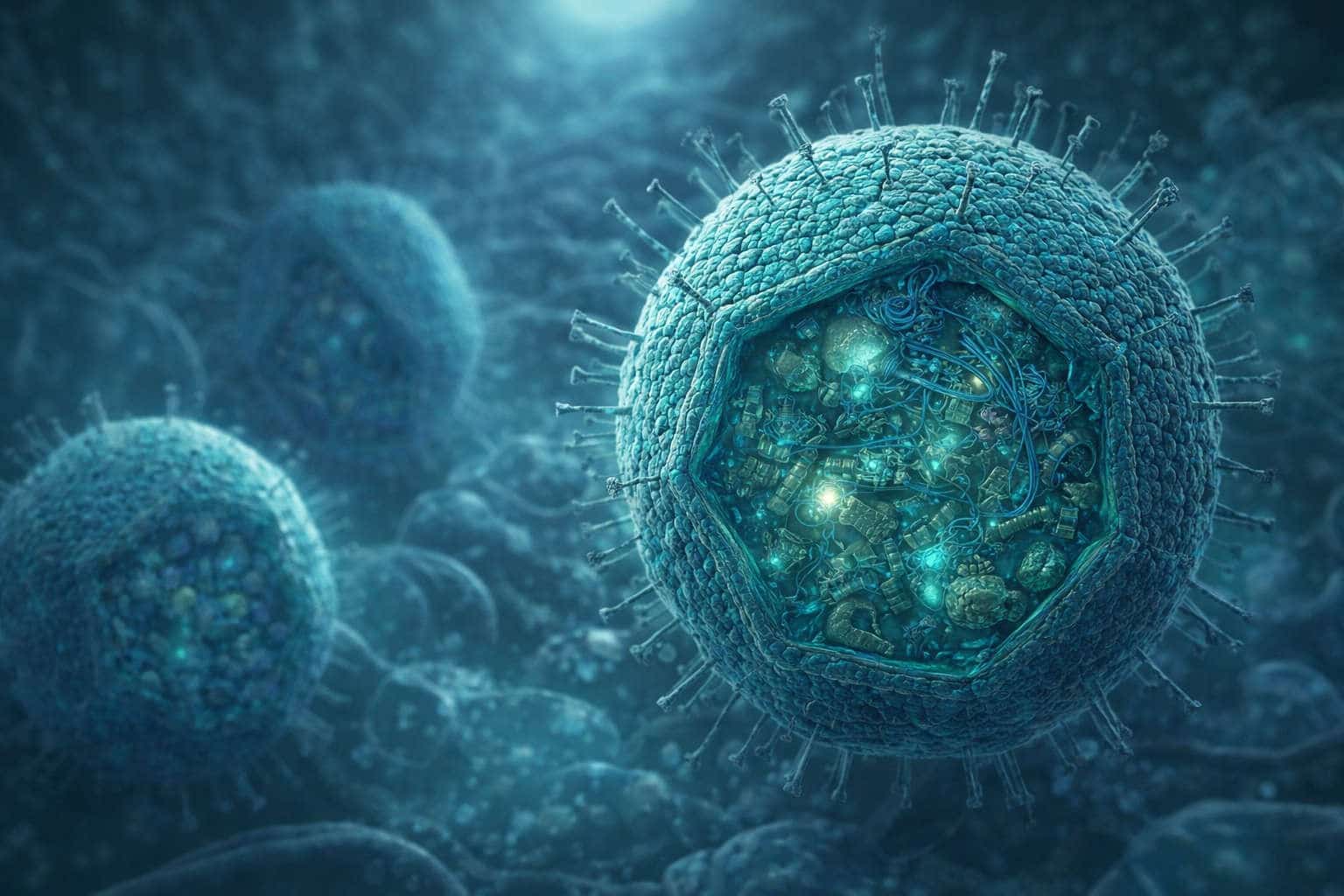
Giant viruses evolved by “hoarding” cellular genes, expanding their genomes until they blurred the line between a simple virus and a living cell.
Appearing alongside early eukaryotes, these members of Varidnaviria specialized in extreme genetic theft. By stealing complex tools from their hosts—including machinery for metabolism and protein synthesis—they grew into massive, “cell-like” entities such as Mimiviruses, often carrying more DNA and complexity than the bacteria they were once mistaken for.
Giant viruses are the “pack rats” of the virosphere. They didn’t just evolve to survive; they evolved to impersonate life.
The Eukaryotic Connection: Because these viruses are so large, they require a complex “factory” to build them. They only appeared after Eukaryotes developed the advanced internal plumbing (like the endoplasmic reticulum) that the viruses could hijack.
The “Fourth Domain” Debate: For a while, their size led scientists to wonder if they were a “lost” fourth domain of life that “devolved” into viruses. However, modern genetic clocks show they are actually “regular” viruses that simply went on a massive gene-stealing spree from their hosts.
Complex Machinery: Some giant viruses are so sophisticated they have their own “immune systems” and can even be infected by smaller viruses (called virophages).
This completes your viral timeline! We’ve gone from the “RNA World” to “Giant Mimics.” Would you like to pivot now to the “Boring Billion” (1.8 to 0.8 BYA)—the period where these complex cells were quietly preparing for the explosion of animal life?
