
Phil • Cr. Think • Science • Hist •
TST PRACTICE

The Philosophy Website

STORY

Retroviruses (within Riboviria)

☐ Read
☑ Read
You’ve read this 0 times.
You’ve listened to this 0 times.

By Michael Alan Prestwood

Sun 22 Feb 2026
Published 7 months ago.
Updated 9 hours ago.
Related Stories
Schema
Neolithic Symbols: China
Grand Rational Framework
Monodnaviria
Ordovician–Silurian Extinction: Ice Strikes the Seas
Aristotle
Share :
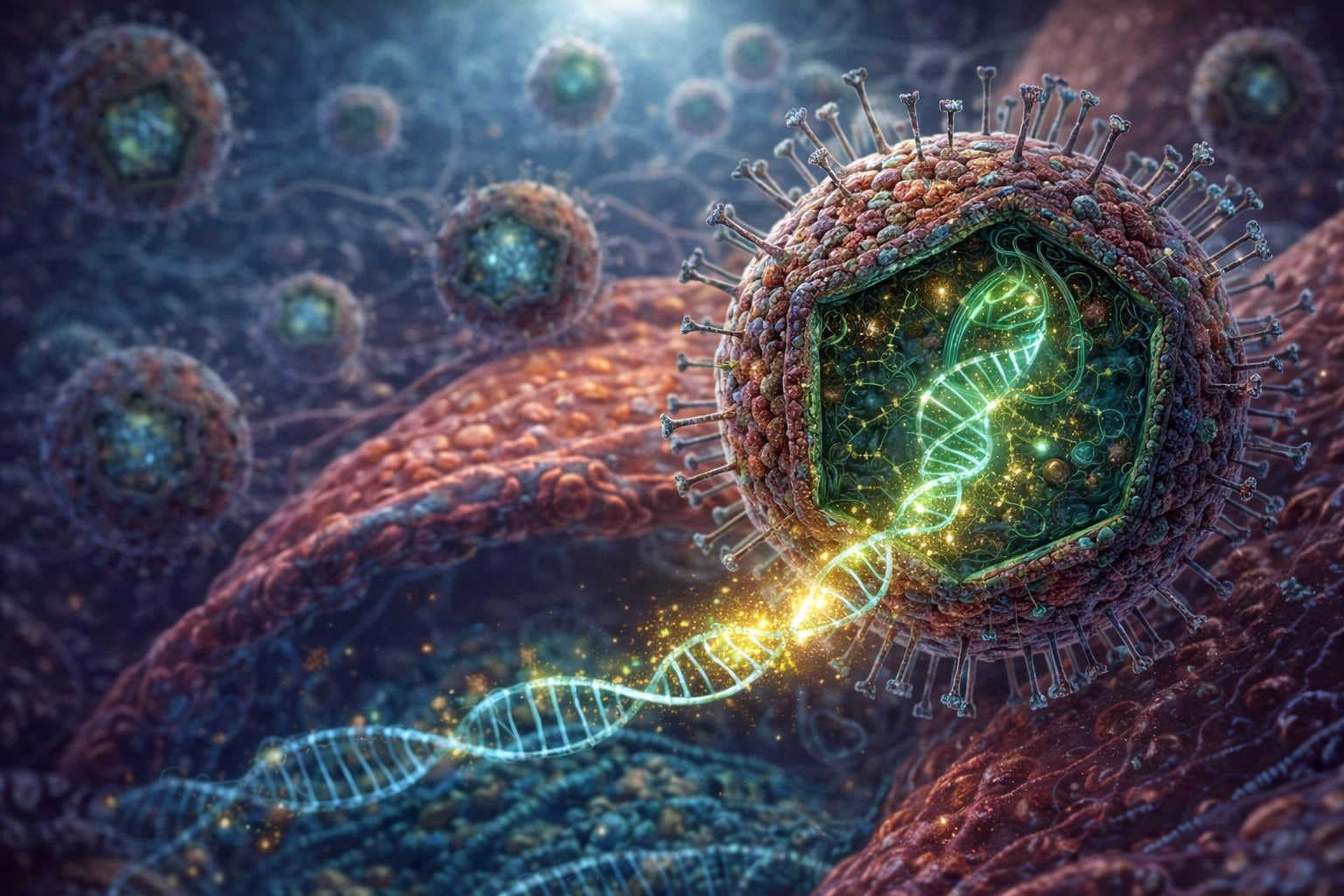
About 1.25 billion years ago, Retroviruses emerged by transforming "jumping genes" into infectious agents, mastering the ability to rewrite a host’s permanent genetic code.

Retroviruses (within Riboviria)

~1.25 Billion years ago (+/- 200 million)
Stitch themselves permanently into the host’s genome

By about 1.25 billion years ago, ancient retroelements related to the ancestors of retroviruses were already present as complex eukaryotes diversified. These mobile genetic elements used reverse transcriptase to copy RNA back into DNA and integrase to insert that DNA into a host genome. Reverse transcriptase is an enzyme that acts as a converter, rewriting viral RNA instructions into a compatible DNA format. Integrase is an enzyme that acts as a molecular weaver, splicing that newly made viral DNA directly into the host cell’s genetic code. Over evolutionary time, related lineages acquired and recombined additional genetic machinery, eventually giving rise to infectious retroviruses capable of moving from one cell or host to another.

This is evolution tinkering with what already exists. New biological abilities do not have to appear from scratch. Evolution copies, modifies, recombines, and repurposes existing parts. Retroviruses are an extraordinary example: old genetic machinery combined in new ways, producing something genuinely new while remaining rooted in what came before.

The same pattern helps us Think Well about ideas. Our new ideas form from impressions and existing ideas connected in new ways. Knowledge accumulates. We observe, remember, compare, recombine, and refine. Whether biological evolution or human thought, novelty has a history. New things emerge, but they emerge from what already exists.

— map / TST —

TST Tracker
✓ Reading recorded.
Michael Alan Prestwood
Author & Natural Philosopher
Prestwood writes on science-first philosophy, with particular attention to the convergence of disciplines. Drawing on his TST Framework, his work emphasizes rational inquiry grounded in empirical observation while engaging questions at the edges of established knowledge. With TouchstoneTruth positioned as a living touchstone, this work aims to contribute reliable, evolving analysis in an emerging AI era where the credibility of information is increasingly contested.
Email
Print
The Prestwood Column
Menu
September 2026
Column Research….
1. Timeline Story
Hume’s Is–Ought Problem
2. Linked Quote
“I meet with no proposition that is not connected with an ought, or an ought not.”
3. Science FAQ »
Can science prove flourishing should be our goal?
4. Philosophy FAQ »
What is the difference between a normative aim and a normative directive?
5. Critical Thinking FAQ »
Is flourishing for all just utilitarianism?
6. History FAQ!
What is the history of the idea of flourishing in philosophy?
Bonus Deep-Dive Article
TST Normative Ethics: Flourishing as a Philosophical Goal

Comments

Join the Conversation! Currently logged out.

Leave a Reply

NEW BOOK! NOW AVAILABLE!!

30 Philosophers: A New Look at Timeless Ideas

by Michael Alan Prestwood
The story of the history of our best ideas!
Scroll to Top