

The earliest known stone tools date back to at least 3.3 million years ago. They are identified by their purposeful flaking patterns, sharp edges, and location with other more identifiable artifacts or fossils. They are then verified with microscopic analysis confirming repetitive use.
STORY
Early Stone Tools
By Michael Alan Prestwood
Thu 8 Jul 2021
Published 5 years ago.
Updated 3 days ago.
Share :
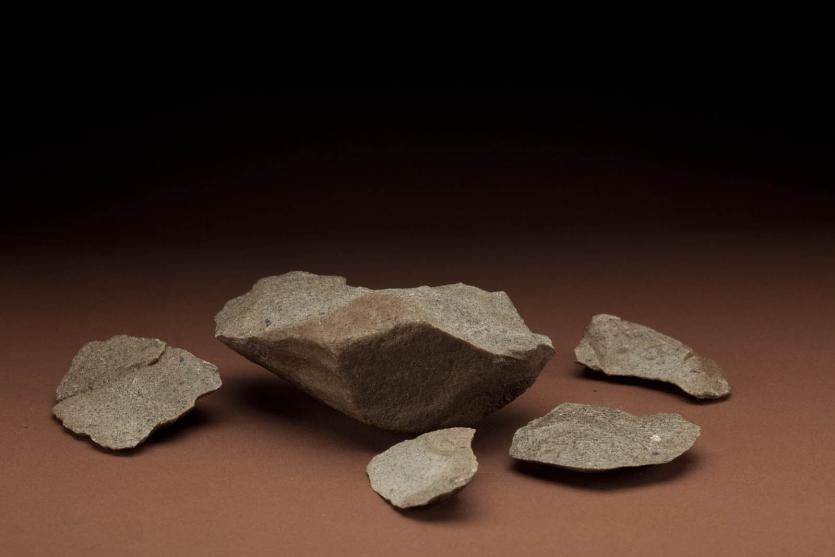
Early Stone Tools
3.3 Million BCE (Hominins)
Prefrontal Cortex Expansion, Internal 3D modeling
Possible Stone-Tool Progression:
By 3.4 mya: Hammerstones, no modification, used for pounding seeds, nuts, or breaking bones.
By 3.3 mya: Lomekwi stone tools. Stone cores, rock flakes removed to reshape, narrow, or sharpen.
By 2.6 mya: Oldowan tools; first definite tools. Stone flakes with sharp edges would used for cutting meat, scraping hides, chopping plants, and wood whittling.
By 2.4 mya: Refinement of Oldowan tools, with more controlled flaking and sharper edges.
By 1.76 mya: Acheulean hand axes, iconic tools with a distinctive teardrop or oval shape for chopping wood, butchering animals, digging, and scraping.
By 1.76 mya: Larger cutting tools such as cleavers for butchering large animals, or heavy-duty scrapers for processing hides or wood.
By 500,000 ya: Middle Paleolithic tools, including pointed hand axes, side scrapers, knife-like tools, and awls for piercing.
By 300,000 ya: Diverse materials such as bone and antler start surviving the test of time. Earliest evidence of composite tools using multiple materials combined to produce tools with specific functions.
By 200,000 ya: Hafted tools, where stone tips are attached to wooden handles, significantly enhancing their effectiveness and range of use.
— map / TST —

Michael Alan Prestwood
Author & Natural Philosopher
Author & Natural Philosopher
Prestwood writes on science-first philosophy, with particular attention to the convergence of disciplines. Drawing on his TST Framework, his work emphasizes rational inquiry grounded in empirical observation while engaging questions at the edges of established knowledge. With TouchstoneTruth positioned as a living touchstone, this work aims to contribute reliable, evolving analysis in an emerging AI era where the credibility of information is increasingly contested.
Email
Print
This Week @ TST
February 18, 2026
»Edition Archive
WWB Research….