
Explore Science-first Philosophy

STORY

Venus of Hohle Fels

By Michael Alan Prestwood

Mon 5 Jul 2021
Published 5 years ago.
Updated 2 years ago.
Related Stories
Share :
Ramessos, CC BY-SA 3.0 , via Wikimedia Commons
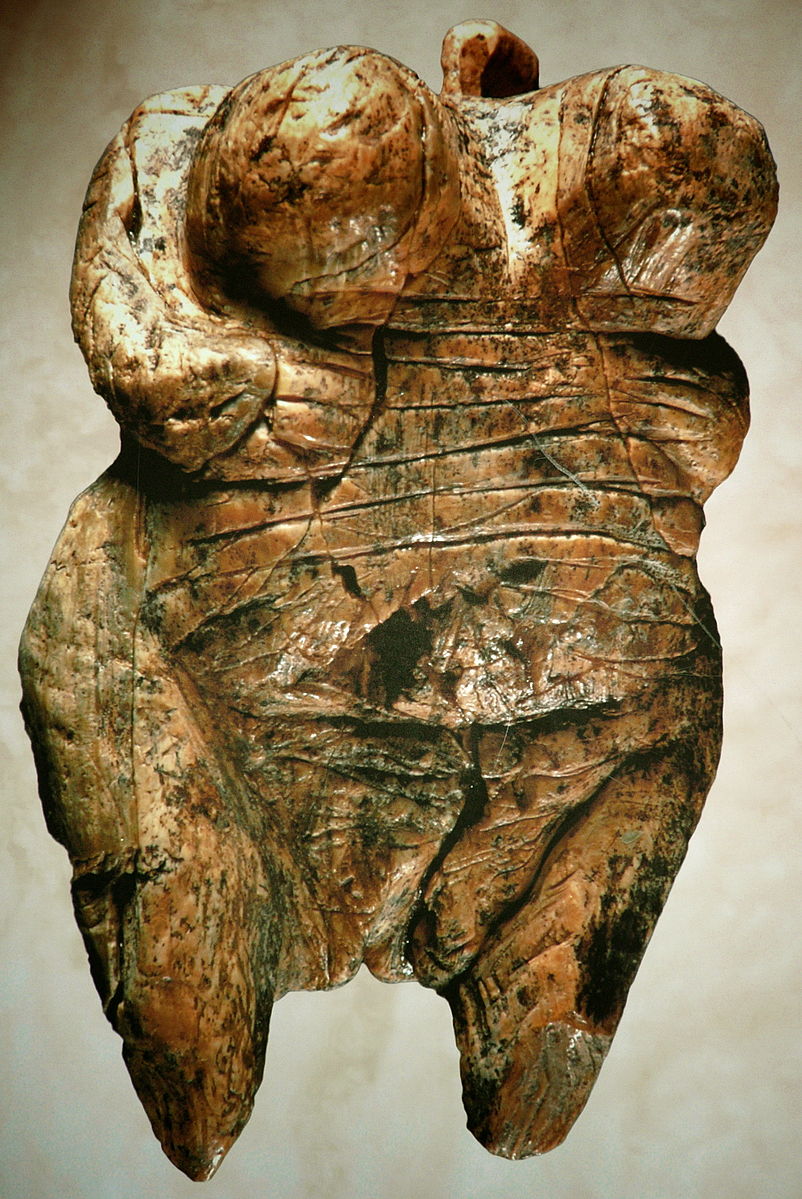
Venus of Hohle Fels figurine (height 6 cm (2.4 in)), which may have been worn as an amulet and is the earliest known, undisputed example of a depiction of a human being in prehistoric art.

Venus of Hohle Fels

38,000 BCE
38,000 to 33,000 BCE

The Venus of Hohle Fels is a 2.4″ figurine made of wooly mammoth ivory that was unearthed in 2008 in Hohle Fels, a cave near Schelklingen, Germany. It was pieced together from six pieces found in a cluster, about 10 feet below ground, and about 60 feet from the cave entrance. The left arm and shoulder are still missing. In place of a head, a carved ring protrudes indicating the sculpture was likely worn as a pendant. Using radiocarbon dating, the figurine is dated to between 38,000 and 33,000 BCE.
— map / TST —

Michael Alan Prestwood
Author & Natural Philosopher
Prestwood writes on science-first philosophy, with particular attention to the convergence of disciplines. Drawing on his TST Framework, his work emphasizes rational inquiry grounded in empirical observation while engaging questions at the edges of established knowledge. With TouchstoneTruth positioned as a living touchstone, this work aims to contribute reliable, evolving analysis in an emerging AI era where the credibility of information is increasingly contested.
Email
Print
This Week @ TST
April 1, 2026
»Column Archive
WWB Research….
1. Story of the Week
The Dawn of Empirical Spirituality
2. Quote of the Week
“It is wrong always, everywhere, and for anyone, to believe anything upon insufficient evidence.”
3. Science FAQ »
Is science tainted by bias?
4. Philosophy FAQ »
How do knowledge frameworks help transform information into wisdom?
5. Critical Thinking FAQ »
Are personal spiritual experiences believable?
6. History FAQ!
Did the Buddha believe in Mount Meru and the six realms of existence?
Bonus Deep-Dive Article
TST Theory of Justification: What to Believe
Scroll to Top