
Explore Science-first Philosophy

FAQ

Is Trump simply wrong when he says water destroys magnets?

Wed 1 Apr 2026
Published 10 hours ago.
Updated 4 months ago.
Related FAQs
Does time travel exist?
Can humans breathe the air of other planets?
Trivia: How many moons does the solar system have: less than or more than 200?
How many planets does our solar system have: 8, 9, or 12?
Is the Fermi Paradox still relevant?
Will the universe end in an ever-expanding cold isolated death?
Share :
Email
Print

Is Trump simply wrong when he says water destroys magnets?

Yes, he’s simply wrong.

Water has little effect on either permanent or temporary magnets. But let’s take a fair look and use this moment to explain how both types are created, and why water plays almost no role at all.

First off, temporary magnets. Take an iron nail. Stroke it with a strong magnet, and the magnetic domains inside, the tiny neighborhoods of aligned atoms, begin to rotate into the same direction. Once enough of these domains point the same way, the nail becomes a temporary magnet.

But this alignment is fragile. A temporary magnet can lose its magnetism through heat, physical shock, or a stronger, opposing magnetic field. Water, on the other hand, does nothing.

Even weak temporary magnets, like a magnetized iron nail, doesn’t lose magnetism just because it gets wet. If the nail rusts over time? That’s chemistry changing the metal’s structure, not water scrambling domains.

Secondly, permanent magnets are a bit of a different story. They are made from special materials, like neodymium or ceramic composites, that naturally resist having their domains scrambled. Manufacturers expose the material to a very strong magnetic field, align nearly all domains, and lock them in place by cooling or pressing the material so its atomic structure “freezes.”

And again, water has almost no effect. You can dunk a neodymium magnet in water all day. The only danger is corrosion or rust if the magnet isn’t coated. But the magnetism itself remains untouched.

If anything, these moments remind us that science is usually far simpler — and far more interesting — than the sound bites we hear. And it gives us a chance to revisit how magnets actually work, rather than letting myths pull us away from the truth.
— map / TST —

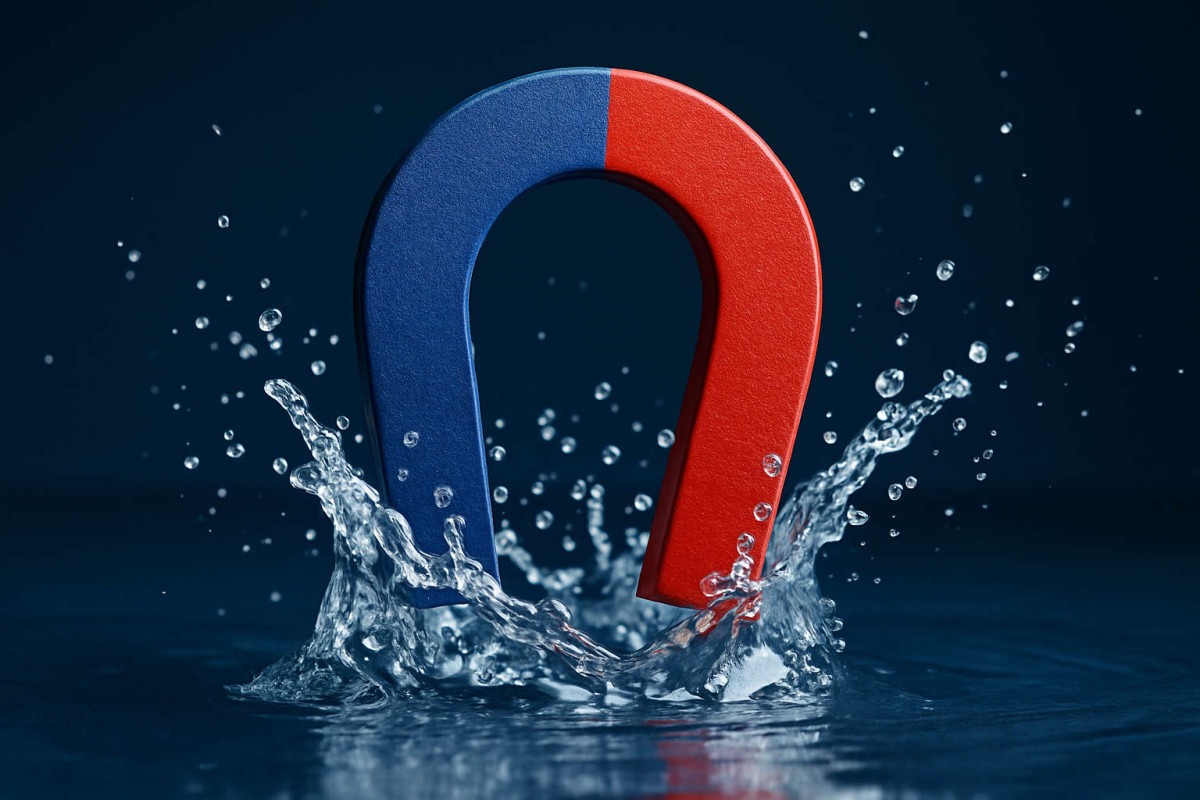
Magnets don’t fear water. They fear heat, shock, and powerful opposing fields. Temporary magnets forget easily; permanent magnets remember almost forever. But in both cases, water is just… water.
Michael Alan Prestwood
Author & Natural Philosopher
Prestwood writes on science-first philosophy, with particular attention to the convergence of disciplines. Drawing on his TST Framework, his work emphasizes rational inquiry grounded in empirical observation while engaging questions at the edges of established knowledge. With TouchstoneTruth positioned as a living touchstone, this work aims to contribute reliable, evolving analysis in an emerging AI era where the credibility of information is increasingly contested.
This Week @ TST
March 25, 2026
»Column Archive
WWB Research….
1. Story of the Week
Absolute Truth
2. Quote of the Week
“The Dao that can be told is not the eternal Dao; The name that can be named is not the eternal name.”
3. Science FAQ »
Why do scientific models work if they aren’t literally true?
4. Philosophy FAQ »
Does Agrippa’s Trilemma Disprove the Idea of Ideas?
5. Critical Thinking FAQ »
How do I know what is true and what is just an opinion?
6. History FAQ!
Is Philo’s interpretation related to the split in the Idea of Ideas?
Bonus Deep-Dive Article
TST Theory of Truth

Comments

Join the Conversation! Currently logged out.
NEW BOOK! NOW AVAILABLE!!

30 Philosophers: A New Look at Timeless Ideas

by Michael Alan Prestwood
The story of the history of our best ideas!
Scroll to Top