

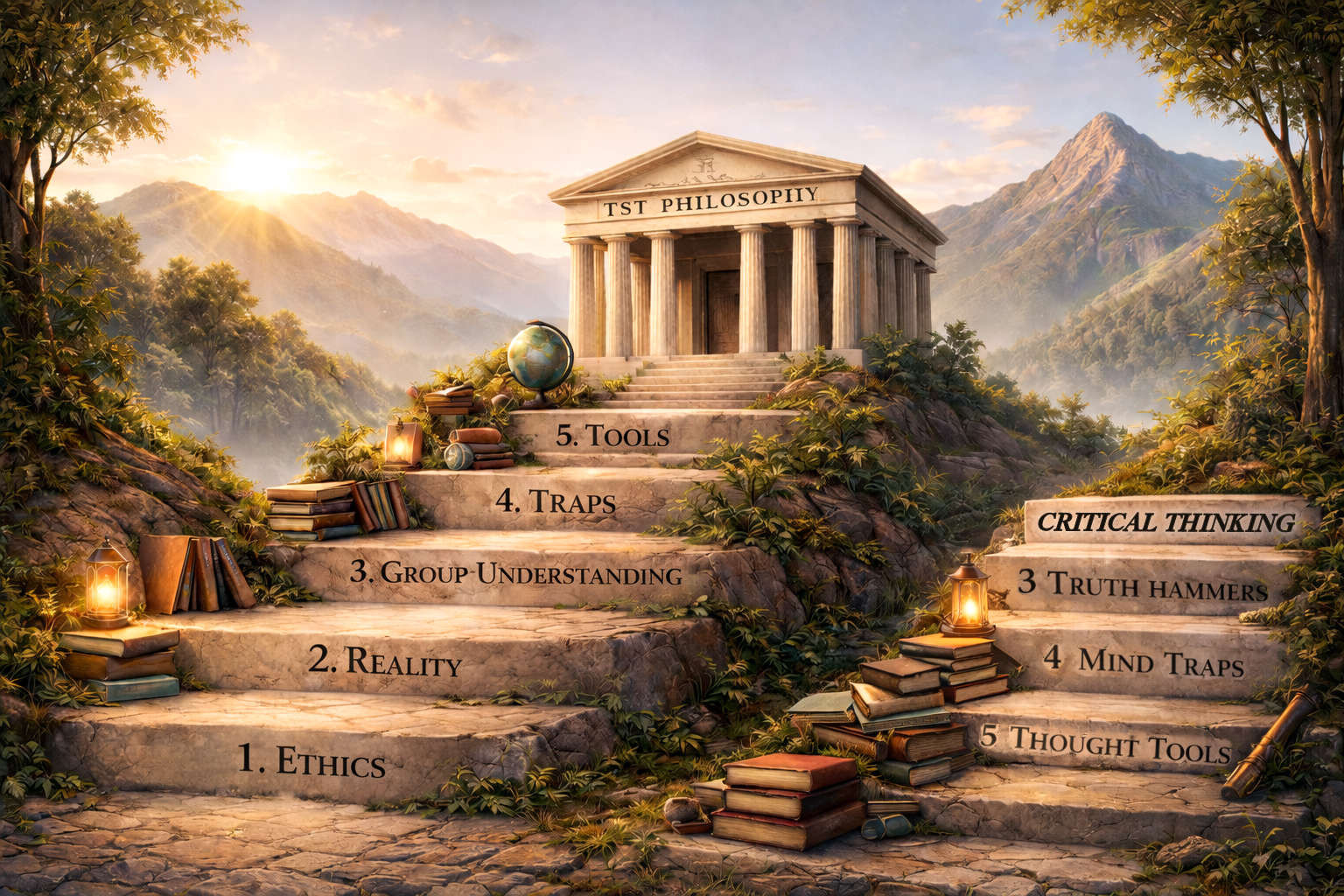
The Architecture of Philosophy: an introduction to TST.
Philosophy should help. It should focus one’s life. At its core, it asks a very simple question:
How should you live?
A focused answer to that question can guide your whole life—whether that focus is enjoyment, pleasure, happiness, virtue, or something else. That’s traditionally the beginning of philosophy, and it’s no different for TST Philosophy.
If you open the teachings of Buddhism, the starting point is suffering. Life includes suffering: aging, illness, loss, unmet desire, impermanence. Buddhism does not sugarcoat this. It begins by naming reality as it is experienced—unstable, fragile, often painful. From there, it asks how we can reduce unnecessary suffering: by loosening attachment, disciplining the mind, and seeing clearly.
It’s a sober beginning.
Many other philosophies do this too. In Epicureanism, the focus shifts to pleasure—and how to cultivate long-term satisfying pleasures over short-term feel-good ones. Stoicism focuses on virtue. Skepticism focuses on doubt.
In TST, the answer is simple. The goal of life is:
- Flourish.
Not merely reducing suffering.
Not merely maximizing pleasure.
Not merely perfecting virtue.
Flourishing—for all.
And yes, flourishing includes reducing suffering—because suffering is real.
Flourishing includes pleasure—because enjoyment is real.
It includes virtue—because character stabilizes growth.
But flourishing is larger than any one of them. For you to truly flourish, others must too. Flourishing includes your family, friends, community, and even nature itself.
It asks: What kind of life grows in coherence, resilience, contribution, and meaningful enjoyment within the constraints of reality?
From that single aim unfolds a layered structure:
- 1 goal.
- 2 layers.
- 3 hammers.
- 4 traps.
- 5 tools.
This is not decorative symmetry. It is architectural.
Let me walk you through it.
One Goal: Flourishing
Everything in TST points toward one thing: Flourish.
Now when people hear that word, they often think it means “be happy.” That’s too small. Flourishing is not constant pleasure. It’s not motivational positivity. It’s not moral perfection.
Flourishing means growing well within reality. It means your life becomes more coherent over time — less chaotic, less self-contradictory. It means you become more resilient — able to take hits without collapsing. It means you contribute — not just consume. And yes, it includes meaningful enjoyment. Life is not meant to be endured only. It is meant to be experienced.
But flourishing doesn’t deny impermanence. It accepts it. You can enjoy the journey while knowing it ends. That maturity is built into the definition. You cultivate character. You practice moderation. You strengthen the systems you’re part of — family, community, work, institutions.
That’s flourishing at the personal level.
But it doesn’t stop there.
Flourishing Scales
Flourishing is not just individual.
Individuals flourish.
Families flourish.
Civilizations flourish.
Ecosystems flourish.
Under the right conditions, complex systems increase in structured coherence. They stabilize. They refine. They become stronger and more adaptive. And we — reflective, self-aware organisms in a 13.8-billion-year unfolding universe — get to decide whether we align with that pattern or undermine it. That’s not poetic. That’s responsibility.
You are not just living inside systems. You are shaping them.
So the question becomes simple:
Is what I’m doing making this system stronger — or weaker?
That question applies to your marriage. Your business. Your politics. Your environment. Your habits. That’s ethics in TST.
Not Perfection — Refinement
Flourishing does not require perfection. Perfection is static, but flourishing is dynamic. It requires refinement. It requires updating behavior when awareness deepens.
If you learn that something you’re doing causes harm, flourishing requires adjustment. If you gain new information, flourishing requires recalibration. Growth is the point. And as awareness increases, responsibility increases. That’s an uncomfortable truth. But it’s honest.
Ethics as Calibration
In TST, ethics comes down to something very simple:
Live legal, moral, and fair.
That’s it. Not rule worship. Not emotional impulse. Calibration.
Legal matters because societies need order. Laws are imperfect, but they are structured attempts to reduce chaos. If you casually dismiss law, you weaken the systems that allow flourishing at scale. Personal morality matters because legality alone is not enough to guide you. History is full of legal systems that were not moral. So never outsource conscience. Fair matters because intent and outcome must be weighed together. Fairness regulates power. It balances self-interest with system stability. It balances your personal morals with the morals of those involved.
This is calibration. Yes, intent matters. Outcomes matter. Context matters. And, systemic impact matters. You weigh them together. You don’t ignore harm because your heart was in the right place. You don’t ignore intent because outcomes were positive.
You ask:
Is this strengthening the system? Or weakening it?
That question works at every level — personal, relational, institutional.
If flourishing is the north star, ethics is the steering mechanism. Flourishing tells you where you’re going. Ethics tells you when to adjust. Not perfection. Adjustment. Not dominance. Balance.
Simple in concept. Demanding in practice.
But clear. And clarity stabilizes life.
Two Layers: The Split
Every philosophy eventually has to address metaphysics.
What is ultimately real?
Beyond life on Earth, is there a Heaven? A Hell? Valhalla? Multiple universes? A simulation?
TST does something very deliberate here. You are free to hold your personal metaphysical beliefs. TST does not attempt to dismantle them. But the philosophy itself operates strictly within the material world and human experience.
If you personally hold only to the material world, TST calls that position Empiricist Pragmatic. If you maintain additional personal beliefs — such as a family religion — but still operate pragmatically within shared material reality, TST calls that Rational Pragmatic.
Why define this at all? Because we need a common ground to think together. Whatever ultimate reality may or may not include, we share this one. Whether this universe is the only one, one of many, or even a simulation, it is what it is. Gravity works. Consequences unfold. Bodies age. TST focuses there.
In philosophical language, we affirm a mind-independent material world. Gravity operates whether we believe in it or not. Ecosystems evolve whether we narrate them well or poorly. Consequences unfold independent of opinion. That’s the first layer.
But here’s where it gets important. What we experience is not raw reality. It is reality filtered through our senses and structured by our minds. We operate within a second layer — the human layer: language, perception, cultural narratives, symbol systems, models, and maps.
There are not two realities. There is one material world and two distinguishable layers of engagement:
- Material World: The world itself. Reality.
- Ideas: Our structured human thoughts, including interpretations of it.
That distinction changes everything.
Why the Split Matters
Recognizing the split is liberating. It prevents naïve realism:
“What I see is simply the world.”
No. What you see is your interpretation of the world.
And it prevents lazy relativism:
“All interpretations are equally valid.”
No. They’re not. Reality constrains outcomes. Some models align better than others. But — and this is crucial — our models are always incomplete. Always evolving. Often distorted.
Take a simple statement:
“That’s three oranges.”
Seems obvious. But what is actually happening?
There are three physical objects — oranges — existing independent of you. The number three is the count. “Oranges” is the category. Language organizes what you see. Your brain separates objects. Your culture teaches number systems.
The description is not the thing. The word “three” is not embedded in the oranges. The category “orange” is a human grouping. The sentence is a model. It’s a useful model. A highly reliable one. But still a model. And once you see that, humility enters.
You realize that all of your structured thoughts — from counting fruit to debating politics to forming religious belief — exist in this human layer.
They are maps. Maps can be accurate. Maps can be distorted. Maps can be incomplete. But they are never the territory.
Why This Is Foundational for TST
If you collapse the layers, two problems appear. First, you mistake your interpretation for reality. That breeds dogmatism. Second, you assume all interpretations are equally grounded. That breeds relativism. TST rejects both. There is a real world. And we interpret it. Alignment matters.
This is why TST can talk about flourishing without drifting into fantasy. Flourishing must operate within material constraints. You cannot flourish by ignoring gravity. You cannot flourish by denying cause and effect. You cannot flourish by pretending systems don’t have feedback loops. Reality pushes back. But within that reality, we build ideas. We build institutions. We build moral systems. We build sciences.
That human layer is powerful. It shapes civilization. Which means clarity about the split is not abstract metaphysics. It is practical.
If you want to live legal, moral, and fair…
If you want to calibrate ethics…
If you want to refine your models…
You must know the difference between what is and how you are describing it. That clarity stabilizes thought. And stable thought is the foundation for flourishing.
Three Truth Hammers
No one thinks alone. Civilizations build institutions to test claims at scale. TST identifies three major “truth systems” that function as structured reality-check mechanisms:
- Science.
- Law.
- Journalism.
Each addresses different domains of life. Science refines models of the natural world through observation, replication, and peer review. It does not promise certainty; it promises disciplined revision. Law adjudicates conflict and responsibility. It operates under evidence standards and procedural safeguards. It is imperfect — but it is structured. Journalism, at its best, investigates and reports public facts so citizens can act responsibly. It depends on verification, sourcing, and correction. These are not infallible. They are processes.
When functioning properly, they distribute the burden of investigation. They save time. They reduce error. They prevent every individual from reinventing the epistemological wheel. When they fail, societies wobble. Truth at scale requires structure.
Four Mind Traps
Even with institutions, we still carry biological baggage. Human cognition evolved for survival, not perfect objectivity. And so we inherit predictable distortions:
- Logical Fallacies.
- Cognitive Biases.
- Heuristics.
- Stereotypes.
These operate within the human layer — before reasoning is even complete. Fallacies distort argument structure. Biases tilt interpretation. Heuristics simplify at the cost of nuance. Stereotypes compress complexity into unfair shortcuts. Awareness doesn’t eliminate them. But awareness creates distance. And distance creates choice. If you can see the trap, you are less likely to fall into it.
Five Thought Tools
Now we get practical. If the Four Mind Traps are the warnings, the Five Thought Tools are the disciplines.
You don’t need to master philosophy to think clearly. You need orientation.
The Five Tools are:
- Open Viewpoint Method (OVM) — Managing perspective. Moving deliberately between belief, empiricism, and skepticism. It builds intellectual humility without collapsing into paralysis.
- Idea of Ideas — Clarifying what kind of claim you’re dealing with. Empirical? Rational? Irrational? Speculative? It prevents category mistakes.
- Reasoning — Deductive, inductive, abductive logic. Structuring inference instead of hand-waving.
- Social Constructs — Recognizing the frameworks humans create — language, money, timekeeping, ownership — so we don’t confuse structural agreements with material reality.
- Idea Evaluation — Testing and refining claims. Occam’s Razor. Socratic questioning. Comparative analysis. Not to destroy ideas — but to improve them.
These tools turn information into structured understanding. And over time, structured understanding into wisdom.
Two Entry Points
Some people enter philosophy through ethics: “How should we live?”
Others enter through critical thinking: “How do we know?”
TST accommodates both.
- The ethical path unfolds 1-2-3-4-5. On goal, flourishing that guides it all. Then metaphysical clarity. Then institutions. Then cognitive risks. Then skill.
- The analytical path tightens to 5-4-3: Though Tools, Mind Traps, and Truth Hammers.
Different doors. Same architecture.
What TST Ultimately Is
TST is not just epistemology. It’s not just ethics. It’s not just a critical thinking toolkit. It is a disciplined way of seeing and living. It encourages conscious participation in the ongoing reconfiguration of the world toward sustainable flourishing.
Its spirit can be summarized simply:
Enjoy the journey, with truth and honor, causing no harm.
That line is not naïve. Harm is unavoidable in embodied existence. Tradeoffs are real. Systems are complex. But destruction demands justification. Power demands restraint. Awareness demands calibration. Life is not a checklist. It is a process.
- To enjoy the journey is to pursue flourishing — not perfection — within reality’s constraints.
- To live with truth is to continually refine your models, testing them against the material world. Truth disciplines ego.
- To live with honor is to cultivate integrity — acting with character even when unseen.
- And “causing no harm” does not mean paralysis. It means striving to cause less harm when possible, weighing tradeoffs honestly, and preferring preservation over unnecessary destruction.
Not perfection. Not dominance. Alignment. And from alignment — flourishing.
Philosophy doesn’t have to be abstract fog. It can be architecture. It can be calibration. It can be a living framework that helps you navigate disagreement, uncertainty, responsibility, and growth. That’s what TST is meant to be. Not a doctrine. A disciplined way of thinking, seeing, and living — in a world that is real, layered, and worth tending.
And if we get that right — even imperfectly — we flourish.

