
Phil • Cr. Think • Science • Hist •
TST PRACTICE

The Philosophy Website

QUOTE

“Our knowledge is finite, while our ignorance is infinite.”
☐ Read
☑ Read
You’ve read this 0 times.
You’ve listened to this 0 times.
Related Quotes
Frameworks vary, but reality does not.
“We are dwarfs on the shoulders of giants.”
“The historian without his facts is rootless…the facts without their historian are…meaningless.”
“It is wrong always, everywhere, and for anyone, to believe anything upon insufficient evidence.”
“I know that I am wise, because I know that I know nothing.”
“Extraordinary claims require extraordinary evidence.”
Share :
Email
Print
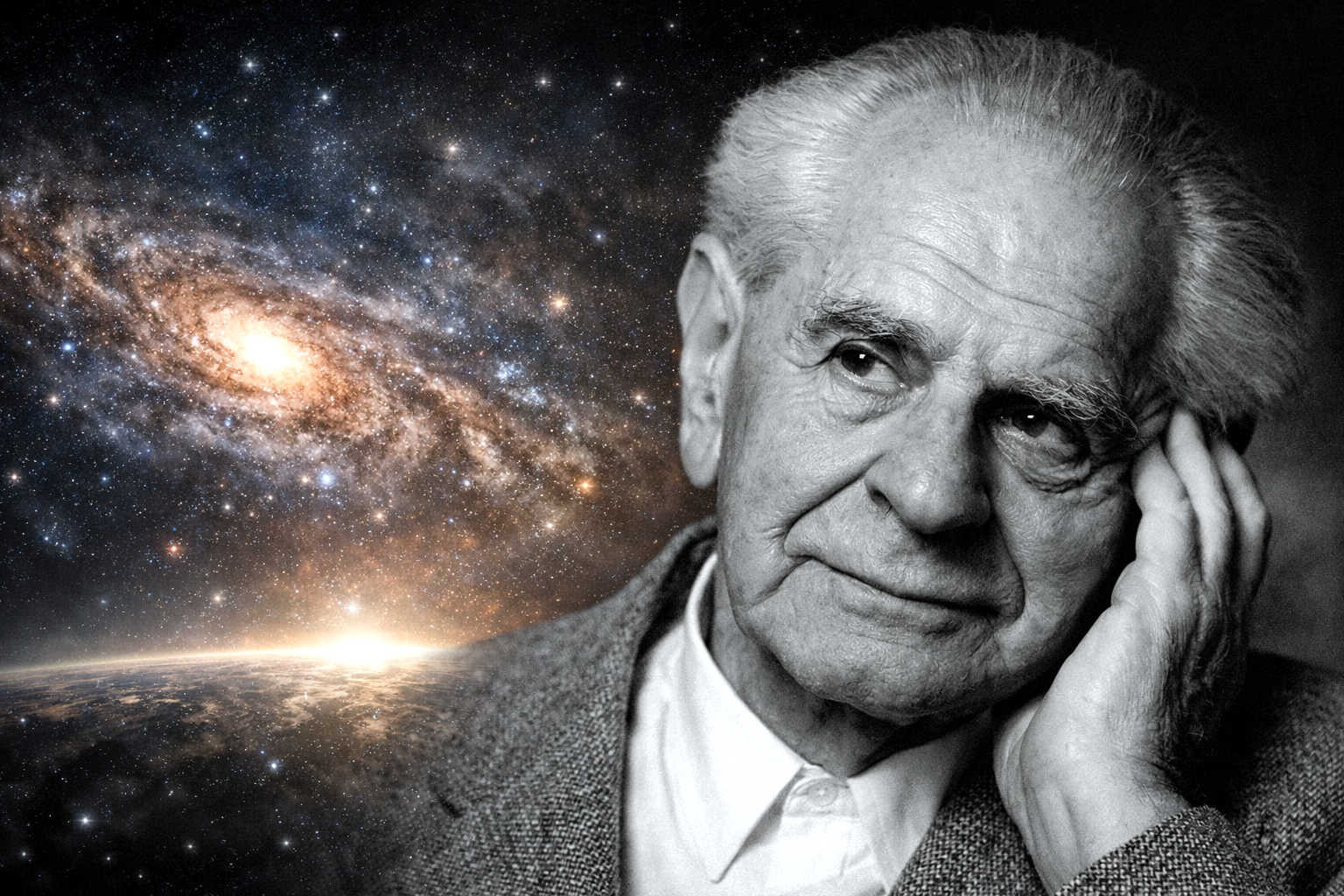
Karl Popper (1902–1994) was an Austrian-British philosopher of science best known for his principle of falsifiability—the idea that scientific theories must be testable and open to refutation.

Mike's Takeaway:

Karl Popper wrote something like this in his 1963 book Conjectures and Refutations. That line — a bit paraphrased — captures the heart of his philosophy. We learn. We refine. We improve our models. But the horizon of what we do not know never disappears. And that is not discouraging. It is clarifying.

Popper wasn’t attacking truth. He was attacking certainty. He was reminding us that knowledge grows through testing, correction, and revision — not through final declarations.

That insight sits right at the center of TST’s architecture. If our knowledge is always finite, then humility isn’t weakness. It’s rational. If ignorance is infinite, then calibration isn’t optional. It’s necessary. And that is why belief, in TST, is never binary. It is proportional. It earns confidence through alignment.

Analysis By Michael Alan Prestwood
03 Mar 2026
Published 6 months ago.
Updated 6 months ago.
TST Tracker
✓ Reading recorded.
Michael Alan Prestwood
Author & Natural Philosopher
Prestwood writes on science-first philosophy, with particular attention to the convergence of disciplines. Drawing on his TST Framework, his work emphasizes rational inquiry grounded in empirical observation while engaging questions at the edges of established knowledge. With TouchstoneTruth positioned as a living touchstone, this work aims to contribute reliable, evolving analysis in an emerging AI era where the credibility of information is increasingly contested.
The Prestwood Column
Menu
September 2026
Column Research….
1. Timeline Story
Hume’s Is–Ought Problem
2. Linked Quote
“I meet with no proposition that is not connected with an ought, or an ought not.”
3. Science FAQ »
Can science prove flourishing should be our goal?
4. Philosophy FAQ »
What is the difference between a normative aim and a normative directive?
5. Critical Thinking FAQ »
Is flourishing for all just utilitarianism?
6. History FAQ!
What is the history of the idea of flourishing in philosophy?
Bonus Deep-Dive Article
Flourishing for All: The Normative Aim of TST Philosophy

Comments

Join the Conversation! Currently logged out.

Leave a Reply

NEW BOOK! NOW AVAILABLE!!

30 Philosophers: A New Look at Timeless Ideas

by Michael Alan Prestwood
The story of the history of our best ideas!
Scroll to Top