

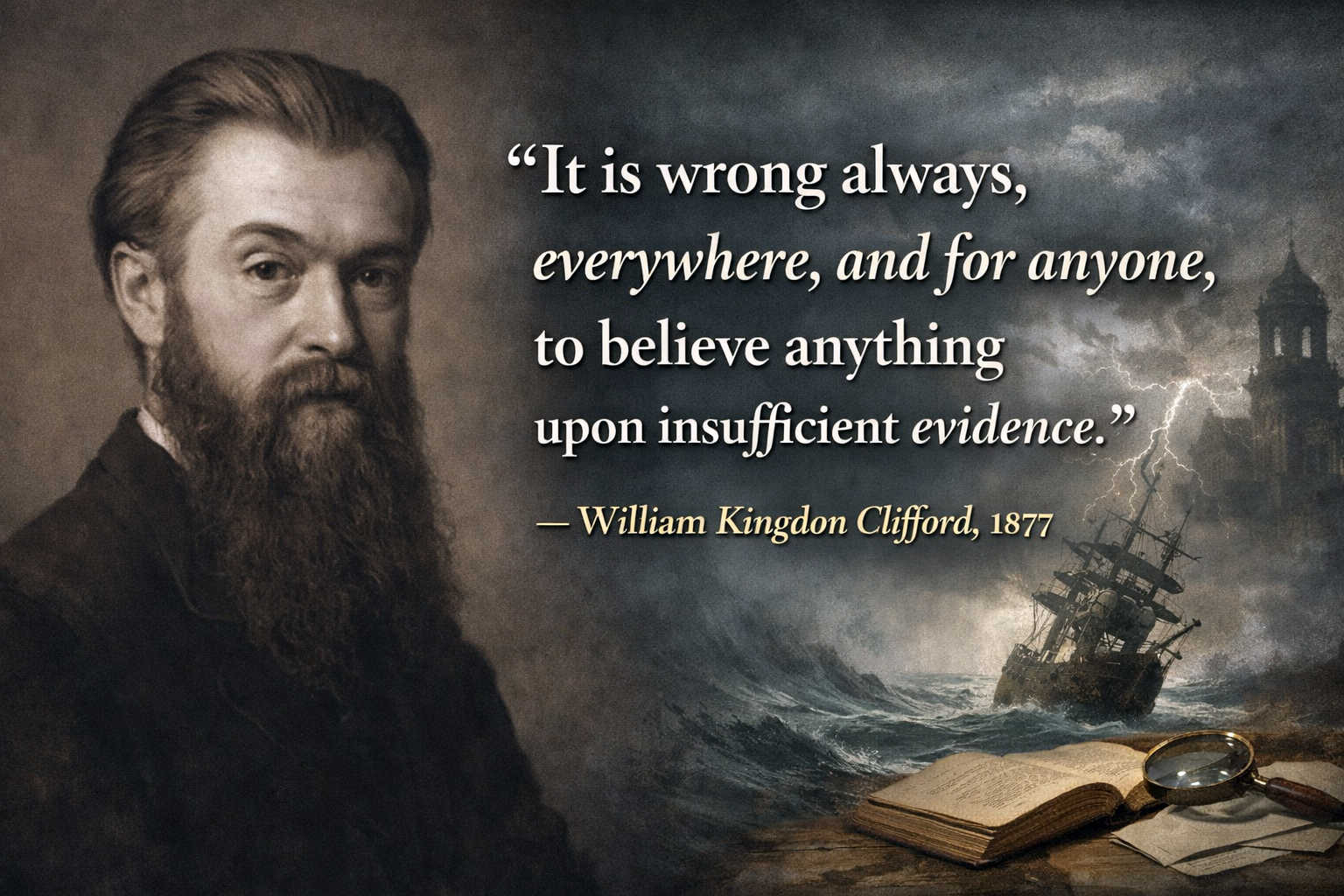
Clifford said this because he thought belief is not morally innocent. In The Ethics of Belief, he used the famous example of a shipowner who convinces himself his unsafe ship is fine without doing the hard work of checking it. Even if the ship had arrived safely, Clifford argued, the man would still have been wrong to believe as he did, because he had not earned that belief through honest investigation. That is why the quote lands so hard. Clifford was not merely telling us to prefer evidence. He was saying that careless belief is already a failure of character and judgment.
William Kingdon Clifford was a British mathematician and philosopher who lived from 1845 to 1879. He died young, at just 33, but left a lasting mark in both mathematics and philosophy. He worked on geometry and the nature of space, and Britannica notes that some of his ideas about matter and spatial curvature foreshadowed later themes in Einstein’s general relativity. So Clifford was not a minor scold wagging his finger at belief. He was a serious mind, cut short early, whose thinking reached across science, mathematics, and philosophy.
Clifford’s severity helped divide later discussion about belief, especially when William James answered him in 1896 with The Will to Believe. James thought Clifford’s rule was too strict. Clifford leaned toward avoiding error through disciplined restraint, while James argued that in some live, forced, and momentous choices, waiting for sufficient evidence can itself block access to truth. In that way, Clifford and James became one of philosophy’s enduring forks in the road, a bit like how Plato and Aristotle helped shape two broad tendencies in Western philosophy, or how Laozi and Confucius came to represent two powerful styles of thought in the East. The comparison is not exact, but the pattern is familiar: one side stresses discipline and restraint, the other leaves more room for practical life, commitment, and lived judgment.
TST agrees with the heart of Clifford’s warning, but not with all of its severity. Belief should never be careless. Evidence matters. Reason matters. Confidence should be ranked. But TST also leaves room for rational structure, degrees of confidence, and pragmatic humility toward stories of the unknown and unknowable. So Clifford fits TST as a stern ancestor, not a final authority. He reminds us that belief has consequences. TST adds that not all beliefs are held in the same way, and not all deserve the same confidence.

