
Explore Science-first Philosophy

Related Quotes
“The Dao that can be told is not the eternal Dao; The name that can be named is not the eternal name.”
“People are disturbed not by the things that happen, but by their opinions about the things that happen.”
“Do not speak arrogantly or do hateful things.”
Is the serenity prayer stoic? “Grant me the serenity…”
“The unexamined life is not worth living.”
“Reality is self-creating by definition… our impressions of it are what we use to build knowledge.”
Share :
Email
Print

Mike's Takeaway:

Current Reference: Used in chapter 11 of 30 Philosophers.

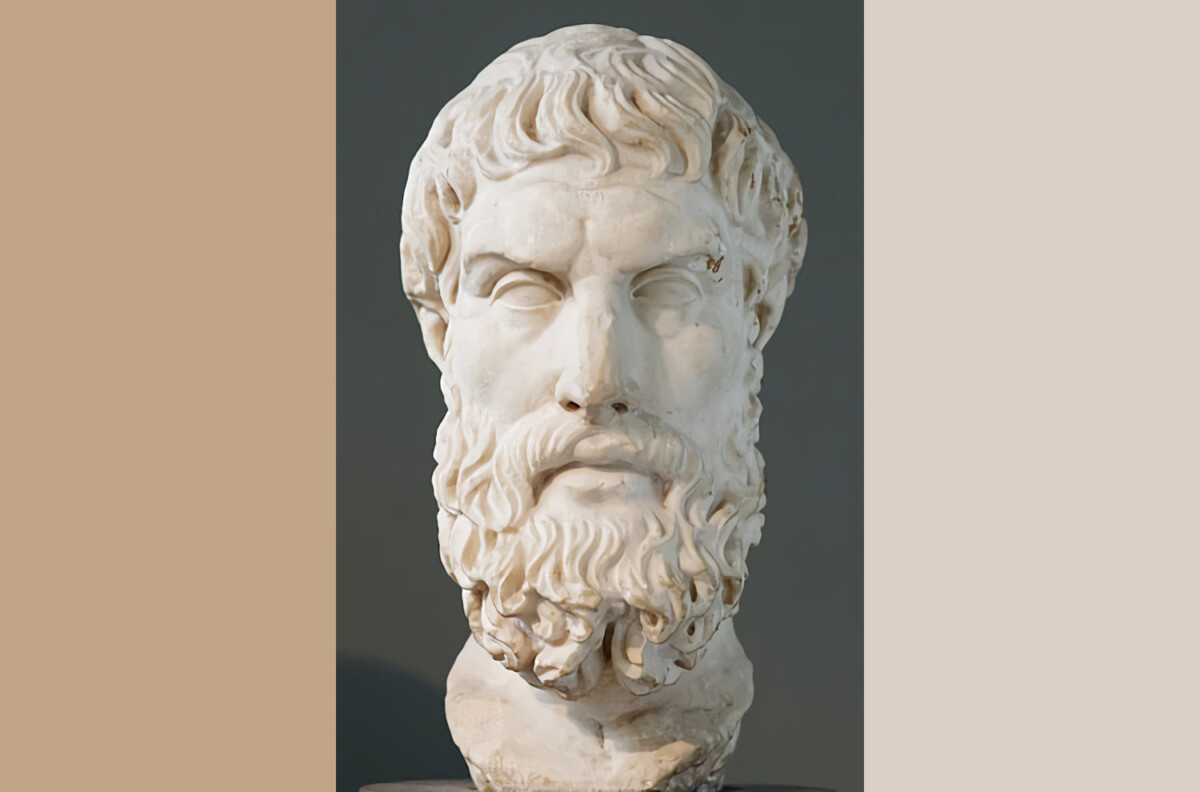
Sometime before 270 BCE, Epicurus had the following thought which marks the outline of everyone’s unique journey.

“I was not; I was; I am not; I do not mind.”

This thought is used in chapter 11 of “30 Philosophers” to explore epicurean thoughts on our fear of death. It reflects that death is either not relevant to us because we are alive, or it is not something we can experience because we are dead. Therefore, there is no reason to fear death or to be anxious about the possibility of not existing after death. This idea marks the outline of our sentient journey.

The following is sometimes labelled the “Epicurus Epitaph,” though no tombstone of his is known to have had this inscription. In a letter to Menoeceus about 300 BCE, translated from Greek, Epicurus wrote,

“Death does not concern us, because as long as we exist, death is not here. And when it does come, we no longer exist.”

It succinctly summarize his teachings on death. When the conversation gets around to someone expressing fear in not existing, I introduce this idea as a talking point in chapter 11. I don’t claim it’s for everyone, just a perspective worth contemplating which can help with the fear of death.
Analysis By Michael Alan Prestwood
12 Dec 2025
Published 1 year ago.
Updated 4 months ago.
Roman marble copy of a 3rd-century BCE Greek original, likely created before 1st century CE.
Michael Alan Prestwood
Author & Natural Philosopher
Prestwood writes on science-first philosophy, with particular attention to the convergence of disciplines. Drawing on his TST Framework, his work emphasizes rational inquiry grounded in empirical observation while engaging questions at the edges of established knowledge. With TouchstoneTruth positioned as a living touchstone, this work aims to contribute reliable, evolving analysis in an emerging AI era where the credibility of information is increasingly contested.
This Week @ TST
April 15, 2026
»Column Archive
WWB Research….
1. Story of the Week
John Snow and the Broad Street Pump
2. Quote of the Week
“A wise man proportions his belief to the evidence.”
3. Science FAQ »
Were dinosaurs Jurassic movie smart?
4. Philosophy FAQ »
How does the idea of Identity in Christ fit within TST?
5. Critical Thinking FAQ »
What is the difference between Public Truth and Public Belief?
6. History FAQ!
Did Einstein’s driver really give one of his early talks?
Bonus Deep-Dive Article
TST Epistemic Calibration: Credence and Degrees of Belief

Comments

Join the Conversation! Currently logged out.

Leave a Reply

NEW BOOK! NOW AVAILABLE!!

30 Philosophers: A New Look at Timeless Ideas

by Michael Alan Prestwood
The story of the history of our best ideas!
Scroll to Top