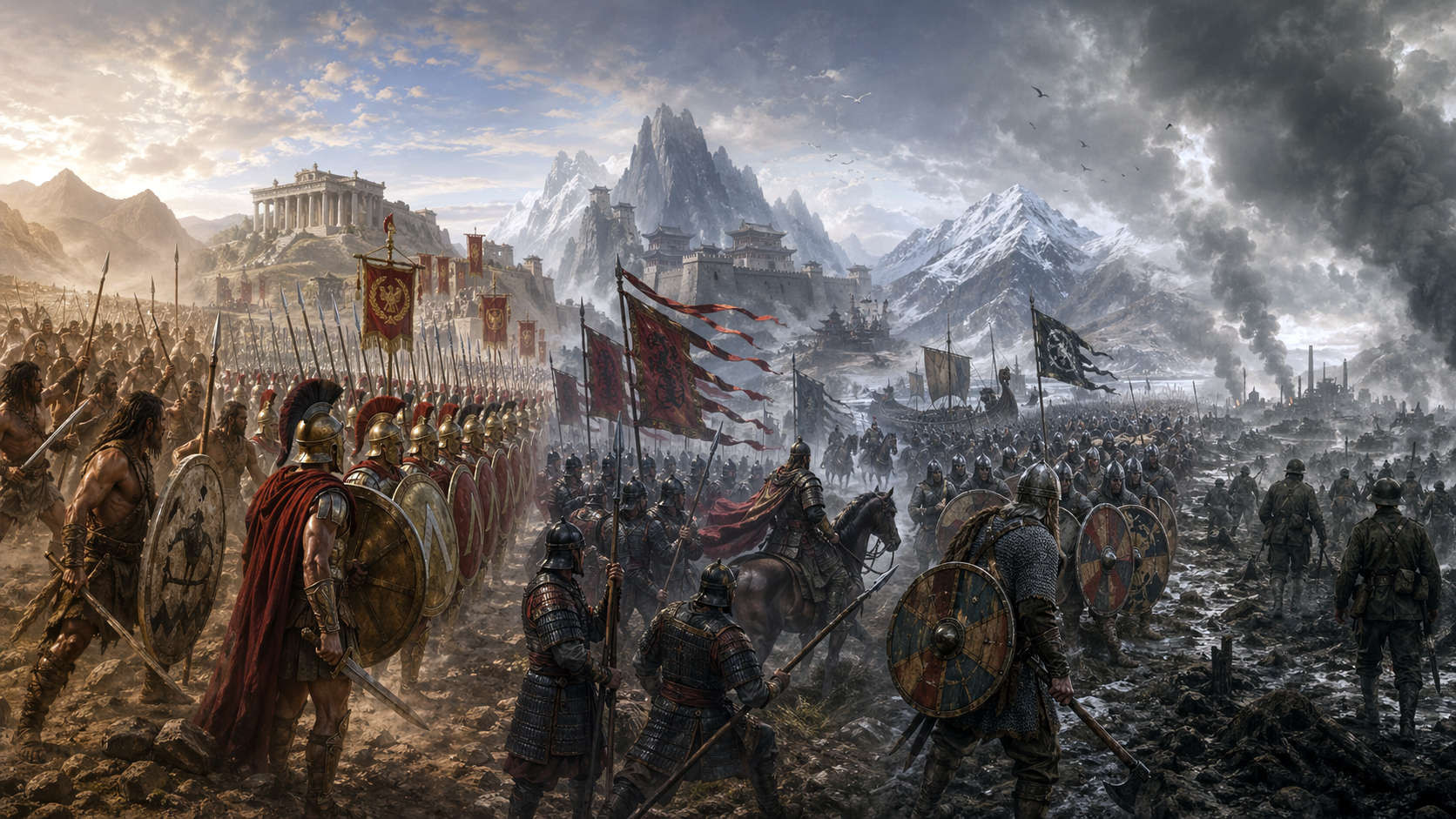
War ethics are almost as old as war itself. In the ancient world, people were already trying to separate acceptable violence from chaos. Among tribal societies, this often showed up as custom: feud rules, revenge limits, compensation, ritual declarations, or protections for kin and envoys. In the Greco-Roman world, the thinking became more explicit. Greeks debated honor, restraint, and what counted as a justified cause, while Romans developed ideas about lawful authority, formal declarations, and rules tied to civic duty and empire. Even then, the basic moral problem was already clear: if war happens, can it be limited?
In the East, China added a deeper layer of reflection. Thinkers like Confucius stressed order, duty, and humane conduct, while Sun Tzu treated war as something dangerous that should be handled with discipline, intelligence, and minimal waste. The ideal was not endless destruction, but swift success with the least disorder possible. Across parts of India, texts like the Mahabharata also wrestled with rules of battle, including concerns about timing, weapons, and conduct toward those no longer fighting. So in the East, just like in the West, war ethics grew from the same painful insight: conflict may be unavoidable at times, but cruelty does not have to be limitless.
Later, the medieval world sharpened these ideas. Augustine helped frame the idea that war might sometimes be tragic but morally necessary, and Aquinas gave clearer structure to what later became Just War Theory: proper authority, just cause, and right intent. Around the same broad era, Islamic legal and moral traditions also developed rules about proportionality, noncombatants, treaties, and restraint. Even Viking and Germanic societies, often remembered mainly for raiding, lived under honor cultures and legal traditions that tried to regulate violence through assemblies, compensation, oathkeeping, and limits on feud. The rules were uneven, often harsh, and not always followed, but the pattern is striking: again and again, societies tried to place moral fences around force.
That long history helped shape modern warfare today. The basic questions never disappeared: Who may start a war? For what reason? How far is too far? Over time, those old customs and philosophies fed into modern international law, military codes, and the laws of armed conflict. That is why countries today still talk about self-defense, proportional response, civilian immunity, prisoners of war, and war crimes. The language is more formal now, but the moral struggle is ancient. Ethical war has never meant good war. It has meant trying, however imperfectly, to stop war from becoming pure atrocity.