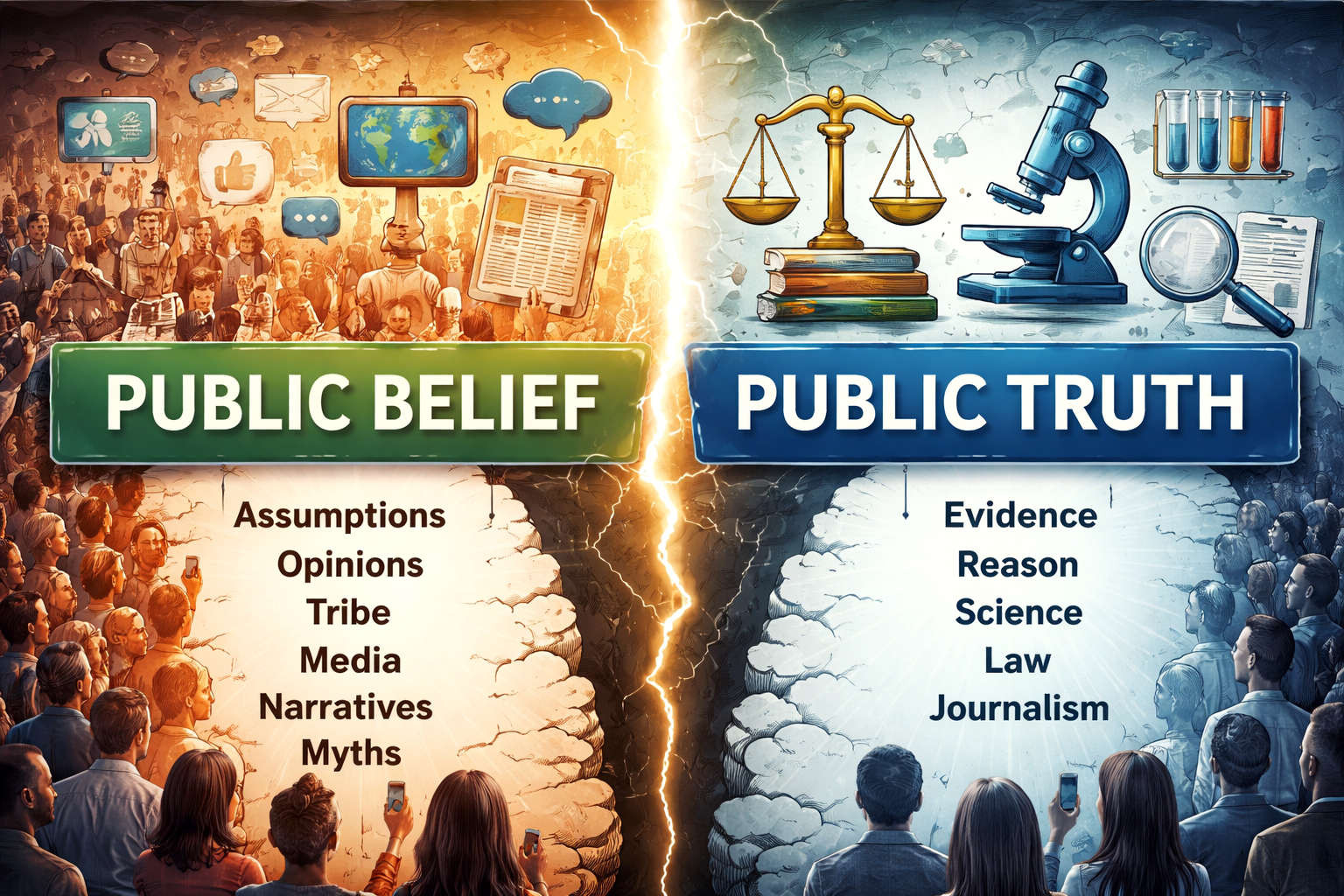
Public belief is what a society carries. Public truth is what earns the right to endure. The two overlap, but neither one is reality itself.
A culture can widely believe something and still be wrong. It can also resist a truth for centuries before finally admitting it.
In science-first philosophy, that difference matters because truth and belief are not the same kind of thing. Truth belongs to reality. Belief belongs to the minds trying to track reality.
Public belief is the larger pool of shared claims, assumptions, and accepted ideas moving through a society. It includes what we hear in conversation, repeat through media, and inherit from the people around us. That is one of civilization’s great strengths, because none of us can rebuild society’s knowledge from scratch. But public belief is always mixed. It carries some of our best common knowledge, but also half-truths, prestige opinions, and inherited myths. Public belief is necessary and powerful, but it is never the final court of truth.
Public truth is the set of claims that pass open testing. Public truth systems are society’s disciplined methods for openly testing them. In TST, the “Truth Hammers” identify three major public truth systems: science, law, and journalism. Science tests empirical claims. Law tests and settles disputed claims. Journalism tests societal claims in public view. None are perfect, but together they separate what merely circulates from what earns the right to stand.
Public belief can be popular, identity-shaping, and deeply meaningful, yet still fail as public truth. That is part of the discipline of public truth systems: respect the person, but do not lower the truth standard.